
ISS On-Orbit Status 5 Oct 2002
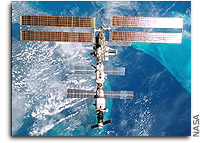 All ISS systems continue to function nominally, except as noted previously or below.
The crew had their regular Saturday rest day, with a minimum of necessary tasks.
After breakfast at 4:40am EDT, Valery Korzun, Peggy Whitson and Sergei Treschev started off by completing the weekly 3-hr. housecleaning, which focuses on removal of food waste products, thorough cleaning of compartments with vacuum cleaner, and wet cleaning of surfaces.
During the cleanup, Korzun did the daily status inspection of the Russian Plants-2 (BIO-5 Rasteniya-2) payload.
The daily routine maintenance of the SOSh life support system was performed by FE-2 Treschev, while Whitson and Korzun did the Lab payload status checkup.
Valery Korzun also removed and replaced the CO2 absorber unit (filter) in the IK0501 gas analyzer (GA) in the SM. While the GA was deactivated, Valery cleaned the intake nozzle of the GA with the vacuum cleaner. [The GA had been faulty in February this year, requiring daily checks by Mikhail Tyurin and Yuri Onufrienko. The device analyzes the air flow pumped through it for humidity (H2O), oxygen (O2), carbon dioxide (CO2) and hydrogen (H2), and converts its measurements into partial pressure values going to a monitoring laptop and, if they exceed limit values, to the SM‚s caution and warning panel (PSS).]
The crew performed their daily physical exercise program on TVIS, RED, CEVIS and VELO with load trainer. While over Russian ground sites, the two cosmonauts held a tagup with a physical training specialist.
The troubleshooting procedure for the balky RED (resistive exercise device) canister was uplinked, and the crew performed the IFM (in-flight maintenance) today. [As replicated on the ground, the slow retraction of the Flexpack canister cable was caused by a misalignment of internal components after the crew had opened the canister to reposition the cord when it produced a clicking noise. The IFM procedure consisted of loosening screws and fasteners to allow the internal components to move back into their nominal position. The ground will now evaluate the outcome of the IFM and decide by Monday which, if any, RED canisters are to be returned on 9A. Meanwhile, the crew continues using the older cans.]
Korzun and Treschev conducted a new experiment that was placed on the Russian task list for today, tomorrow and Monday. It is the LSO experiment of the Belgian science program “Odissea” for 5S, originally part of the French “Andromeda” program, which could not be performed as planned during Increment 4 due to an ISS flight attitude conflict. The experiment, which has similar objectives as the Russian Molniya-SM experiment, uses SM windows #2 and #3 today and tomorrow. It will be dismantled on 10/7. [The objective of LSO is to study rare optical phenomena occurring in the upper layers of Earth atmosphere (sprites, i.e., aglow observed above the thunderstorm clouds). This is]
Another Russian task list item concerns the search for four unknown items in the IMS (inventory management system) database. [Unidentified items can result when the scanner of the barcode reader does not register the barcode correctly. This happened in February this year, and the crew was requested to look for the items in IMS-listed locations.]
Also on the task list are Uragan earth observations of drifting icebergs, performed by CDR Korzun today in the Southern Ocean (Drake Strait to Sandwich Islands). Valery used the Nikon D1 electronic still camera on two overflights and later downlinked the images via Regul-Paket.
Science Update (Expedition Five — 16th):
Lead Increment Scientist Vic Cooley to crew: “Thank you for your attention this week to PuFF, Interactions, CEO, SAMS, MAMS, and the back-to-back PFMI runs. We will do another pair of PFMI runs starting Sunday. Although we were a bit anxious [during the hurricane Lili contingency] about having to power down most payloads and leaving ER-4 in a minimal power-draw configuration, it turns out that the MCC-H evacuation and consequent five-day delay of 9A is a blessing for ADVASC. The ADVASC PI determined from the latest photos that the seeds were not quite dry enough and needed more drying time. A slip was just what those soybeans need to be good and dry for the ride home.”
Extra-Vehicular Activity Radiation Monitors (EVARM): Upcoming EVARM sessions are tied to the EVA schedule. Badge readings are planned on each of the two days before the first EVA, the day between each EVA, and the day after the last EVA.
GASMAP/Pulmonary Function in Flight (PuFF): The PuFF team sent thanks for “another great session”.
Renal (Kidney) Stone Experiment: Final session is planned for mid-October.
Interactions (NTXN): Continuing.
Human Research Facility/Workstation (HRF WS): n/a
Commercial Refrigerator Incubator Module-Commercial Stelsys (STELSYS): Experiment is complete.
Microencapsulation Electrostatic Processing (MEPS): Complete. To be returned on 9A.
Advanced Astroculture (ADVASC): Peggy completed the final ADVASC plant confirmation photos on 9/30. The payload is still drying out the plants and is running nominally.
Solidification Using a Baffle in Sealed Ampoules (SUBSA): SUBSA operations have been completed with eight successful samples runs.
Pore Formation and Mobility Investigation (PFMI): Two samples were successfully completed this week. Both of them had a small amount (less than 1%) of water mixed in with the succinonitrile. Because of the „alloy‰ mixture, dendrites grew as the samples were processed. Several different growth velocities were used and the spacing between dendrites were observed to become narrower at higher velocities. Plans are to process two more samples this next week, on 10/6 and 10/7.
Space Acceleration Measurement System (SAMS): SAMS SE 121f08 in the MSG (microgravity science glovebox) was activated again to support PFMI. Anticipate capturing 9A docking.
Microgravity Acceleration Measurement System (MAMS): MAMS is active and continuing measurement of microgravity environment in the quasi-steady regime for general characterization.
Active Rack Isolation System (ARIS) Support: Peggy Whitson was thanked for taking the time in working the cable re-routing (to clear up any interference). Some range-of-motion testing was performed to see if the laptop cable configuration cleared its movement. The crew will be advised of how it looks.
Protein Crystal Growth-Single Locker Thermal Enclosure System (PCG-STES): Temperatures are stable. Deactivation of remaining cylinders on 10/9.
Materials ISS Experiment (MISSE): In progress. Deployed outside. Nominal and collecting data.
Educational Payload Operations (EPO-5): Completed.
EarthKAM: Planned. Will be performed during Stage 9A.
Zeolite Crystal Growth (ZCG): ARIS preparations to support ZCG during 9A are continuing. Activation of new ZCG samples will most likely begin during the 9A joint ops period.
ARCTIC Refrigerator/Freezer 1 (ARCTIC-1): Nominal operation providing a ~-20ºC cold volume temperature in support of Stelsys. Desiccant bag changeout planned upon Stelsys sample removal.
ARCTIC Refrigerator/Freezer 2 (ARCTIC-2): Still experiencing diminished cooling water flow, but unit is maintaining the desired cold volume temperature of ~+4ºC for ZCG. Troubleshooting of flow is planned for the period between 9A and 11A when no science samples will be in either Arctic. Have confirmed that ground commanding is now enabled as a result of the new 9A ER software configuration. Desiccant bag changeout planned upon ZCG sample removal.
Commercial Generic Bioprocessing Apparatus (CGBA): Will be performed during Stage 9A.
Plant Generic Bioprocessing Apparatus (PGBA): Will be performed during Stage 9A.
Crew Earth Observations (CEO): Current crew photography and ISS 04 reviewed film (being readied for ISS 4 debriefs) showed that 400 mm lens are excellent for Ice Cap photos, for tropical volcanoes, and for planetary analogs (desert land forms). Also smog plumes blowing off third world cities is a new feature the ISS photography really revels well. The crew was thanked for the huge imagery download over the last two weeks. Lighting and your daylight awake periods are revealing many new Asian sights.
Today’s targets for CEO were Eastern Mediterranean Aerosol (high pressure setting in. Crew was to look left and right of track for any aerosol loadings. Expedition 4 photography has recently shown two interesting and possibly unusual results–that aerosol, probably smog, seems to enter the E Mediterranean from the Turkish plateau, funneling down valleys to the Med basin. Dust plumes are also shown starting in the Jordan valley and blowing out to sea), Buenos Aires, Argentina (nadir pass; ESC [electronic still camera] requested), Sao Paulo, Brazil (nadir pass; ESC), Recife, Brazil (nadir pass; ESC), Dakar, Senegal (slightly right; ESC), Chao Iava Landslide, Chile (detailed views of steep Pacific-facing slopes where landslides are a real hazard. Crew was to try a mapping pass looking a touch right of nadir), Lower Amazon River Basin (the crew’s detailed views of the estuary shorelines are generating a locally unique geological dataset of river-bank change in this vast river), Bogota, Colombia (nadir pass; ESC. Clouds on neighboring ranges, but city should be visible), Caracas, Venezuela (nadir pass; ESC), Tuamotu-Austral Islands (detailed images requested, looking left and right of track up and down this string of islands), and Tuamotu Archipelago (detailed images requested, looking left and right of track up and down this string of islands).
ISS Orbit (as of this afternoon, 3:00pm EDT [= epoch]):
- Mean altitude — 384.6 km
- Apogee — 396.2 km
- Perigee — 373.1 km
- Period — 92.2 min.
- Inclination (to Equator) — 51.64 deg
- Eccentricity — 0.0017116
- Orbits per 24-hr. day — 15.61
- Solar Beta Angle — 19.7 deg (magnitude decreasing)
- Altitude decrease — 250 m (mean) in last 24 hours
- Revolutions since FGB/Zarya launch (Nov. ’98) — 22128
- Current Flight Attitude — LVLH (local vertical/local horizontal = “earth-fixed”: z-axis in local vertical, x-axis in velocity vector [yaw: -10 deg, pitch: -7.8 deg, roll: 0 deg]).with CMG/Thruster Assist Momentum Management).
For more on ISS orbit and worldwide naked-eye visibility dates/times, see
http://www.hq.nasa.gov/osf/station/viewing/issvis.html



