
ISS On-Orbit Status 29 Mar 2003
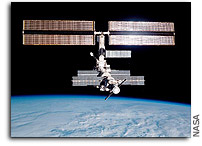
All ISS systems continue to function nominally, except as noted previously or below. State of the station is fine. “We’ve come a long way to achieve that kind of state, don’t you think?” (Flight Control to crew).
It’s another Saturday with crew rest and a minimum of regular necessary tasks (although the day isn’t quite over yet).
As every week around this time, the crew completed the 3-hr. “uborka stantsii” (housekeeping), going over all exposed surfaces of “mezhdunarodnaya kosmicheskaya stantsiya (MKS)” (international space station) with vacuum cleaner, wet wipes and disinfectants.
FE-1 Nikolai Budarin performed his regular daily inspection of the BIO-5 Rasteniya-2/Lada-2 (“Plants-2”) experiment which researches growth and development of plants under spaceflight conditions. [The experimental seeds of acacia-leaf type pea are planted between wicks in a root tray, with environmental control powered on. Regular daily maintenance of the experiment involves monitoring of seedling growth, humidity measurements, moistening of the substrate if necessary, and photo/video recording.]
At 10:30am EST, Science Officer Dr. Don Pettit talked with students at Utah State University who, under the guidance of Prof. Jan Sojka of the Center for Atmosphere and Space Sciences, were excited by “Dr. Scary Science” and his by-now regular Saturday Morning Science demos (having made it to the “job jar” task list). [The Q&A session mostly turned on amazing physical phenomena in zero-G such as thin-film water demonstration and related demos on ISS. A list of 24 questions from various science disciplines had been culled and uplinked beforehand (e.g.,: “Can you create rainbows with water droplets?”, “Would penicillin grow in space and still work as an antibiotic?”, and “How easy it is to make a Piña Colada using a conventional mixer?”). Dr. Pettit’s most excellent demo videos can be found at the website http://spaceflight.nasa.gov/gallery/video/station/expedition6/ndxpage1.html ]
Nikolai completed the daily routine maintenance of the SM’s SOZh life support system (including ASU toilet facilities), and Don readied the IMS inventory system for the daily automated export/import of updates.
The crew was complimented on their “nice job” with the fire drill OBT (on-board training) yesterday which was judged constructive both for the crew and the ground teams.
Photo/TV specialists on the ground detected that one of the onboard Kodak 760 DCS (digital camera system) has a wrong firmware version, viz., vers. 1.3.6 instead of 2.1.6. The correct code is on board, and the crew was ask to perform the upgrade, which should take 15 min.
A flight note was uplinked with changes to the crew’s EVA procedures resulting from switching from the standard 4-hr. in-suit prebreathe back to the much shorter exercise prebreathe protocol, now that the failed CEVIS (cycle ergometer with vibration isolation) control panel workaround has been approved. The EVA by Sox and Don is still scheduled for 4/8.
As every day, line-of-sight passes over Russian ground sites (RGS) during appropriate Daily Orbits (today 15, 3, 7 and 9) were used for routine communications exchanges: downlinks of Russian contingency telemetry (RCT), uplinks of daily flight programs, prop limits and state vector (position & velocity), and the daily onboard smoke detector (SD) test. The data dumps are stored at the RGS for transmittal to Moscow, and any real-time involvement by MCC-Moscow depends on the very limited link provided by Molniya satellite coverage, besides regular overland hard lines. [“Molniya satellite” not to be confused with the on-board Russian geophysical “Molniya-SM” experiment VFS-3M (for which troubleshooting is planned for next Monday, 3/31).]
Flight attitude mode continues to be XPOP (x-axis perpendicular to orbit plane) momentum management, until 4/3 when MCC-M conducts the periodic SM/FGB solar array efficiency test for which 4/3 apparently offers rare optimum conditions of near-zero Beta angle and XPOP (ref. Status report 3/11). Last conducted: 11/6/02.
The crew held their regular periodic teleconference with the ISS Program Office via S-band.
Preparations are underway for ISS crew greetings to the upcoming Russian Cosmonautics Day on 4/12. Celebrations involve “Yuri’s Night”, observed worldwide in commemoration of the first human space flight in 1961, and also the anniversary of Shuttle Columbia’s maiden flight on April 12, 1981 with John Young and Bob Crippen.
Science Update (Expedition Six — 17th):
Another exciting week of payload activities on ISS is past. It included completion of another EVARM badge reading as well as a FOOT session. The video and commentary provided by the crew for the InSPACE coil monitor was excellent. The crew completed the MSG troubleshooting, and now MSG is in a nominal configuration to begin InSPACE operations on Monday. EXPRESS Rack 2 ARIS tests were completed this week and the data is being examined.
Extra-Vehicular Activity Radiation Monitors (EVARM): Next EVARM session is scheduled for 3/31 (Monday).
GASMAP/Pulmonary Function in Flight (PuFF): PuFF team is looking forward to the pre-EVA/monthly session on 4/4 (Friday).
Renal (Kidney) Stone Experiment: Completed for Increment 6. Bowersox and Pettit continue taking their stone-prevention (or placebo) pills. Final session is planned for in Week 20.
Human Research Facility/Workstation (HRF WS): Continuing.
Foot/Ground Reaction Forces During Space Flight (FOOT): FOOT team has received data from this week’s session and is analyzing it to determine whether there will be any changes for next week’s session. Thanks went up to Bowersox for videotaping both the signal check display anomalies on the PC screen and the hardware interactions while using RED and TVIS. These videos help to improve FOOT hardware and software during future increments.
Pore Formation and Mobility Investigation (PFMI): The ground appreciated all the hard work that went into removing the hardware from MSG and stowing it in the correct locations.
Space Acceleration Measurement System (SAMS): SAMS is nominal and currently supporting a test to compare drag profiles for different solar array orientations. Preparing for operations during upcoming EVA with possible hammer application to CETA light stanchion.
Microgravity Acceleration Measurement System (MAMS): MAMS is nominal and currently supporting a test to compare drag profiles for different solar array orientations. Preparing for operations during upcoming EVA with possible hammer application to CETA light stanchion.
Protein Crystal Growth-Single Locker Thermal Enclosure System (PCG-STES): Temperatures are nominal. Crystals are still growing.
Investigating the Structure of Paramagnetic Aggregates from Colloidal Emulsions (InSPACE): InSPACE has been setup in MSG and is ready to initiate ops on 3/31. Thanks to Don for working a very long day.
Materials ISS Experiment (MISSE): In progress. Deployed outside. Nominal and collecting data.
Zeolite Crystal Growth (ZCG): ZCG has finished science operations for Inc 6.
EarthKAM (EK): Ground is examining other resources for EarthKAM operations. SSRMS will be blocking the science window during planned operations.
Crew Earth Observations (CEO): The Increment 6 CEO offering to NASA’s Earth Observatory this week is the two major ice floes on southern Lake Michigan taken a few weeks ago. These large ice masses are seen rafted against the soft dunes and off the lake’s SE coastline where they undoubtedly have caused beach erosion. The crew’s startling images of cities at night have yielded a sharp Los Angeles image; it is in preparation for the Earth Observatory offering for next week. An unusual oblique view of the entire South Island of New Zealand was complemented by a series of highly detailed nadir views. The aurora shots also generated comment. These are just a few of the notable images. As April approaches, investigators will concentrate on change-of-season views.
Today’s CEO (crew earth observations) targets, currently restricted by flight rule constraints limiting the use of the science window in the Lab, were Patagonian Glaciers (gaps in the clouds, especially over southern parts of the glacier fields. Looking nadir and right of track), and Angolan Biomass Burning (Kalahari Desert savannas are drying out in remote western Botswana and eastern Namibia, and rapidly becoming fire-prone. Scars from fires in past seasons are the main visuals from ISS altitude).
CEO images can be viewed at the websites
http://eol.jsc.nasa.gov and
http://earthobservatory.nasa.gov
ISS Orbit (as of this morning, 7:04am EST [= epoch]):
- Mean altitude — 389.7 km
- Apogee — 395.4 km
- Perigee — 383.9 km
- Period — 92.35 min.
- Inclination (to Equator) — 51.63 deg
- Eccentricity — 0.00085
- Orbits per 24-hr. day — 15.59
- Mean altitude loss in last 24 hours — 120 m
- Revolutions since FGB/Zarya launch (Nov. ’98) — 24857
- For more on ISS orbit and worldwide naked-eye visibility dates/times, see http://www.hq.nasa.gov/osf/station/viewing/issvis.html



