
ISS On-orbit Status 24 Sep 2002
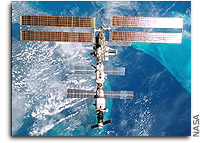 All ISS systems continue to function nominally, except as noted previously or below.
Today at 9:59am EDT, with ISS still in darkness, 8P/Progress M-46 undocked smoothly and on time. Separation was nominal, and the cargo ship is now in its own orbit to observe targets in NE Russia for about a week before deorbiting. For the undocking, the ISS went into free drift at 9:55am for nine minutes.
The next resupply ship, 9P/Progress M1-9, is in final launch preparations at Baikonur for liftoff tomorrow at 12:58pm EDT. Docking is scheduled for Sunday, 9/29, at 1:07pm EDT. [MCC-Moscow has confirmed that the possible use of Service Module (SM) thrusters for maneuvering in the interim, should it become necessary, has been successfully modeled on the ground, without indications of any structural, stability or other technical problems.]
CDR Valery Korzun and FE1/SO Peggy Whitson spent several hours preparing EVA hardware for next week’s visit by 9A/STS-112. They first conducted a thorough familiarization session with the EMU C&W (extravehicular mobility unit caution & warning) system on the EMU simulator software on the laptop. Later, they configured three EMUs for 9A and 11A and subsequently performed a detailed EMU checkout. [This included EMU communications (UHF/Audio), coolant flow, O2 system, power supply, umbilical hardline, primary and alternate radios, the regulator/fan/pump system, etc. The three 9A spacewalks will be performed by Mission Specialists David Wolf and Piers Sellers, with Pilot Pam Melroy acting as IV (intravehicular) crewmember. There are currently three EMUs onboard the ISS, and 9A will carry two additional spacesuits. The latter will return to Earth (in case a contingency EVA is required for payload bay doors closing by Wolf and Sellers).]
During the charging of EVA batteries for helmet lights, PGT (pistol grip tool) and two REBA (rechargeable EVA battery assembly) batteries in the BSA (battery stowage assembly), battery charger #1, for PGT, inexplicable appeared to have shut down. This has not been seen previously and is currently under investigation.
As he did three months ago, FE-2 Sergei Treschev installed the Russian GFI-1 "Relaksatsiya" (Relaxation) experiment by mounting the ultraviolet (UV) camera with spectrometer unit at SM window #9, after reconfiguring the Russian payload laptop 3 for the experiment. The geophysical experiment was then performed on several occasions throughout the day and finally torn down and stowed again, followed by a tagup with ground specialists and reconfiguration of laptop 3. [Relaksatsiya deals with the study of the chemoluminescent chemical reactions and atmospheric light phenomena that occur during high-velocity interaction between the exhaust products from space vehicles and the atmosphere at orbital altitude and during the entry of space vehicles into the Earth’s upper atmosphere. Purpose of the current experiment was to (1) measure the night airglow layer of the Earth, and (2) record the second separation burn of 8P/Progress M-46 thrusters with a camcorder.]
After the primary GNC-2 MDM (guidance, navigation & control computer #2) failed on Sunday (reported yesterday), the backup MDM also went down yesterday morning after its take-over and before GNC-2 was brought back up. Among else, this impacted TDRS antenna pointing, and a brief period of low data rate comm resulted, until antenna and solar array pointing resumed with Russian segment (RS) data, switching S-band back to HDR (high data rate). Ground support was quickly mobilized at MCC-H and MCC-M, with Dryden, White Sands and Wallops standing by, to ensure continued comm, data and commanding. This morning, both GNC MDMs were fully restored and working OK (GNC-2 is primary, GNC-1 backup), getting their sensor data for propagation not from the GPS (global positioning satellite) system, but from the RS as before the arrival of the S0 (S-Zero) truss, backed up by the U.S. RGAs (rate gyro assemblies). S- and Ku-band autopointing is re-established. [Dump data indicate that the MDM failures were caused by a strange and anomalous "not a number" value from the SIGI (space integrated GPS/inertial navigation system), against which the GNCs are not protected by an exception handler, i.e., a computer glitch that caused them to stop processing until timed out and switched to Diagnostics mode. This has happened once before last May on the ground. The time-consuming troubleshooting to find out, before 9A launch, what caused the "not a number" value has begun, as the GNCs and CMG momentum management continue to function well on Russian data for state vector and rate data (as well as the usual Russian attitude data). SIGI uses four commercial GPS antennas mounted on the S0 truss. The system, supported by four RGAs (rate gyro assemblies), can determine station attitude, position and velocity.]
CDR Korzun inspected the VR fan of the active SKV-1 air conditioner, while FE-2 Sergei Treschev later worked a troubleshooting procedure on the second unit, SKV-2, to restore its condensate evacuation function. [This involved shutting it down, inspecting valve positions, checking connections, inlet/outlet valves and filter, restarting the system and monitoring the movement of condensate and moisture for the next 24 hours.]
CDR Korzun also inspected the BRPK-1 water condensate separation and pumping unit. He then spent about two hours on a carefully scripted functionality test of the BRPK-1, with the objective to establish if its certified service life can be extended or if it should be returned to Earth. [The test involved flushing out water supply lines, filter and valves with clean water, checking freedom of movement of the membrane pump plunger, and assessing the efficiency of the condensate pump. Afterwards he returned the BRPK-1 to its nominal configuration.]
Daily routine servicing tasks were completed by Treschev (SOSh life support systems maintenance; IMS inventory delta file preparation) and Whitson (Lab payload status checkup).
Peggy Whitson deactivated the PFMI (pore formation and mobility investigation) hardware and MSG (microgravity science glovebox) video system, removed the finished sample (PFMI-01), loaded the data on a PCMCIA (portable computer memory card international adapter) and removed the video tape. The MSG was later powered down. [The second sample processing run got off to a shaky start when the MSG laptop locked up; also, the thermal chamber translation motor started out with erratic behavior, probably due to corrupted motor constants. Peggy was able to recover the run by launching the PFMI software after powering on the hardware, instead of the reverse. The next run will be preceded by a 30-min. test to reset motor constants in the computer. Also, yesterday’s sample run was terminated early due to the Ku-band loss caused by the GNC MDM failure, but it should have been sufficiently along in the resolidification process to yield useful data.]
FE-1/SO Whitson had another service turn at the ADVASC (advanced astroculture) during its dry-out stage, removing about 200 mL of fluid from the Nutrient Reservoir and storing it in Nutrient replenishment Bag #3.
At 1:38pm EDT, the crew participated in an interactive televised educational event with Mt. Ayr, Iowa, Community Schools, set up by the Iowa NASA Educator Resource Center. The ISS residents spent about 20 minutes answering questions from students of all ages from Kindergarten to 12th grade.
All crewmembers completed their daily physical exercise program on RED (resistive device) and TVIS (treadmill). Progress 9P will deliver two pieces of TVIS repair hardware as a stop-gap in case the chassis fails before 9A, viz., clamshell truss stiffener and an internal chassis support assembly (ICSA). [If not required before 9A, which delivers a full new chassis, the parts will not installed but remain on orbit as spare parts.]
The last repress/refresh of the ISS atmosphere with gaseous oxygen from Progress M-46/8P was completed last night, amounting to about 10 lbs of O2 and a pressure increase of 7 mmHg.
Late last week the MCA (major constituent analyzer), while continuing to run, got stuck with static data during processing of a Lab air sample. It is not producing any data at this time. Investigation is underway.
Yesterday’s removal and replacement of the failed RPCM (remote power controller module ) N13B A in the Node by Whitson and Treschev was fully successful.
The crew was asked to take still and video images of Earth when over Yucatan early this morning, to try to catch tropical storm Isadore. After dwelling over land for some time, the storm is predicted to moves north over the Gulf, strengthening as it heads for eventual landfall along the Texas or Louisiana coast. MCC-H is currently assessing whether the storm will impact next Wednesday’s launch of 9A/STS-112.
Today’s targets of the U.S. CEO (crew earth observations) program were Lower Amazon River Basin (sunglint opportunity left of track. Crew was to shoot river banks and island shorelines for ongoing research project), Buenos Aires, Argentina (good nadir pass of this huge metropolitan area. Left and right of track), Lake Poopo (lake levels should be responding downward by this stage of the present El Nino), and Lake Eyre, Australia (crew was asked to document any water in the lake. A major control of Eyre’s filling cycle is El Nino. Sunglint opportunity left of track. Crew to shoot river banks and island shorelines for ongoing research project).
CEO images can be viewed at the website http://eol.jsc.nasa.gov
U.S. and Russian Segment Status (as of 1:35 am EDT):
Environmental Control and Life Support (ECLSS) and Thermal Control (TCS):
Elektron O2 generator is powered On (16-amp mode), on backup pump. Vozdukh CO2 scrubber is ON in MANUAL cycle mode #5, i.e., 10-min. cycle time (vacuum pump failed). U.S. CDRA CO2 scrubber is offline. BMP Harmful Impurities unit: Absorbent bed #1 in Purify mode, bed #2 in Purify mode.
SM Working Compartment: Pressure (mmHg) — 764, temperature (deg C) — 26.4, ppO2 (mmHg) — 163.9, ppCO2 (mmHg) — 2.6.
SM Transfer Compartment: Pressure (mmHg) — 762, temperature (deg C) — 21.5.
FGB Cabin: Pressure (mmHg) — 756, temperature (deg C) — 21.7.
Node: Pressure (mmHg) — 757.88, temperature (deg C) — 23.0 (shell); ppO2 (mmHg) — n/a; ppCO2 (mmHg) — n/a.
U.S. Lab: Pressure (mmHg) — 760.07, temperature (deg C) — 25.0, ppO2 (mmHg) — n/a; ppCO2 (mmHg) — n/a;
Joint Airlock (Equip. Lock): Pressure (mmHg) — 760.07, temperature (deg C) — 25.0; shell heater temp (deg C) — 24.0, ppO2 (mmHg) — n/a; ppCO2 (mmHg) — n/a.
PMA-1: Shell heater temp (deg C) — 21.6
PMA-2: Shell heater temp (deg C) — 18.4
(n/a = data not available)
Propulsion System (PS): Total propellant load available (SM + FGB) — 3639 kg (8023 lb) [as of 9/19].
Electrical Power Systems (EPS):
Both P6 channels fully operational. Beta Gimbal Assembly (BGA) 2B and BGA 4B in Autotrack mode (solar-tracking).
SM batteries: Battery data not available.
FGB batteries: Battery #4 is in "Storage" mode (offline); all other batteries (5) are in "Partial Charge" mode.
Plasma Contactor Unit PCU-1 in Standby mode; PCU-2 in Standby mode.
Thermal Control Systems:
Air conditioner SKV-1 is Off; SKV-2 is Off.
Command & Data Handling Systems:
C&C-3 MDM is prime, C&C-2 is back-up, and C&C-1 is in standby.
GNC-2 MDM is prime; GNC-1 is Backup.
LA-1, LA-2 and LA-3 MDMs are all operating.
PL-1 MDM is On (primary); PL-2 MDM is off (cold backup).
APS-1 (automated payload switch #1) and APS-2 are both On.
SM Terminal Computer (TVM): 3 redundant lanes (of 3) operational.
SM Central Computer (TsVM): 3 redundant lanes (of 3) operational.
Attitude Source:
3 CMGs on-line.
State vector — Russian segment
Attitude — Russian segment
Angular rates — Russian segment
Communications & Tracking Systems:
All Russian communications & tracking systems are nominal.
S-band is operating nominally.
Ku-band is operating nominally.
Audio subsystem operating nominally.
Video subsystem operating nominally.
MCOR (medium-rate communications outage recorder) is operating nominally.
Robotics:
SSRMS/Canadarm2 at MBS PDGF1 (mobile base system/power & data grapple fixture 1) and PDGF2, with Keep Alive power on both strings. SSRMS based on PDGF1 (LEE A, derigidized)
MBS: Keep Alive power on both strings.
RWS (robotics workstations): Lab RWS is Off; Cupola RWS is Off.
ISS Orbit (as of this morning, 7:15am EDT [= epoch]):
Mean altitude — 387.7 km
Apogee — 399.4 km
Perigee — 376.0 km
Period — 92.3 min.
Inclination (to Equator) — 51.63 deg
Eccentricity — 0.0017291
Orbits per 24-hr. day — 15.60
Solar Beta Angle — 51.0 deg (magnitude increasing)
Altitude decrease — 230 m (mean) in last 24 hours
Revolutions since FGB/Zarya launch (Nov. ’98) — 21951
Current Flight Attitude — XVV (x-axis in velocity vector, 5.0 deg roll bias [yaw: -10 deg, pitch: -9.5 deg, roll: -5 deg], with CMG Thruster Assist Momentum Management).
For more on ISS orbit and worldwide naked-eye visibility dates/times, see
http://www.hq.nasa.gov/osf/station/viewing/issvis.html



