
ISS On-Orbit Status 24 Nov 2002
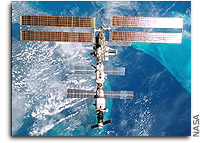 All ISS systems continue to function nominally, except as noted previously or below. As of today (11/24), the station has been continuously staffed for 751 days.
STS-113/Endeavour lifted off on time at 7:50pm EST last night flawlessly on Mission ISS-11A and is currently catching up with the ISS. Docking is scheduled for Monday (11/25) evening at about 4:25pm EST. [Beforehand, at 3:00 pm, the station will start a 27-min rotation maneuver to docking attitude. About 8.5 min later, Endeavour arrives on the R-bar, 600 ft below the station, then flies around it to reach a point 310 ft ahead of the station (V-bar). With minute thruster impulses, CDR Jim Wetherbee will then conduct the approach, station keeping at 4:15pm and then “push to dock”. The ISS crew will record the approach and docking with the new ETVCGs (external TV camera groups) and camcorder through the Lab window.]
With the transfer of the Expedition 6 crew to the station after the docking, ISS Stage 9A ends and Stage 11A begins. After hatch opening, first tasks are safety briefing, swapping out the rotating crewmembers? IELKs (individual equipment and liner kits) in the individual?s seat in Soyuz TMA-1, including the tailored Sokol suits, and transfer of the EMU spacesuits. First of three EVAs will be on 11/26 (Tuesday). Undocking is scheduled for 12/2 (2:18pm EST), landing at KSC on 12/4 (3:49pm). Valery Korzun, Peggy Whitson and Sergei Treschev will then have spent 182 days in space (178 days aboard ISS).
For the ISS crew, wake-up today was at 8:45am EST (Shuttle: 9:50am), for a normal Sunday with a round of PFCs (private family conferences) for everyone, via IP (Internet protocol) phone.
CDR Valery Korzun completed repressurization and checkout of PMA2 (pressurized mating adapter #2) in front of the Lab module, the docking port for Endeavour.
FE-1/SO Peggy Whitson performed some remaining payload tasks preparatory to 11A. At 1:10pm, she was to deactivate the PCAM 007 (protein crystallization
apparatus for microgravity) container of the PCG-STES (protein crystal growth-single locker thermal enclosure system #7) experiment, which she recorded on video.
Later, Whitson removed the HDD (hard disk drive) of the HRF (human research facility) computer for return to Earth.
She also activated the EVARM (EVA radiation monitoring) reader and performed another badge reading of the background radiation environment in the cabin, part of a series of weekly data collections in preparation for the three 11A spacewalks.
Microgravity Science Glovebox (MSG): The failed PDC (power distribution controller) of the inoperative MSG has been removed by Whitson, packed and temporarily stowed for return on Flight 11A (pending completion of necessary transfer paperwork). With the PDC in hand, MSG and ESA engineers will have a better handle on replacing the unit and restoring MSG. Meanwhile, review of impacts to Increment 6 science continues.
Peggy Whitson was scheduled to perform pre-arrival calibration of the MCA (major constituent analyzer) in the Lab in two parts.
Two separate files were downlinked successfully from the onboard medical equipment computer (MEC), thus fulfilling the engineering requirement to test the MEC working properly on the RF LAN (radio frequency local area network). Crew was instructed to leave the MEC on this new wireless network connection.
CDR Korzun took readings of the SP urine collection and pretreat assembly flush counter and SVO water supply counter for calldown to MCC-Moscow via VHF.
FE-1 Whitson meanwhile performed flush, return-to-ground and ammonia ITCS (internal thermal control system) sampling on both low temperature (LTL) and moderate temperature (MTL) loops.
All crewmembers did their regular daily physical exercise on TVIS and RED.
Today’s optional targets of the CEO (crew earth observation) program were Tuamotu-Austral Islands (crew was to shoot coral fringing reefs and atolls. This smaller set of islands is encountered relatively infrequently), Tuamotu Archipelago (of interest: coral fringing reefs and atolls), Angolan Biomass Burning (final phase of the long burning season. Oblique views left and right of track requested), Industrialized SE Africa (aerosol loadings rapidly building up due to high pressure setting in. Special request for obliques right of track of the entire wide coastal plain in one view [to illustrate comparative haze density above and below the steep and high plateau edge]), and Johannesburg, South Africa (of interest: both sides of track near nadir for detail of this large city. ESC [electronic still camera]).
CEO images can be viewed at the website
http://eol.jsc.nasa.gov
U.S. and Russian Segment Status (as of 4:15am EST).
Environmental Control and Life Support (ECLSS) and Thermal Control (TCS):
- Elektron O2 generator is powered On (32 Amp mode). Vozdukh CO2 scrubber is On (manual mode 5, cycle time 10 min). U.S. CDRA CO2 scrubber is Off. TCCS is operational. BMP Harmful Impurities unit: Absorbent bed #1 in Purify mode, bed #2 in Purify mode.
- SM Working Compartment: Pressure (mmHg) — 750; temperature (deg C) — 25.5; ppO2 (mmHg) — 142.1; ppCO2 (mmHg) — 2.4.
- SM Transfer Compartment: Pressure (mmHg) — 752; temperature (deg C) — 19.8.
- FGB Cabin: Pressure (mmHg) — 752; temperature (deg C) — 20.7.
- Node: Pressure (mmHg) — 742.62; temperature (deg C) — 22.2 (shell); ppO2 (mmHg) — n/a; ppCO2 (mmHg) — n/a.
- U.S. Lab: Pressure (mmHg) — 745.12; temperature (deg C) — 25.2; ppO2 (mmHg) — n/a; ppCO2 (mmHg) — n/a;
- Joint Airlock (Equip. Lock): Pressure (mmHg) — 745.12, temperature (deg C) — 25.9; shell heater temp (deg C) — 22.6, ppO2 (mmHg) — 163.4; ppCO2 (mmHg) — 3.8.
- PMA-1: Shell heater temp (deg C) — 23.3
- PMA-2: Shell heater temp (deg C) — 20.8
(n/a = data not available)
Propulsion System (PS):
- Total propellant load available (SM + FGB + Progress) — 3808 kg (8395 lb) [as of 11/21/02].
Electrical Power Systems (EPS):
- Both P6 channels fully operational. Beta Gimbal Assembly (BGA) 2B and BGA 4B both in dual-angle mode (directed position).
- SM batteries: Battery #2 is in “Cycle” mode; all other batteries (7) are in “Partial Charge”: mode.
- FGB batteries: Batteries #3 and #4 are off line; all other batteries (4) are in “Partial Charge” mode.
- Plasma Contactor Unit PCU-1 in Standby mode; PCU-2 in Standby mode.
Thermal Control Systems:
- Air conditioner SKV-1 is On; SKV-2 is Off.
Command & Data Handling Systems:
- C&C-1 MDM is prime, C&C-2 is back-up, and C&C-3 is in standby.
- GNC-1 MDM is prime; GNC-2 is Backup (new patches loaded on both).
- EXT-1 is On (primary), EXT-2 is off.
- LA-1, LA-2 and LA-3 MDMs are all operating.
- PL-1 MDM is On (primary); PL-2 MDM is off (diagnostic
- APS-1 (automated payload switch #1) and APS-2 are both On.
- SM Terminal Computer (TVM): 2 redundant lanes (of 3) operational. Lane 1 is down.
- SM Central Computer (TsVM): 3 redundant lanes (of 3) operational.
Attitude Source:
- 3 CMGs on-line.
- State vector — U.S. SIGI-1
- Attitude — Russian segment (RS)
- Angular rates — U.S. RGA-1 (from RS attitude)
Communications & Tracking Systems:
- FGB MDM-1 failed; FGB MDM-2 is operating.
- All other Russian communications & tracking systems are nominal.
- S-band is operating nominally.
- Ku-band is operating nominally.
- Audio subsystem operating nominally.
- Video subsystem operating nominally.
- MCOR (medium-rate communications outage recorder) is operating nominally.
Robotics:
- SSRMS/Canadarm2 at MBS PDGF3 (mobile base system/power & data grapple fixture 3) and mated to PDGF1 (11A park position), with Keep Alive power on both strings.
- MBS: Keep Alive power on both strings. POA: Keep Alive power on both strings.
- RWS (robotics workstations): Lab RWS is Off; Cupola RWS is Off.
ISS Orbit (as of this morning, 6:43am EST [= epoch]):
- Mean altitude — 388.7 km
- Apogee — 397.8 km
- Perigee — 379.6 km
- Period — 92.33 min.
- Inclination (to Equator) — 51.64 deg
- Eccentricity — 0.0013475
- Orbits per 24-hr. day — 15.60
- Altitude loss — 175 (mean) in last 24 hours
- Revolutions since FGB/Zarya launch (Nov. ’98) — 22897
- Current Flight Attitude — LVLH (local vertical/local horizontal = “earth-fixed”: z-axis in local vertical, x-axis in velocity vector [yaw: -13 deg, pitch: -9 deg, roll: 0 deg]). LVLH until 11A docking.
For more on ISS orbit and worldwide naked-eye visibility dates/times, see
http://www.hq.nasa.gov/osf/station/viewing/issvis.html



