
ISS On-Orbit Status 22 Oct 2002
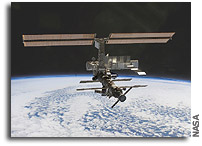 All ISS systems continue to function nominally, except as noted previously or below.
After wakeup at 4:30am EDT, before breakfast and first exercise session, all crewmembers underwent the regular periodic Russian biomedical assessments MO-7 (calf volume measurement) and MO-8 (body mass measurement, BMM). [Sergei Treschev set up the BMM mass measuring device, which uses calibrated springs to determine the subject’s mass in weightless space, and stowed it away after the tests. Calf measurements (left leg only) are taken with the ISOG device, a custom-sewn fabric cuff that fits over the calf, using the knee and lower foot as fixed reference points, to provide a rough index of deconditioning in zero-G and effectiveness of countermeasures.]
This was the last day for the Renal Stone experiment for Expedition Five, with Valery Korzun terminating his sample collections after breakfast and FE-1/SO Whitson later stowing the equipment for the next crew. [The Renal research, which investigates how to prevent kidney stone formation in zero-G, is a NASA/JSC program with Dr. Peggy Whitson as Principal Investigator (PI).]
Whitson set up and then took the monthly O-OHA (on-orbit hearing assessment) test, an EHS (environmental health systems) examination to assess the efficacy of acoustic countermeasures. The two other crewmembers followed suit. A background spot check was performed with the SLM (sound level meter) before Peggy’s audiogram and after Treschev’s as last crewmember. [The O-OHA test involves minimum audibility measurements for each ear over a wide range of frequencies and sound pressure levels, with the crewmembers using individual-specific Prophonics earphones, Bose ANC headsets and the SLM (sound level meter). To conduct the testing, the experimenter is supported by special “EarQ” software on the MEC (medical equipment computer). The baseline test is required for about Flight Day 14 for the Expedition and is then performed once per month.]
Peggy Whitson configured and powered up the CGBA (commercial generic bioprocessing apparatus) in preparation for the PGBA (plant generic bioprocessing apparatus) harvest next week. POC (Payload Operations Center) will check out and monitor CGBA throughout the week to ensure it is in good condition to accept the PGBA samples.
The ADVASC (advanced astroculture) team reported that their payload has arrived OK after its return to Earth, and that the soybean plants “look great”.
At about 10:50am EDT, Whitson started with the scheduled regeneration process of the EVA Metox (metal oxide) CO2 absorption canisters in the Airlock’s (AL) bakeout oven. As per joint agreement between Houston and Moscow, the crew collected air samples in the AL at 3 and 3.5 hrs. after the regeneration at high temperature started, using the Russian AK-1 and IPD-1 Draeger samplers, particularly testing for nitrous gases. When in the AL, crewmembers wore half-masks for safety.
Air samples were also taken by FE-2 Treschev at various times with the U.S. GSC (grab sample container), followed by atmospheric checkup with the CSA-CP (compound specific analyzer-combustion products). A second Metox regen cycle is timelined for 10/25 (Friday), with air sampling after 10 hrs. of regeneration.
Peggy Wilson removed the freshly discharged EMU (extravehicular mobility unit) battery (#2010) from the BSA (battery stowage assembly) and installed the next battery (#2026) for its discharge. Discharge/recharge cycling is required to protect the lifetime of the batteries.
Korzun and Whitson started preparing for the next Robotics Day, scheduled for 10/24 (Thursday), by reviewing the uploaded 11A version of the DOUG (dynamic onboard ubiquitous graphics) video system. This is a creation of the JSC Virtual Reality Lab, which depicts a realistic view of the station’s exterior and allows running the SSRMS robotarm from its telemetry data or for using it in stand-alone operations. [DOUG also gives the crew a simulation capability that allows them to review procedures and trajectories in preparation for external robotics activities with the SSRMS on a PCS laptop. The primary objective of the Robotics ops on Thursday will be to conduct a dry run of the P1 truss install operations and to perform a checkout of the Lab PDGF (power and data grapple fixture) in preparation for 11A.]
Sergei Treschev completed an inventory of the available new and used data output devices (USI) of the Russian BETA-08 electrocardiogram (ECG) lead cable belt.
Peggy Whitson performed the psychological MedOps WinSCAT (spaceflight cognitive assessment tool) experiment, a 30-min. time-constrained test of cognitive abilities that is routinely performed by astronauts aboard the ISS every 30 days before or after the IMG PHS (Integrated Medical Group/periodic health status) test or on special CDR’s, crewmember’s or flight surgeon’s request.
Korzun completed a functional checkout of the urine receptacle of the Russian ASU toilet, checking electrical resistances with the MMTs-01 multimeter.
He also performed the daily status check of the Rasteniya-2 plant growth experiment and the routine maintenance of the SOSh life support system, while Treschev prepared the regular update file of the IMS (inventory management system) and Whitson checked up on Lab payloads status.
At 12:30pm EDT, the crew set up and engaged in an interactive educational TV event with West Ward Elementary School in Killeen, TX, fielding questions from fifth-grade students and demonstrating toys in space (e.g., for Valery: how does a boomerang behave in zero-G?).
Later, amateur radio operator Peggy Whitson chatted with students of Spruce Hill Christian School, near the University of Pennsylvania in Philadelphia, during a 10-min. ham radio pass relayed via Maryland, Hawaii and South Africa.
Yesterday’s R2 software upgrade of the LSYS MDMs was completed without problems, and all three Lab systems computers appear to be functioning nominally.
During the systems reconfiguration following the upgrade, the port and starboard water vent assemblies failed to reinitialize. [Ground specialists believe that this is because the water vent system is very cold in the current flight attitude and, thus, the heaters could not warm them up soon enough to prevent the FDIR (failure detection, isolation, and recovery) system from annunciating a failure. While water dumps cannot be performed without the vent system, they are not required for some time, and the system will be left disabled until it can be reinitialized when the station’s attitude and Beta angle become more favorable.]
The crew was thanked for yesterday’s work in the Z1 dome/vestibule, which provided the ground with updated stowage information. However, the spare P6 BMRRM (bearing motor roll ring module) did not fit into the dome stowage area, and a few items still are missing.
Before start of sleep period (8:00pm EDT), Treschev is scheduled to set up the equipment for tomorrow’s planned Russian biochemical urine test (PZE MO-9), which uses the sophisticated in-vitro diagnostic apparatus „Urolux‰ developed years ago for the Mir program. MO-9 is one of several Russian medical assessments that have been accepted by US MedOps officials in the interest of working more jointly as an Integrated Medical Group (IMG). It is performed every 30 days, also before and after Orlan EVAs.
Peggy Whitson reported problems with a Lab PCS ThinkPad laptop yesterday, which to the ground are indicative of a hard drive (HD) failure. She was advised to replace it with a space HD from stowage.
Soyuz 5S: Last night, the Russian State Commission delivered the final report of the investigation of the Soyuz launch failure on 10/15 at Plesetsk. The cause was determined to be unique to the failed Soyuz-U, with no impact on the Soyuz-FG type used for 5S. One recommendation concerns additional quality control inspection for the turbopumps (which has already been done for the FG). 5S will be the fourth FG to be launched to the ISS; the other three, carrying Progress ships, have all performed flawlessly. According to RSC-Energia, the FG is certified ready for human flight. Fueling of the booster has begun last night, and the new launch date for Soyuz 5S has been set for 10/30, at 3:11am GMT (10/29 at 10:11pm EST). Docking will be on 11/1. The 5S taxi mission will last till 11/9, one day more than originally scheduled to enable landing in northern Kazakhstan, the airbase in southern Kazakhstan having been closed down. Soyuz 4S, with the taxi crew, will undock on 11/9 (4:00pm EST) and land near Arkalykh, Kazakhstan, around midnight. The launch of STS-113/11A has been rescheduled for 11/11 (Veteran’s Day), early in the morning, pending confirmation at the FRR (Flight Readiness Review) next week on 10/31. A launch on 11/11 gains the ISS crew an additional day to adjust their sleep cycle (start shifting 11/9). There will be no need for another reboost by Progress 9P, unless the 5S launch slips.
No CEO (crew earth observations) targets today, due to target software generation problems on the ground.
U.S. and Russian Segment Status (as of 12:53 pm EDT):
Environmental Control and Life Support (ECLSS) and Thermal Control (TCS):
- Elektron O2 generator is powered On (32 Amp mode, on backup pump). Vozdukh CO2 scrubber is ON in MANUAL cycle mode #5, i.e., 10-min. cycle time (vacuum pump failed). U.S. CDRA CO2 scrubber is offline. TCCS is operational. BMP Harmful Impurities unit: Absorbent bed #1 in Purify mode, bed #2 in Purify mode.
- SM Working Compartment: Pressure (mmHg) — 758, temperature (deg C) — 27.0, ppO2 (mmHg) — 159.2, ppCO2 (mmHg) — 2.5.
- SM Transfer Compartment: Pressure (mmHg) — 761, temperature (deg C) — 20.2.
- FGB Cabin: Pressure (mmHg) — 756, temperature (deg C) — 22.0.
- Node: Pressure (mmHg) — 752.16, temperature (deg C) — 24.7 (shell); ppO2 (mmHg) — 165.5; ppCO2 (mmHg) — 4.6.
- U.S. Lab: Pressure (mmHg) — 754.01, temperature (deg C) — 24.8, ppO2 (mmHg) — 165.3; ppCO2 (mmHg) — 4.9;
- Joint Airlock (Equip. Lock): Pressure (mmHg) — 754.11, temperature (deg C) — 21.1; shell heater temp (deg C) — 23.4, ppO2 (mmHg) — n/a; ppCO2 (mmHg) — n/a.
- PMA-1: Shell heater temp (deg C) — 23.4
- PMA-2: Shell heater temp (deg C) — 12.4
(n/a = data not available)
Propulsion System (PS):
- Total propellant load available (SM + FGB + Progress) — 4118 kg (9079 lb) [as of 10/17/02].
Electrical Power Systems (EPS):
- Both P6 channels fully operational. Beta Gimbal Assembly (BGA) 2B and BGA 4B in Autotrack mode (solar-tracking).
- SM batteries: Battery #6 is in “Cycle” mode; all other batteries (7) are in “Partial Charge” mode.
- FGB batteries: Battery #1 is offline; all other batteries (5) are in “Partial Charge” mode.
- Plasma Contactor Unit PCU-1 in Standby mode; PCU-2 in Standby mode.
Thermal Control Systems:
- Air conditioner SKV-1 is On; SKV-2 is Off.
Command & Data Handling Systems:
- C&C-3 MDM is prime, C&C-2 is back-up, and C&C-1 is in standby.
- GNC-2 MDM is prime; GNC-1 is Backup.
- EXT-1 is On (primary), EXT-2 is off.
- LA-1, LA-2 and LA-3 MDMs are all operating.
- PL-1 MDM is On (primary); PL-2 MDM is off (cold backup).
- APS-1 (automated payload switch #1) and APS-2 are both On.
- SM Terminal Computer (TVM): 3 redundant lanes (of 3) operational.
- SM Central Computer (TsVM): 3 redundant lanes (of 3) operational.
Attitude Source:
- 3 CMGs on-line.
- State vector Russian segment
- Attitude — Russian segment
- Angular rates — Russian segment
Communications & Tracking Systems:
- All Russian communications & tracking systems are nominal.
- S-band is operating nominally.
- Ku-band is operating nominally.
- Audio subsystem operating nominally.
- Video subsystem operating nominally.
- MCOR (medium-rate communications outage recorder) is operating nominally.
Robotics:
- SSRMS/Canadarm2 at MBS PDGF3 (mobile base system/power & data grapple fixture 1) and PDGF2, with Keep Alive power on both strings (based on PDGF3 [LEE A, derigidized] and mated to PDGF2).
- MBS: Keep Alive power on both strings. POA: Keep Alive power on both strings.
- RWS (robotics workstations): Lab RWS is Off; Cupola RWS is Off.
ISS Orbit (as of last night, 11:24pm EDT [= epoch]):
- Mean altitude — 396.1 km
- Apogee — 406.4 km
- Perigee — 385.8 km
- Period — 92.48 min.
- Inclination (to Equator) — 51.63 deg
- Eccentricity — 0.00151
- Orbits per 24-hr. day — 15.57
- Solar Beta Angle — -58.9 deg (magnitude increasing)
- Altitude loss — 190 m (mean) in last 24 hours
- Revolutions since FGB/Zarya launch (Nov. ’98) — 22377
- Current Flight Attitude — XPOP (x-axis perpendicular to orbit plane = “sun-fixed” [yaw: -5.0, pitch: -8.6 deg., roll: 0.4 deg]),with CMG/Thruster Assist Momentum Management).
For more on ISS orbit and worldwide naked-eye visibility dates/times, see
http://www.hq.nasa.gov/osf/station/viewing/issvis.html



