
ISS On-Orbit Status 21 Nov 2002
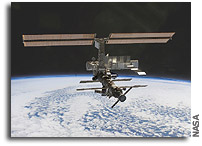 All ISS systems continue to function nominally, except as noted previously or below. Day 169 in space for Expedition 5, and it looks like the crew’s stay in space may go to 181 days (at least).
Endeavour’s RMS robot arm has been cleared for flight, and the launch of STS-113 is scheduled for tomorrow night. Weather: 80% favorable (but high winds and TAL weather may be of concern). If launched as planned, main events will occur as follows (all times EST):
- Dock — 11/24 (Sunday), 5:19pm
- EVA-1 — 11/25 (Monday), 3:45pm (6.5 hrs.)
- EVA-2 — 11/27 (Wednesday), 2:45pm (6.5 hrs.)
- Thanksgiving — 11/28
- EVA-3 — 11/29 (Friday), 2:45pm (6.5 hrs.)
- Undock — 12/1 (Sunday), 3:10pm
- Land (KSC) — 12/3 (Tuesday), 3:07pm.
CDR Valery Korzun’s morning hours, after wake-up at the current sleep-shifted 11:00am, were re-scheduled by MCC-M/TsUP on short notice to continue troubleshooting work on the failed Russian Vozdukh carbon dioxide (CO2) scrubber. [The part under investigation continues to be selector valve BVK-1 of the three-valve BOA valve panel controlling Vozdukh. The valve has been replaced and is undergoing function checks with a special Vozdukh test panel (PP SOA), along with its automatic control unit (SOA). Vozdukh has three adsorbent cartridges/channels, but only two of them are in use (PP1 and PP2).]
MCC-H/Flight Surgeon has developed and uplinked ppCO2 (carbon dioxide partial pressure) criteria for crew sleep commitment without overnight CO2 removal. [Based on (a) CDMK (carbon dioxide monitoring kit) measurements in Lab and Service Module (SM) yesterday, (b) CO2 production by three sleeping crewmembers of 0.15mmHg/hr, and (c) the hard flight rule limit of 7.6 mmHg ppCO2 requiring action, CO2 removal can be terminated at sleep time only if the GA (gas analyzer) shows 5.48 mmHg or less in the SM, and the MCA (major constituent analyzer) shows 6.4 mmHg or less in the Lab immediately before crew sleep.]
Troubleshooting of the MSG (microgravity science glovebox) by FE-1/SO Peggy Whitson become necessary yesterday, when the rack lost power after the first (of two) PFMI (pore formation and mobility investigation) samples had been processing for about five hours. Everything was looking good up to this point, and POC (Payload Operations Center) personnel hope to process this sample again at a later time.
Korzun and Whitson have another PuFF (pulmonary function in flight) session scheduled today, required to ensure that the final data take is within 30 days of landing. [After Peggy set up and activated the HRF GASMAP (human research facility / (gas analyzer system for metabolic analysis physiology), she performs an initial calibration, followed by the standard “blow” test for Valery and herself (repeated one more time if time allows).]
FE-2 Sergei Treschev is to conduct a number of inventories today, starting with a review of all AK-1M air sampler kits on board, due to discrepancies in current information on the number of kits still on station and offloaded on Soyuz and Progress vehicles. [Based on the results of the inventory, the available AK-1M equipment may have to be relabeled.]
Another inventory task today pertains to the image database collected for the Uragan earth observation program on laptops TP1 and EGE2. A special file was uplinked for auditing the EGE2 hard drive, and the flight engineer was advised to select the most typical Uragan shots for handover to the Expedition 6 crew for instructional purpose.
Treschev was also scheduled to retrieve the storage disk of the recent GFI-1 Relaksatsiya experiment (Soyuz departure) and to transfer its data to OCA (Orbiter communications adapter) for downloading via US assets.
For the Russian laptop 3, the crew was to log the contents of its HDD (hard disk drive) with a special uplinked file for transmittal to MCC-M via Regul-Packet.
An inventory of the food supply subsystem (SPP) is scheduled for Treschev in the afternoon, to establish a count of the quantities in two locations behind panels in FGB and SM.
The daily routine tasks of SOSh life support system maintenance and IMS inventory update preparation will be performed by Sergei Treschev. The Lab payloads status checkup by Peggy Whitson was placed on the task list, to make room on the “hard” timeline.
All crewmembers are scheduled for their daily physical exercise regimen on TVIS and RED.
At about 3:20pm EST, TsUP/Moscow will conduct a test of the Kurs-P system’s second string from the FGB (nadir direction).
As of early this morning, the MDM-1 in the FGB has failed. MDM-2 is off. This renders “Zarya” telemetry and commanding inaccessible via US S-band (but not via Russian assets).
At 5:08pm EST, the crew will downlink their PAO messages for this year’s Christmas tree lighting ceremony at Rockefeller Center in New York (live on NBC on 12/4 at 7-9pm EST). They were requested to perform the ceremonial plugging-in of the tree’s more than 30,000 lights, strung over five miles of wire, by symbolizing the event with a handheld electrical plug and socket.
Today’s targets for the CEO (crew earth observations program) were Patagonian Glaciers (general clearing over the entire length of the site [northern and southern ice fields]. Two additional opportunities later in the day), Angolan Biomass Burning (good low-sun opportunity to document continuing fires and smoke palls, looking mainly right. Second opportunity late afternoon provided enhanced smoke aerosols), Congo-Zimbabwe Biomass Burning (high point of the burning season in northern Mozambique. Crew was to document the new burning season in N Madagascar ~1 min later in pass if possible), Lagos, Nigeria (nadir pass. Interesting sun glint opportunity for great detail of the coastal lagoons on which Lagos is located. ESC [electronic still camera] requested), Industrialized SE Africa (oblique views for aerosol accumulation on the southern African Plateau. Opportunity to reveal altitudinal layering of aerosol: crew was to look right towards the high mountains of Lesotho [>9000 feet] which should appear clearer. Views of the coastal plain [broad views between the mountains and coast] are specifically requested, especially obliques), and Johannesburg, South Africa (nadir pass; ESC).
CEO images can be viewed at the website
http://eol.jsc.nasa.gov
U.S. and Russian Segment Status (as of 3:00am EST).
Environmental Control and Life Support (ECLSS) and Thermal Control (TCS):
- Elektron O2 generator is powered On (32 Amp mode). Vozdukh CO2 scrubber is Off (failed 11/18). U.S. CDRA CO2 scrubber is On (single-bed mode). TCCS is operational. BMP Harmful Impurities unit: Absorbent bed #1 in Purify mode, bed #2 in Purify mode.
Propulsion System (PS):
- Total propellant load available (SM + FGB + Progress) — 3808 kg (8395 lb) [as of 11/21/02].
Electrical Power Systems (EPS):
- Both P6 channels fully operational. Beta Gimbal Assembly (BGA) 2B and BGA 4B both in dual-angle mode (directed position).
- SM batteries: Battery #6 is in “Cycle” mode; all other batteries (7) are in “Partial Charge”: mode.
- FGB batteries: Battery #3 is offline; all other batteries (5) are in “Partial Charge” mode.
- Plasma Contactor Unit PCU-1 in Standby mode; PCU-2 in Standby mode.
Thermal Control Systems:
- Air conditioner SKV-1 is On; SKV-2 is Off.
Command & Data Handling Systems:
- C&C-1 MDM is prime, C&C-2 is back-up, and C&C-3 is in standby.
- GNC-1 MDM is prime; GNC-2 is Backup (new patches loaded on both).
- EXT-1 is On (primary), EXT-2 is off.
- LA-1, LA-2 and LA-3 MDMs are all operating.
- PL-1 MDM is On (primary); PL-2 MDM is off (diagnostic
- APS-1 (automated payload switch #1) and APS-2 are both On.
- SM Terminal Computer (TVM): 2 redundant lanes (of 3) operational. Lane 1 is down.
- SM Central Computer (TsVM): 3 redundant lanes (of 3) operational.
Attitude Source:
- 3 CMGs on-line.
- State vector — U.S. SIGI-1
- Attitude — Russian segment (RS)
- Angular rates — U.S. RGA-1 (from RS attitude)
Communications & Tracking Systems:
- FGB MDM-1 failed; FGB MDM-2 is off.
- All other Russian communications & tracking systems are nominal.
- S-band is operating nominally.
- Ku-band is operating nominally.
- Audio subsystem operating nominally.
- Video subsystem operating nominally.
- MCOR (medium-rate communications outage recorder) is operating nominally.
Robotics:
- SSRMS/Canadarm2 at MBS PDGF3 (mobile base system/power & data grapple fixture 3) and mated to PDGF1 (11A park position), with Keep Alive power on both strings.
- MBS: Keep Alive power on both strings. POA: Keep Alive power on both strings.
- RWS (robotics workstations): Lab RWS is Off; Cupola RWS is Off.
ISS Orbit (as of this morning, 7:23am EST [= epoch]):
- Mean altitude — 389.3 km
- Apogee — 398.5 km
- Perigee — 380.2 km
- Period — 92.34 min.
- Inclination (to Equator) — 51.63 deg
- Eccentricity — 0.0013503
- Orbits per 24-hr. day — 15.59
- Solar Beta Angle — 30.0 deg (magnitude increasing)
- Altitude loss — 220 (mean) in last 24 hours
- Revolutions since FGB/Zarya launch (Nov. ’98) — 22851
- Current Flight Attitude — LVLH (local vertical/local horizontal = “earth-fixed”: z-axis in local vertical, x-axis in velocity vector [yaw: -13 deg, pitch: -9 deg, roll: 0 deg]). LVLH until 11A docking.
For more on ISS orbit and worldwide naked-eye visibility dates/times, see
http://www.hq.nasa.gov/osf/station/viewing/issvis.html



