
ISS On-orbit Status 17 Sep 2002
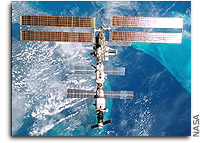
All ISS systems continue to function nominally, except as noted previously or below. Today is the 145th anniversary of the birthday of Konstantin Eduardovich Tsiolkovsky.
After wakeup at the regular time (2:00 am EDT), flight engineer Dr. Peggy Whitson found congratulations from the ground on being the first ISS Science Officer. [NASA ISS Science Officer is a new duty assignment that will be made for a NASA astronaut on each ISS Expedition crew. For now, the SO will focus on U.S. research conducted aboard the station. NASA will explore with its 15 international partners the potential to expand the SO role as the station’s research capabilities are increased.]
FE-1/SO Whitson today successfully checked out the new MSG (Microgravity Science Glovebox) experiment PFMI (pore formation and mobility investigation). After activating the MSG, she installed the PFMI thermal chamber, cameras and other data collection devices in the large, sealed MSG work area. Using a laptop computer, she then ran a successful checkout on a test sample ampoule (PFMI-12), outside the thermal chamber. Afterwards, the equipment was powered down and stowed. [PFMI observes bubble dynamics in materials that are being processed similar to industrial methods, e.g., in turbine blade manufacturing. As opposed to Earth, where such bubbles in molten metals tend to rise to the surface and disappear, in zero-G they often do not disappear but get trapped in the final metal or crystal sample, creating porosity defects which diminish the materials strength and usefulness. To study how they interact and move, PFMI melts samples of a transparent modeling material, succinonitrile and succonitrile water mixtures, at temperatures not exceeding 135 degC. The melting and subsequent directional resolidification in a cold zone are observed in real time with two cameras by investigators, who, in true telescience manner, can then change conditions from the ground]
CDR Valery Korzun and FE-2 Sergei Treschev continued packing and loading operations on Progress M-46 (8P), documenting the work with still photography and video, using the DVCAM (digital video camera). The images were later, at 7:05 am EDT, downlinked via U.S. assets and Ku-band.
Peggy Whitson worked on the ARIS ER2 (active rack isolation system EXPRESS rack #2), performing another snubber adjustment and compensator pushrod calibration of the sensitive vibration isolation system that protects micro-G experiments from rack disturbances. She then removed alignment guide rails from the snubbers, thus unlocking the rack mechanically. [Calibration for centering (nulling) the upper pushrods and the position sensor setting on the ARIS display, is required after the rack has been rotated. The snubber adjustment, which protects the lower pushrod actuators from hyperextension damage, is an iterative process with the ground where telemetry data are used to check on the actuator positions after each adjustment by the crew, until they are centered properly.]
FE-2 Treschev initiated the 24-hr. regeneration cycle on absorbent bed 1 of the BMP micropurification subsystem, a part of the air revitalization system (SOGS), leaving channel 2 in Purify mode.
The crew completed a first procedures review of the upcoming STS-112/9A mission, starting with an overview of the mission and discussing it with the ground at 12:20 pm EDT.
The two cosmonauts conducted another session with the Russian/Japanese HDTV (high-definition television) experiment, which involves taking high-definition video of the subjects during “interviews”, showing their facial features for medical evaluation. The session was conducted without TV downlink, but there was a real-time tagup with ground specialists via RGS (Russian ground sites) during a comm pass. The recorded cassettes will be returned to Earth.
The daily routine tasks of IMS inventory delta file preparation and Lab payload status checks were performed by Whitson, while Treschev did the daily SOSh life support system maintenance.
At 1:55 pm EDT the crew participated in a live interactive educational TV event with Ashland, Wisconsin area schools. They fielded questions from high school students and played back the video recorded previously (9/2), which demonstrated the use of exercise equipment in space, viz., jogging on TVIS, arm ergometry on the VELO cycle, a workout on the CEVIS ergometer bike, and the use of the RED for various muscle strengtening exercises. After the downlink, Whitson recharged the 120V video battery,
As reported yesterday, the leaking hydroflow coupling of the CDRA (carbon dioxide removal assembly) was successfully repaired (a snap-ring over an O-ring was found misconfigured). Pumpdown and leak check tests were nominal, but due to lack of sufficient power a more extensive 24-hr. run of the CDRA in dual-bed mode has to wait until 9/19 (Thursday).
In trying to install new IV-CPDS (intravehicular charged particle directional spectrometer) software yesterday, FE-1/SO Whitson encountered problems, which are currently being looked at by engineers.
The Russian TsVM (Central Computer) system in the SM, which had lost the second of three redundant lanes on Sunday (9/15), underwent an automatic restart last night and is now running on all three subsets again. TVM (Terminal Computer system) continues on three lanes.
New PPL (pre-positioned load) software uploaded by MCC-H to the station for the GPS (global positioning satellite) system appears to be working well.
Checkout of new SSMMU (space station mass memory unit) firmware loads on both PL MDMs (payload multiplexer/demultiplexers, computers) was successful. Both MDMs are back in nominal configuration, with PL-1 in primary mode and PL-2 powered off as backup.
MCA (major constituents analyzer) continues to work nominally.
The RED (resistive exercise device), being used at a much higher rate than originally expected, approaches the end-of-life of its two Flexpack canisters, with potential failure before ULF-1 (on which two new canisters are manifested). [A second set of canisters is on board. Specialists are proposing to replace the current set and return it on 9A, to be refurbished and launched on ULF-1, while manifesting the available ground set already on 11A. This would require an R&R (removal and replacement) before 9A, which is currently not on the schedule.]
The spare CMG (control moment gyroscope), scheduled to fly on STS-114/ULF-1, was successfully fit-checked on its Shuttle payload bay carrier.
On Thursday (9/19), TsUP plans to conduct an on-station test of the SM’s Kurs-P (passive part of the automated rendezvous and approach radar).
Undocking of Progress M-46 (8P) is set for 9/24 (Tuesday); launch of Progress M1-9 (9P) follows on 9/25 at 11:58 am EDT, and docking of 9P on 9/29 at 12:07 pm EDT..
Current Shuttle launch dates:
- 11A/STS-113 — November 10, 2002
- ULF-1/STS-114 — March 1, 2003
Today’s target areas for the U.S. CEO program were Angolan Biomass Burning (this was an excellent fair weather pass over southern Angola and northern Namibia. Fire season is coming to an end now. The crew was asked to view left and right of track to document fire scar patterns in nadir to slightly oblique views), Industrialized Southeastern Africa (cool high pressure has dominated southern Africa for nearly a week allowing the buildup of aerosols and smog plumes. The ISS pass was directly over the industrialized heartland of the Republic of South Africa. Crew was to try for oblique views either side of track to document the location and extent of aerosols over the Orange and Vaal River valleys), Recife, Brazil (crew to look left of track this pass for this large coastal city on the easternmost bulge of Brazil), Havana, Cuba (the Cuban capital was just to the left of track on the north coast), Tropical Storm Formation (Dynamic Event Site: Tropical Depression Ten is reforming south of Hispanola. By the time of this pass it was expected to have intensified to become Tropical Storm Isadore in the vicinity of Jamaica. Crew was to use the ESC [electronic still camera] to document the cloud structure and formations of this potentially dangerous weather system to the left of track), Jarvis Island (the crew should have had a cloud-free nadir view of this isolated island and its reefs), Tuamotu Archipelago (pass was over the western end of this extensive archipelago. Crew to use the long lens of the ECS in nadir views to help map details of the coral reef structures of these islands and atolls).
CEO images can be viewed at the website http://eol.jsc.nasa.gov
U.S. and Russian Segment Status (as of 1:43 am EDT):
Environmental Control and Life Support (ECLSS) and Thermal Control (TCS):
- Elektron O2 generator is powered On (32-amp mode), on backup pump. Vozdukh CO2 scrubber is ON in MANUAL cycle mode #5, i.e., 10-min. cycle time (vacuum pump failed). U.S. CDRA CO2 scrubber is offline. BMP Harmful Impurities unit: Absorbent bed #1 in Regeneration mode, bed #2 in Purify mode.
- SM Working Compartment: Pressure (mmHg) — 759, temperature (deg C) — 25.9, ppO2 (mmHg) — 160.2, ppCO2 (mmHg) — 3.9.
- SM Transfer Compartment: Pressure (mmHg) — 752, temperature (deg C) — 20.7.
- FGB Cabin: Pressure (mmHg) — 752, temperature (deg C) — 20.7.
- Node: Pressure (mmHg) — 749.61, temperature (deg C) — 23.7 (shell); ppO2 (mmHg) — 162.7*; ppCO2 (mmHg) — 5.1*.
- U.S. Lab: Pressure (mmHg) — 751.68, temperature (deg C) — 25.0, ppO2 (mmHg) — 162.7*; ppCO2 (mmHg) — 5.1*;
- Joint Airlock (Equip. Lock): Pressure (mmHg) — 751.68, temperature (deg C) — 24.6; shell heater temp (deg C) — 23.8, ppO2 (mmHg) — n/a; ppCO2 (mmHg) — n/a.
- PMA-1: Shell heater temp (deg C) — 24.1
- PMA-2: Shell heater temp (deg C) — 18.4
(*Note: Partial pressures ppO2 and ppCO2 in Node and Lab are obtained from the recently restored MCA [major constituent analyzer] and are not considered reliable until purge of water vapor within sample lines has been completed.
Electrical Power Systems (EPS):
- Both P6 channels fully operational. Beta Gimbal Assembly (BGA) 2B and BGA 4B in Autotrack mode (solar-tracking).
- SM batteries: Battery #1 is offline, battery #2 is in “Cycle” mode; all other batteries (6) are in “Partial Charge” mode. Data are static.
- FGB batteries: Battery #4 is in “Storage” mode (offline); all other batteries (5) are in “Partial Charge” mode.
- Plasma Contactor Unit PCU-1 in Standby mode; PCU-2 in Standby mode.
Thermal Control Systems:
- Air conditioner SKV-1 is Off; SKV-2 is On.
Command & Data Handling Systems:
- C&C-3 MDM is prime, C&C-2 is back-up, and C&C-1 is in standby.
- GNC-2 MDM is prime; GNC-1 is Backup.
- LA-1, LA-2 and LA-3 MDMs are all operating.
- PL-1 MDM is On (primary); PL-2 MDM is off (cold backup).
- APS-1 (automated payload switch #1) and APS-2 are both On.
- SM Terminal Computer (TVM): 3 redundant lanes (of 3) operational.
- SM Central Computer (TsVM): 3 redundant lanes (of 3) operational.
Attitude Source:
- 3 CMGs on-line.
- State vector — US GPS (SIGI string 1)
- Attitude — Russian segment
- Angular rates — US RGA1 (rate gyro assembly 1)
Communications & Tracking Systems:
- All Russian communications & tracking systems are nominal.
- S-band is operating nominally.
- Ku-band is operating nominally.
- Audio subsystem operating nominally.
- Video subsystem operating nominally.
- MCOR (medium-rate communications outage recorder) is operating nominally.
Robotics:
- SSRMS/Canadarm2 at MBS PDGF1 (mobile base system/power & data grapple fixture 1) and PDGF2, with Keep Alive power on both strings. SSRMS based on PDGF1 (LEE A, derigidized)
- MBS: Keep Alive power on both strings.
- RWS (robotics workstations): Lab RWS is Off; Cupola RWS is Off.
ISS Orbit (as of this morning, 7:33am EDT [= epoch]):
- Mean altitude — 389.4 km
- Apogee — 401.6 km
- Perigee — 377.1 km
- Period — 92.3 min.
- Inclination (to Equator) — 51.64 deg
- Eccentricity — 0.0018093
- Orbits per 24-hr. day — 15.59
- Solar Beta Angle — 35.5 deg (magnitude increasing)
- Altitude decrease — 240 m (mean) in last 24 hours
- Revolutions since FGB/Zarya launch (Nov. ’98) — 21842
- Current Flight Attitude — LVLH (local vertical/local horizontal = “earth-fixed”: z-axis in local vertical, x-axis in velocity vector [yaw: -10 deg, pitch: -7.8 deg, roll: 0 deg]). Transition from LVLH (Russian: OSK) back to XPOP (Russian: RSO) will be on 9/20.
For more on ISS orbit and worldwide naked-eye visibility dates/times, see
http://www.hq.nasa.gov/osf/station/viewing/issvis.html



