
ISS On-Orbit Status 17 Feb 2003
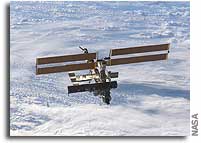
All ISS systems continue to function nominally, except as noted previously or below. Begin of Week 12 for Expedition 6.
CDR Ken Bowersox undertook the scheduled Week 12 water sampling for in-flight chemistry/microbiology analysis, using the WS&A (water sampler & archiver) for collection and the WMK (water microbiology kit) for processing within 6 hrs. of the collection. [Samples were taken in the Service Module (SM) at the heated-water SRV-K port and at the warm-water SVO-ZV outlet. The system was then flushed and the chemical analysis performed. After heating SRV-K again, Bowersox then took the microbiology sample. Special Flight Surgeon instructions had been uplinked to conserve onboard water: Sox was to take the flush samples for both the SRV-K Hot and SVO-ZV in his drink bags rather than the small waste water bags, after the drink bag was flushed with water (the water collected in the drink bags is good for consumption). As an alternate to using the drink bags, Sox could also collect the flushes into a small waste water bag (from WMK). If the SRV-K hot galley port was used within the last hour prior to the sampling activity, the flush for this port could be eliminated. After microbial water processing was completed, all bags used were to be stowed into the WMK.]
FE-1 Nikolai Budarin changed out the Russian SVO-ZV water supply system (EDV container, hose and other equipment), then started a three-day activity to disinfect and wash the SVO-ZV gear with disinfectant solution delivered on Progress-247/10P and water, using a hand pump and special receptacles. The disinfection and flushing will continue tomorrow and Wednesday.
Bowersox and FE-2/SO Don Pettit took another 30-min. CBT (computer-based training with video and audio) refresher course to hone their CMO ACLS (crew medical officer/advanced cardiac life support) proficiency. [Objectives of today’s exercise, which is regularly scheduled once a month, were to re-familiarize crewmembers with IV (intravenous) fluid infusion, and identification of potential causes and complications for treating a tension pneumothorax, using the RSP (respiratory support pack).]
Budarin performed the regular inspection/maintenance of the BRPK-2 air/liquid separator in the SM.
Nikolai also completed the daily routine maintenance of the SOSh life support system, incl. ASU toilet subsystem, as well as the preparation of the IMS inventory database for automated file import/export, while Sox checked up on Lab payload status (PCG-STES010 temperature).
Pettit took the daily ppCO2 (carbon dioxide partial pressure) readings in Lab and SM with the CDMK (CO2 monitoring kit), after breakfast and again before dinner.
Bowersox performed the regular monthly maintenance of the CEVIS (cycle ergometer with vibration isolation), examining the wire rope isolators for damage. Later in the day, he also completed the periodic inspection of the RED (resistive exercise device), which includes checking its bolts for retightening.
All crewmembers worked out on TVIS (treadmill), RED and VELO with load trainer, completing their daily physical exercise program of 2.5 hrs.
At about 3:20am EST, attitude control of the station was handed over to the Russian MCS (motion control system) for conducting a dynamic test of an SM ODU manifold-2 yaw thruster (RZ, plane II), which failed during the recent Progress 10P docking. For the test, ISS attitude was inertial (free drift), then returned to XPOP and handed back to U.S. CMG momentum management at 3:48am.
Don Pettit had two hours scheduled for the SIS (Surround Imagery for Station) procedure, a photographic activity to capture the digital still pictures needed to create an advanced 360-degree-view graphics of the ISS interior. The illusion of a total surround image is then created on the ground by digitally „stitching‰ the images together using QTVR (QuickTime Virtual Reality) software. [The on-board photography uses the Kodak DCS 760 (digital camera system) with zoom lens between 17 and 35 mm, taking one shot from the center of each short module, two shots from the one-third and two-third points in the longer modules, and mapping in a circular motion with approximately 50% overlap between shots. Suggested work-forward sequence was SM, DC-1, FGB, Node, JAL, and Lab.]
Budarin sent down another video record from a previous run of the Russian “telescience” Plasma Crystal-3 (PK-3) experiment, today from 1/23/03. For the downlink, the ISS had to be in sight of RGS (Russian ground sites).
Also over RGS, at 3:35am, the crew downlinked two PAO TV messages to MCC-M/TsUP on the occasion of the upcoming (2/22) Russian national holiday, “Defenders of the Fatherland Day”. One greeting from ISS was addressed to the participants of the Russian Armed Forces Day ceremony and opening of a Youth Arts Palace in Krasnoznamensk (“Space Heart of Russia”), the other to the celebratory gathering at the Kremlin and all Russian citizens on 2/22.
Today’s targets for the CEO (crew earth observations) program were Lake Nasser, Toshka Lakes; Egypt (the crew was asked to continue to monitor the vicinity of this large man-made lake in southern Egypt, especially looking for changes in the small new lakes to the west of the Nile River), Lake Volta in Sun Glint (looking right of track to detect details of the shoreline and rivers of this large man-made lake), Eastern Mediterranean Smog (although the weather pattern may be breaking down by the time of this pass, the view of the Adriatic Sea to right of track was too good to pass up. Crew was to look for patterns in the smog plumes over this basin in oblique views), and Chicago, Illinois (while the Windy City may not have been visible this pass, crew was to try looking left of track up the shores of Lake Michigan. Of interest is ice in the bays and inlets and views of the patterns of lake-effect snows on the western side of lower Michigan).
CEO images can be viewed at the website
http://eol.jsc.nasa.gov
U.S. and Russian Segment Status (as of 3:00am EST).
Environmental Control and Life Support (ECLSS) and Thermal Control (TCS):
- Elektron O2 generator is powered On (32 Amp mode). Vozdukh CO2 scrubber is On (auto mode). U.S. CDRA CO2 scrubber is Off. TCCS (trace contaminant control subsystem) is operating. MCA (major constituents analyzer) is operating. BMP Harmful Impurities unit: Absorbent bed #1 in Purify mode, bed #2 in Purify mode. RS air conditioner SKV-1 is On; SKV-2 is Off.
Propulsion System (PS):
- Total propellant load available [SM(811) + FGB(2777) + Progress(444)] — 4032 kg (8889 lb) as of 2/14/03. (Capability: SM — 860 kg; FGB — 6120 kg).
Electrical Power Systems (EPS):
- Both P6 channels fully operational. Beta Gimbal Assembly (BGA) 2B and 4B both in auto track (sun following) mode.
- SM batteries: Battery #3is in “Cycle” mode (freshly installed); all other batteries (7) are in “Partial Charge” mode.
- FGB batteries: Battery #1 is off line; battery #2 is in “Cycle” mode; all other batteries (4) are in “Partial Charge” mode.
- Plasma Contactor Unit PCU-1 and PCU-2 both in Standby mode.
Command & Data Handling Systems:
- C&C-3 MDM is prime, C&C-2 is back-up, and C&C-1 is in standby.
- GNC-1 MDM is prime; GNC-2 is Backup.
- EXT-1 is On (primary), EXT-2 is off.
- LA-1, LA-2 and LA-3 MDMs are all operating.
- PL-2 MDM is On (primary); PL-1 MDM is off (diagnostic
- APS-1 (automated payload switch #1) and APS-2 are both On.
- SM Terminal Computer (TVM): 2 redundant lanes (of 3) operational. Lane 1 is out of the set (as of 11/14/02).
- SM Central Computer (TsVM): 3 redundant lanes (of 3) operational.
Attitude Source:
- 3 CMGs on-line (CMG-1 failed).
- State vector — U.S. SIGI-1 (GPS)
- Attitude — U.S. SIGI-1 (GPS)
- Angular rates — U.S. RGA-1
Flight Attitude:
- XPOP (x-axis perpendicular to orbit plane = “sun-fixed” [yaw: 0 deg, pitch: -8.8 deg., roll: 0 deg]), with CMG/Thruster Assist Momentum Management).
- Solar Beta Angle: -58.0 deg (magnitude increasing).
Communications & Tracking Systems:
- FGB MDM-1 is powered Off; FGB MDM-2 is operational.
- All other Russian communications & tracking systems are nominal.
- S-band is operating nominally.
- Ku-band is operating nominally.
- Audio subsystem operating nominally.
- Video subsystem operating nominally, but VTR1 is off.
- HCOR (high-rate communications outage recorder) is operating nominally.
Robotics:
- SSRMS/Canadarm2 based at MBS PDGF2 with Keep Alive (KA) power on both strings.
- MBS: KA power on both strings.
- MT: latched at WS4, with KA power.
- POA: KA power on both strings.
- RWS (robotics workstations): Lab RWS is Off; Cupola RWS is Off.



