
ISS On-Orbit Status 15 Nov 2002
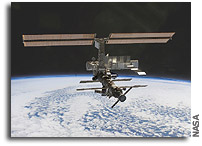 All ISS systems continue to function nominally, except as noted previously or below. Day 163 in space for Expedition 5 (161st day on board ISS).
Replanning of on-orbit crew timelines is continuing. An official launch date/time for STS-113/11A is not available yet, but it appears now that the launch could slip to 11/21 (Thursday).
After their wakeup at 11:00am EST, the crew has a relatively light schedule today, starting out with another 2-hr. round of SSRMS operations for 11A for crew rehearsal and thermal characterization. [First, the ground was to power up the MSS (mobile service system) at 12:10 pm EST on the prime string. CDR Valery Korzun and FE-1/SO Peggy Whitson were then to connect the DCP (display and control panel) cable for both the Lab and Cupola RWS (robotics workstation) and perform hand controller calibration on both Cupola and Lab RWS, followed by a single-joint maneuver of the SSRMS to the P1 pre-grapple position. After P1 grapple (from Shuttle RMS), transfer to install and P1 release, Valery and Peggy will maneuver the arm to the Lab PDGF (power and data grapple fixture). After they are done, MCC-H performs FMS (force moment sensor) data collection and MSS power-down.]
Later today, Korzun and FE-2 Sergei Treschev will again perform the Russian MedOps MO-4 ODNT training, working out while wearing the “Chibis” suit. Valery and Sergei will assist each other as CMO as each takes his turn with the device. [Chibis is a Russian below-the-waist reduced-pressure device to provide gravity-simulating stress to the cardiovascular/circulatory system for training the body’s orthostatic tolerance (e.g., the Gauer-Henry reflex) for return into Earth gravity. The device applies suction to the lower part of the body and legs, thereby exerting specific functional loadings to test the body’s adaptation to prolonged exposure to microgravity. Chibis data and biomed cardiovascular readings are recorded. The Chibis suit (not to be confused with the Russian “Pinguin” suit for spring-loaded body compression, or the “Centaur” anti-g suits used during reentry) has the same function as the stationary U.S. LBNP (lower-body negative pressure, Russian acronym: ODNT) machine used on Skylab in 1973/74.]
Korzun and Treschev are scheduled for periodic preventive maintenance of ventilation systems in the Russian segment. Today, Sergei will clean grilles of Group C ventilators, fans 1 and 2, and dust filters in the SM. He also changes out the CO2 absorber unit (filter) in the IK0501 gas analyzer while Valery replaces four dust collector cartridges in the SM.
A one-hour task on the cosmonauts’ timeline is the inspection, with mirror and flashlight, of Kurs-P cable harnesses behind SM panels for their integrity, to ensure good connectivity. [Kurs-P is the passive (transponder) half of the Russian automatic rendezvous and approach radar system. The active part, Kurs-A, is located on the visiting Soyuz or Progress spacecraft.]
FE-1/SO Peggy Whitson collects and stows the FMK (formaldehyde monitoring kit) monitors deployed yesterday and deactivates the SSAS (solid sorbent air sampler) after its 24-hr. operation.
The ground is awaiting the results of yesterday’s GSC (grab sample container) sample collection for verifying/corroborating the correct operation of the recently overhauled VOA (volatile organics analyzer), before officially declaring VOA “back in business”.
The MCA (major constituents analyzer) still is non-functional after the recent bit-flip failure flag that was not properly cleared. Restoring it to service would be simple and straightforward with a power cycle (turning off/on) and a full calibration, but it uses crew time, besides “calibrant” gas. [To avoid using crew time, appropriate software commands need to be written. If this can be accomplished before 11/19 (Tuesday), full MCA calibration can be accomplished before Shuttle docking.]
Daily routine servicing tasks will be performed by Korzun (SOSh life support systems maintenance), Treschev (IMS inventory update file preparation for downlink), and Whitson (daily Lab payload status checkup).
The crewmembers are scheduled for their daily physical exercise on the newly serviced TVIS treadmill. Noises from the RED (resistive exercise device) indicate that failure of the old Flexpack canisters in use may be imminent. [The planned swap-out with new canisters is awaiting the arrival of the Expedition 7 crew; Don Pettit having received special training for the IFM (in-flight maintenance). Meanwhile, if a hard failure occurs before 11A, one of the cans can be replaced with a good unit. Also, expanders and the contingency resistive device CRESS would temporarily permit anaerobic exercise.]
Shortly before dinner time tonight, Peggy Whitson is to transfer stored exercise data from the TVIS, RED and CEVIS to the MEC (medical equipment computer) for subsequent downlink via OCA.
Operation of EarthKAM (Earth Knowledge Acquired by Middle schools) is coming to a close today. Whitson will deactivate the remotely controlled camera system tonight and stow the equipment which has been used by over 2000 students and teachers from across the U.S. and Japan to obtain spectacular photography of selected geographic targets.
Troubleshooting has been underway for some time on the SSC4 (station support computer #4) which recently issued warning and error messages. Suspected failure source is the access point (AP) device which provides the SSC4 with RF (radio frequency) access to the network (as opposed to using SSC4 as a hard-lined client). Until further corrective steps are developed and uplinked, Peggy Whitson was advised to use the backup AP on the network.
As the ISS orbit approaches another period of XPOP (x-axis perpendicular to orbit plane) attitude and high solar Beta angles, i.e., high irradiation by the Sun, a joint effort by NASA and RSC-Energia specialists is underway to determine a flight attitude program balancing requirements of both sides. [Under consideration, besides XPOP, is the Russian-proposed “barbecue” mode, which would better protect Progress batteries from excessive temperatures and not require U.S. GPS data for navigational updates. For XPOP, at Beta angles larger than 56 deg, the Russian BOKS star mapper system would be useless for navigation, requiring an active GPS system to step in for BOKS.]
A request has been received from RSC-Energia to return the GCF-B payload (Granada Crystallization Facility B) on 11A/Endeavour. No cooling liquid is remaining in the dewar equipment. GCF-B had been delivered by Progress 9P, for use by ESA guest cosmonaut Frank De Winne for experimenting with counterdiffusion crystallization of biological macromolecules.
CSA (Canadian Space Agency) is looking into the feasibility of doing the P1 transfer on 11A without the use of the Shuttle RMS (remote manipulator system), in case the latter should require repair more elaborate than changes that would be required to use the ISS SSRMS alone, operating from the Lab PDGF as base. No work on replanning, timelining and software programs has started as yet, pending Shuttle Program decisions later today.
Four carbide drill bits are being manifested on STS-113 for the deferred repair of the ARCTIC-1 refrigerator/freezer, which has a stripped screw preventing removal of an access cover.
The Terminal Computer system (TVM) in the SM lost one of its three redundant subsets (“lanes”).
Today’s targets of the CEO (crew earth observations) program were Patagonian Glaciers (southern end of the glacial field, especially on the downwind side [Argentine side], was clear. On second pass: lower sun opportunity. As revealed by ISS images from Tibet, images with low sun angles reveal important detail of topography of glacier surfaces [patterns of crevasses and dark lines of rock debris within the ice mass indicate directions and differing speeds of ice movement]), Sydney, Australia (nadir pass; ESC [electronic still camera] requested), Lahore, Pakistan (nadir pass; ESC requested), Delhi, India (nadir pass; ESC requested), Papandayan Volcano, W Java (Dynamic event. Authorities are transporting local populations away from the base of this volcano where smoke plume and mudslides herald an expected major eruption. Crew was to look obliquely left about 150 mi from the west end of Java), and Eastern Mediterranean Smog (high pressure dominates east-central Mediterranean: looking left for low- sun enhancement of smog in the air. [research just published shows that the Med basin receives low-altitude smog from the north, dust from Asia and North America from the west at mid levels, and dust from Asia from the east at high altitudes].)
CEO images can be viewed at the website http://eol.jsc.nasa.gov
U.S. and Russian Segment Status (as of 1:14pm EST).
Environmental Control and Life Support (ECLSS) and Thermal Control (TCS):
- Elektron O2 generator is powered On (32mp mode). Vozdukh CO2 scrubber is ON in MANUAL mode 5. U.S. CDRA CO2 scrubber is Off. TCCS is operational. BMP Harmful Impurities unit: Absorbent bed #1 in Purify mode, bed #2 in Purify mode.
- SM Working Compartment: Pressure (mmHg) — 752; temperature (deg C) — 23.4; ppO2 (mmHg) — 140.9; ppCO2 (mmHg) — 3.8.
- SM Transfer Compartment: Pressure (mmHg) — 751; temperature (deg C) — 19.6.
- FGB Cabin: Pressure (mmHg) — 744; temperature (deg C) — 20.3.
- Node: Pressure (mmHg) — 743.89; temperature (deg C) — 22.5 (shell); ppO2 (mmHg) — n/a; ppCO2 (mmHg) — n/a.
- U.S. Lab: Pressure (mmHg) — 746.23; temperature (deg C) — 25.6; ppO2 (mmHg) — n/a; ppCO2 (mmHg) — n/a;
- Joint Airlock (Equip. Lock): Pressure (mmHg) — 746.13, temperature (deg C) — 24.2; shell heater temp (deg C) — 22.5, ppO2 (mmHg) — n/a; ppCO2 (mmHg) — n/a.
- PMA-1: Shell heater temp (deg C) — 23.3
PMA-2: Shell heater temp (deg C) — 19.2
(n/a = data not available)
Propulsion System (PS):
- Total propellant load available (SM + FGB + Progress) — 3793 kg (8362 lb) [as of 11/14/02].
Electrical Power Systems (EPS):
- Both P6 channels fully operational. Beta Gimbal Assembly (BGA) 2B and BGA 4B both in dual-angle mode (directed position).
- SM batteries: Battery #8 is offline; all other batteries (7) are in “Partial Charge”: mode.
- FGB batteries: All batteries (6) are in “Partial Charge” mode.
- Plasma Contactor Unit PCU-1 in Standby mode; PCU-2 in Standby mode.
Thermal Control Systems:
- Air conditioner SKV-1 is Off; SKV-2 is On.
Command & Data Handling Systems:
- C&C-1 MDM is prime, C&C-2 is back-up, and C&C-3 is in standby.
- GNC-1 MDM is prime; GNC-2 is Backup (new patches loaded on both).
- EXT-1 is On (primary), EXT-2 is off.
- LA-1, LA-2 and LA-3 MDMs are all operating.
- PL-1 MDM is On (primary); PL-2 MDM is off (diagnostic
- APS-1 (automated payload switch #1) and APS-2 are both On.
- SM Terminal Computer (TVM): 2 redundant lanes (of 3) operational.
- SM Central Computer (TsVM): 3 redundant lanes (of 3) operational.
Attitude Source:
- 3 CMGs on-line.
- State vector — U.S. SIGI-1
- Attitude — Russian segment (RS)
- Angular rates — U.S. RGA-1 (from RS attitude)
Communications & Tracking Systems:
- All Russian communications & tracking systems are nominal.
- S-band is operating nominally.
- Ku-band is operating nominally.
- Audio subsystem operating nominally.
- Video subsystem operating nominally.
- MCOR (medium-rate communications outage recorder) is operating nominally.
Robotics:
- SSRMS/Canadarm2 at MBS PDGF3 (mobile base system/power & data grapple fixture 3) and mated to PDGF1 (11A park position), with Keep Alive power on both strings.
- MBS: Keep Alive power on both strings. POA: Keep Alive power on both strings.
- RWS (robotics workstations): Lab RWS is Off; Cupola RWS is Off.
ISS Orbit (as of this morning, 7:23m EST [= epoch]):
- Mean altitude — 390.6 km
- Apogee — 400.0 km
- Perigee — 381.3 km
- Period — 92.37 min.
- Inclination (to Equator) — 51.64 deg
- Eccentricity — 0.0013825
- Orbits per 24-hr. day — 15.59
- Solar Beta Angle — 14.8 deg (magnitude increasing)
- Altitude loss — 190 (mean) in last 24 hours
- Revolutions since FGB/Zarya launch (Nov. ’98) — 22757
- Current Flight Attitude — LVLH (local vertical/local horizontal = “earth-fixed”: z-axis in local vertical, x-axis in velocity vector [yaw: -13 deg, pitch: -9 deg, roll: 0 deg]).
For more on ISS orbit and worldwide naked-eye visibility dates/times, see
http://www.hq.nasa.gov/osf/station/viewing/issvis.html



