
ISS On-Orbit Status 15 Dec 2002
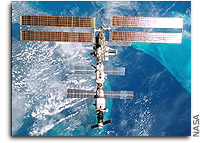
All ISS systems continue to function nominally, except as noted previously or below. Ahead: Week 3 for Expedition 6.
Onboard the station, it was another typical Sunday: off-duty except for a few scheduled tasks.
FE-2/SO Don Pettit completed the regular daily routine maintenance of the SM environment control and life support system (SOSh), while FE-1 Nikolai Budarin took the weekly data readings of the SVO water supply and SP toilet flush counters for calldown to MCC-Moscow via S-band.
CDR Kenneth Bowersox and Pettit had their regular weekly PFCs (private family conferences) via Ku- and S-band.
During XPOP momentum management attitude mode, the S-band and Ku-band antennas trend to higher operating temperatures. Unplanned parking of either antenna may be required to cool these systems at which time communications will be lost. Should this be required, the crew will be notified ahead of time.
For tomorrow’s planned geophysical Russian GFI-1″Relaxatsyia” experiment, MCC-Houston will uplink commands to maneuver so the Relaksatsiya equipment can target the Moon through window #9 in the Service Module (by the VELO cycle) and then the station will be put in attitude hold during the test. Afterward, MCC-H will maneuver back to XPOP TEA (torque equilibrium attitude) and go back to momentum management. [Relaksatsiya deals with the study of the chemoluminescent chemical reactions and atmospheric light phenomena that occur during high-velocity interaction between the exhaust products from space vehicles and the atmosphere at orbital altitude and during the entry of space vehicles into the Earth’s upper atmosphere. Tomorrow’s experiment will use the (known) spectra of the Moon for payload calibration.]
For the first ten hours of the ZCG (Zeolite crystal growth) experiment next week, the ground is concerned about large disturbances in microgravity such as reboosts, docking /undocking, etc. ARIS (active rack isolation system) will be in active isolation to dampen smaller disturbances like crew exercising.
Day/night cycle for the ISS continues from 1:00am to 4:30pm EST. Next week’s (12/18) Kurs ring test on Service Module (SM) Kurs-P (passive) and Soyuz Kurs-A (active) while going through Russian ground site comm passes will require very early wake-up by the crew, viz., 9:50pm EST on Tuesday night, 12/17.
The crew completed their regular daily physical exercise program.
Science Update (Expedition Six — 2nd):
Extra-Vehicular Activity Radiation Monitors (EVARM): The STS-113 EVA data were sent down this week and are being evaluated by the PI. This completes the EVA related data collection for EVARM, however monthly background radiation readings will continue through the end of Increment 6.
GASMAP/Pulmonary Function in Flight (PuFF): PuFF is awaiting next week’s pre- and post-EVA sessions. Staff will be on console both days if any questions arise.
Renal (Kidney) Stone Experiment: Investigators hope that the first renal stone sample collections went well and are looking forward to getting the BCR (barcode reader) data from the crew’s diet and sample logging
Human Research Facility/Workstation (HRF WS): The crew was thanked for the work they put in on the HRF Rack and Workstation. This effort will help set the stage for a truly successful science mission.
Foot Experiment: Now that the Workstation checkouts are complete, ground and crew are ready to “rock” with Foot.
Solidification Using a Baffle in Sealed Ampoules (SUBSA): Complete. To be returned at next opportunity.
Pore Formation and Mobility Investigation (PFMI): Complete for Inc. 5. On hold pending further MSG problem resolution. Will remain in MSG until further notice.
Space Acceleration Measurement System (SAMS): SAMS continues to collect acceleration data for vibratory characterization of the microgravity environment.
Microgravity Acceleration Measurement System (MAMS): MAMS continues measurement of microgravity environment in the quasi -steady regime for general characterization.
Protein Crystal Growth-Single Locker Thermal Enclosure System (PCG-STES): PCG STES temperatures are nominal.
Materials ISS Experiment (MISSE): In progress. Deployed outside. Nominal and collecting data.
Zeolite Crystal Growth (ZCG): Samples returned on 11A. New experiments planned.
Crew Earth Observation (CEO): The ground has received the first major download of imagery since the eclipse photos last week and these did include a number of requested targets. There are a few targets which will probably be removed from the list for a while, e.g. Toshka, because the ground already has great images for this time of year. It may reappear on the list as the seasons change. We also received the first imagery of the Patagonian glaciers since the spring started there.
Today’s targets for the CEO (crew earth observations program) were Yamuna inland delta, N India (a continuous series of inland deltas has formed along the southern flanks of the Himalaya Mts. The largest in the group [possibly the largest on the planet!] is formed by the Yamuna River, may reach 800 km, almost to the Pakistani coast. View of the apex portion of this inland delta is requested–look right of track. Crew was to center the view on New Delhi, which lies on the Yamuna River [visual cue: today the Yamuna describes a great curve on the plains, becoming the western headwater of the Ganges]), Angolan Biomass Burning (oblique views left and right of track. The savanna forest immediately south of the rainforest is the most flammable part of the planet), Inland deltas, SE Sudan (excellent pass over this poorly mapped and geologically poorly understood region, stretching along the western foot of the Ethiopian plateau. Nadir and near-nadir views both sides of track are requested, in a detailed mapping swath, for a global study in progress), Mt Cameroon, Cameroon (this volcanic edifice [at 13,435 feet, the highest point in West and Central Africa], on the coastline, lies about 2 degrees right of track. Weather remains as clear as it gets), Tunis, Tunisia (nadir pass; ESC [electronic still camera], Eastern Mediterranean Aerosol (high atmospheric pressure should generate visible smog in the relatively enclosed Adriatic Sea between Italy and Yugoslavia. Smog derives from northern Italy‚s industry in the Po Valley [one of Europe‚s strongest source regions for smog]. Left of track), Costa Rica cloud patterns (cloud patterns related to the very high mountains of Costa Rica are beginning to be understood. Various dynamics operate, including cold air drainage off the high mountains, and reverse flow from the Pacific [as a rotor on the west, downwind, side]), Albuquerque, New Mexico (nadir pass; ESC), and Melbourne, Australia (nadir pass; ESC.).



