
ISS On-Orbit Status 14 Sep 2002
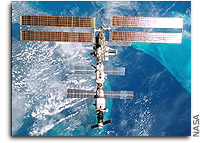 All ISS systems continue to function nominally, except as noted previously or below. The crew awoke to hearty congratulations for having completed 100 days on orbit (yesterday afternoon at 5:23pm EDT, i.e., launch time of STS-111 on 6/5).
It’s weekend, and today was a day of R&R (rest and relaxation) for the crew…almost.
After breakfast (2:40 am EDT), the station residents worked their way through the regular weekly housecleaning, with three hours set aside for it. Running under the heading of Bioenvironmental Surveillance, the extensive cleanup, nominally every Saturday, focuses on removal of food waste products, periodic cleaning of compartments with vacuum cleaner, and wet cleaning of surfaces.
Much of the rest of the day was taken up by physical exercise, the full 2.5-hr daily regimen for each crewmember,- one hour aerobic and 1.5 hr anaerobic. Use of the TVIS (treadmill with vibration isolation and stabilization) continues to be limited to passive mode only (i.e., tread not motor-driven), at speeds not exceeding 6 mph, and tied down with the SPDs (subject positioning devices).
The daily routine maintenance of the Service Module life support systems (SOSh) was completed by CDR Valery Korzun, while FE-1 Peggy Whitson did the payload status checkup in the Lab.
The crew was uplinked a list of questions regarding the IMS (inventory management system). MCC-Moscow is in the process of putting together the next version of the IMS software and training the Expedition 6 crew to operate it. The questionnaire solicits the current crew’s inputs on IMS system performance and operations.
On the Russian task list, Korzun and FE-2 Sergei Treschev today had ocean observations of the Diatomeya program, looking for bioproductive areas (color-contrast blooms, TsKO) in the world’s ocean. Targets were in the Indian and Atlantic Oceans (around Madagascar, northern front of the West Wind Drift and the Brazilian Current).
In the Russian Uragan (hurricane) earth observation program, Korzun focused his electronic still camera with 100 mm focal length lens on floating glaciers in the waters of the Southern Ocean between 56 and 48 deg S latitude.
Science Update (Expedition Five — 13th):
Lead Increment Scientist Vic Cooley to crew: “Thanks for the ADVASC photos, Interactions, PuFF, EVARM, SUBSA, and the SUBSA/PFMI transition. Next week we will run a PFMI test run on Tuesday, and then a science run on Thursday. The PFMI ampoule packaging is not expected to be as troublesome as it was for SUBSA. We expect to complete five PFMI samples prior to the Belgian Taxi Flight. It turns out that the increment extension and the SUBSA delays have cancelled out each other — completing five PFMI samples on Expedition 5 is where we planned to be at the end of the Increment. You’re doing a great job!”
Extra-Vehicular Activity Radiation Monitors (EVARM): There are two more weekly badge readings planned before the 9A docking and two “dailies” planned immediately prior to the EVA.
GASMAP/Pulmonary Function in Flight (PuFF): Next PuFF session will be in early October.
Renal (Kidney) Stone Experiment: In progress.
Interactions (NTXN): Continuing.
Human Research Facility/Workstation (HRF WS): n/a
Commercial Refrigerator Incubator Module-Commercial Stelsys (STELSYS): Experiment is complete and samples are stowed in frozen state in ARCTIC-1. “Waiting for a ride home”.
Microencapsulation Electrostatic Processing (MEPS): Complete. To be returned on 9A.
Advanced Astroculture (ADVASC): ADVASC continues to operate nominally. Based on the pictures taken by the crew on 9/7, the ADVASC team has determined that the seed pods are mature enough to start the dry down and preservation period. This process will begin on Monday (916) with the first ADVASC fluid removal activity and some ground commanding to start drying out the growth chamber.
Solidification Using a Baffle in Sealed Ampoules (SUBSA): SUBSA operations have been completed with eight successful samples runs. The crew was thanked for all their perseverance and patience. “Without your extra efforts, we wouldn’t have been able to get the additional science obtained after the SUBSA-07 anomaly”.
Pore Formation and Mobility Investigation (PFMI): The PFMI team will conduct a test run on 9/17 prior to conducting their first science run on 9/19. This test run is to check out translation systems and camera functions. PFMI is a video-intensive experiment, and the ground will be downlinking video after each run in order to allow the GI (Glovebox Investigator) to review the data and make science decisions for the next run.
Space Acceleration Measurement System (SAMS): SAMS is nominal. All sensors were active during the reboost and thruster tests.
Microgravity Acceleration Measurement System (MAMS): MAMS is nominal. The recent micro-G disturbances due to the reboost and thruster tests were captured with the OSS sensor.
Active Rack Isolation System (ARIS) Support: n/a
Protein Crystal Growth-Single Locker Thermal Enclosure System (PCG-STES): PCG STES-008 continues with nominal temperatures, checked every day by the crew.
Materials ISS Experiment (MISSE): In progress. Deployed outside. Nominal and collecting data.
Educational Payload Operations (EPO-5): Completed.
EarthKAM: Planned. Will be performed during Stage 9A.
Zeolite Crystal Growth (ZCG): POC (Payload Operations Center) is currently preparing to operate the next set of samples during the 9A stage.
ARCTIC Refrigerator/Freezer 1 (ARCTIC-1): (-19.6 degC) Supporting Stelsys samples. PD reported a 1.5 C rise in temp. There is no concern at this time, but an investigation into possible causes is going on.
ARCTIC Refrigerator/Freezer 2 (ARCTIC-2): Nominal, supporting ZCG sample autoclaves (+5.0 degC).
Commercial Generic Bioprocessing Apparatus (CGBA): Will be performed during Stage 9A.
Crew Earth Observations (CEO): The quality of recent photos has been exceptionally good. Today’s (optional) targets of the U.S. CEO program were L. Nasser, Toshka Lakes, Egypt (Aswan dam wall nadir or just left of track. Crew was to look right to assess filling Toshka lakes), Angolan Biomass Burning (high pressure system dominating southern Africa. Crew to shoot oblique views left to document haze), Industrialized SE Africa (high pressure system dominating southern Africa. Of interest: oblique views left and right to document smoke and industrial haze, and looking left to document whether the high 9,000 foot-plus mountains [of the small kingdom of Lesotho] rise above the polluted near-surface layer), Haze, tropical storm, southern United States (Dynamic events. Severest haze event of this summer affecting Houston. Crew was to look half right of track for oblique views necessary to document this event. Haze may derive locally in Texas or from further afield in the Ohio River valley. Haze is being transported offshore of SE Texas around the west side of Tropical Storm Hanna [now S of the Mississippi delta]. ISS track passed near the center of this well structured and well defined storm), and Buenos Aires, Argentina (one third of Argentina’s 40 million population lives in greater Buenos Aires. Crew to look slightly left to document one of South America’s largest urban regions–on the S side of the River Plate estuary. Crew was to try to get city margins in one or two views).
ISS Orbit (as of this afternoon, 1:27pm EDT [= epoch]):
- Mean altitude — 390.0 km
- Apogee — 402.5 km
- Perigee — 377.5 km
- Period — 92.3 min.
- Inclination (to Equator) — 51.64 deg
- Eccentricity — 0.0018404
- Orbits per 24-hr. day — 15.59
- Altitude decrease — 220 m (mean) in last 24 hours
- Revolutions since FGB/Zarya launch (Nov. ‚98) — 21799
- Current Flight Attitude — LVLH (local vertical/local horizontal = “earth-fixed”: z-axis in local vertical, x-axis in velocity vector [yaw: -10 deg, pitch: -7.8 deg, roll: 0 deg]). Transition from LVLH (Russian: OSK) back to XPOP (Russian: RSO) will be on 9/20.
For more on ISS orbit and worldwide naked-eye visibility dates/times, see
http://www.hq.nasa.gov/osf/station/viewing/issvis.html



