ISS On-Orbit Status 10 May 2003
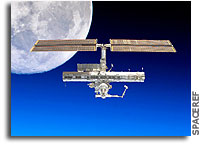
All ISS systems continue to function nominally, except as noted previously or below. It is a rest day for the crew, with a few mandatory maintenance and optional “job jar” tasks thrown in.
As on every Saturday (generally), the ISS residents performed the 3-hr. “uborka” (house cleaning), which includes wiping surfaces with disinfectants and cleaning of all fan screens.
CDR Yuri Malenchenko completed the regular daily inspection of the BIO-5 “Rasteniya-2/Lada-3” (Plants-2) zero-G plant growth experiment. [Using the digital camera (Kodak 760 or Nikon D1). he also took pictures of the entire plant crop in the “Lada” greenhouse and of the pods growing on the acacia-leaf pea plants for transmittal to the ground, and discussed the session with a ground specialist via S-band.]
Malenchenko performed the daily routine maintenance/inspection of SOZh life support systems (incl. ASU toilet facility, KRP food containers, EDV water containers and KTO solid waste containers), while FE/SO Edward Lu prepared the daily IMS (inventory management system) delta file for automatic export/import to update the database.
Yuri conferred with a ground expert at MCC-M/TsUP to discuss today’s session with the Russian Diatomeya world ocean aquatoria investigation program. Main target area on the Russian task list for today was the Atlantic Ocean. The accumulated pictures will be prepared for downlink after tomorrow’s session.
Also working from the Russian discretionary task list, Malenchenko conducted today’s session of the Russian Uragan (“hurricane”) earth imaging program (GFI-8) which currently concentrates on educational imagery of selected geographical targets. [Suggested targets were the Canary Islands, tracks across West and South Africa, the Western seaboard of the US with California and W. Mexico, a panorama of the Andes, and Argentinean plains.]
Ed Lu’s swap-out of two Flexpack canisters and change-out of their pulley cables on the RED (resistive exercise device) yesterday was successful, earning words of commendation from the ground this morning.
Lu and Malenchenko completed their daily physical exercise program, on TVIS, RED, CEVIS and, for Yuri, on the Russian VELO ergometer with load trainer.
The crew had their regular weekly conferences with the MCC-H Crew Office and ISS Program Management, via S-band/audio.
Tomorrow (5/11) ISS attitude will transition to XPOP (x-axis perpendicular to orbit plane), until 5/18 when the transition to YVV/”Barbecue” attitude occurs. [The maneuver will commence with handover to Russian MCS (motion control system) thrusters at 12:05pm EDT, followed by the turn at 12:18-12:33pm, and return to US/CMGs at 12:45pm. While in inertial XPOP (solar arrays always facing the Sun), the Lab window will be within plus/minus five degrees of the velocity vector for almost half the orbit. Flight rules dictate that the window remains shuttered during this time to reduce the risk of MMOD (micrometeoroid/orbital debris) damage.]
For about 14 hours starting this morning at 7:00am EDT, MCC-H is undergoing Static Transfer Switch modifications which render some ground equipment and flight consoles unavailable. Alternate workstations and workarounds have been defined where required.
Weekly Science Update (Expedition Seven — 1st):
The new crew was thanked for their successful operation of the EarthKAM payload during mated operations. 1832 images of student selected Earth features were downlinked and distributed to students at 26 schools. MSG (Microgravity Science Glovebox) operations with InSPACE will begin on 5/19 (ISS- 7 Week 3). A conference with the crew is being planned to review the revised increment science plan, date TBD.
GASMAP: First 30 Day Health Check scheduled in Week 3.
Human Research Facility/Workstation (HRF WS): Continuing.
Pore Formation and Mobility Investigation (PFMI): The ground team is excited about upcoming operations in Increment 7.
Space Acceleration Measurement System (SAMS): SAMS is nominal and currently analyzing data in support of general characterization efforts toward tracking down numerous unknown disturbance sources. The SAMS system collects data for both science and structural analysis. The fundamental frequency of the ISS changes (lowers) during docking and when new modules are added.
Microgravity Acceleration Measurement System (MAMS): MAMS is nominal and currently analyzing data in support of general characterization efforts toward tracking down numerous unknown disturbance sources. MAMS collects data for both science and structural analysis. The fundamental frequency of the ISS changes (lowers) during docking and when new modules are added.
Protein Crystal Growth-Single Locker Thermal Enclosure System (PCG-STES): Temperatures are nominal. Crystals are still growing. Requires only regular status check by the crew, including cleaning the filters.
Investigating the Structure of Paramagnetic Aggregates from Colloidal Emulsions (InSPACE): The InSPACE test runs are scheduled to resume on 5/19. The test points are being planned and will initially continue with the Coil Assembly that is currently installed (CA005 – 0.4 micron sized particles). Tests are also being planned with two additional Coil Assemblies (CA006 0.6 micron sized particles and CA004 or CA001 0.31 micron sized particles). Investigators are all looking forward to working with the crew and completing the experiment.
Materials ISS Experiment (MISSE): In progress. Deployed outside. Nominal and collecting data.
Earth Knowledge Acquired by Middle School Students (EarthKAM): EarthKAM has a two-pronged approach to upcoming operations in July: Students participating in summer school will select images for downlink, and teachers will also participate in educator seminars this summer. EarthKAM welcomes Expedition 7 to ISS ops and looks forward to work with the crew.
Coarsening in Solid-Liquid Mixtures-2 (CSLM-2): The CSLM-2 team is looking forward to working with Dr. Lu in the mid-July timeframe. The anticipated return of engineering verification data will aid in planning for science runs on later expeditions.
Educational Payload Operations (EPO): First EPO activity will be scheduled later this month. The team is “really excited” about EPO planned for Expedition 7 and looks forward to working with Ed Lu and Yuri Malenchenko.
EarthKAM (EK): Setup for next operation is tomorrow, 4/6, in the SM. Over 70 schools will participate in this session.
Crew Earth Observations (CEO): Today’s CEO targets, including cities during daylight and at night (again available as targets in the current LVLH attitude) were Lisbon, Portugal (nadir pass), Industrialized SE Africa (looking left for evidence of aerosols. Industrial South Africa is one of the biggest generators of aerosol in the southern hemisphere), Tornado damage, Oklahoma (Dynamic event. Looking left for swaths of damage of the most recent deadly family of tornados), Havana, Cuba (looking left, on the north coast of Cuba), Los Angeles, California (nadir and a touch left), Buenos Aires, Argentina (nadir pass over this city of 13 million, fully 30% of Argentina’s population. Also trying for glint views of the lower Parana River where very severe floods have occurred), Patagonian Glaciers (opportunity for low sun-angle panoramas of the southern Andes ranges, as lighting conditions improve at the bottom of the orbit), Jarvis Island, Central Pacific (this 2-mile-long island is located on the equator. Crew was asked to capture detail of the reef that completely surrounds this atoll. The settlement of Millersville is “usually uninhabited” [CIA Factbook]), Phoenix, AZ (city at night; good pass just west of the metro area), and Taipeh, Taiwan (Taipeh and the string of cities along the west coast, all to the right of track).
http://eol.jsc.nasa.gov and
http://earthobservatory.nasa.gov
ISS Orbit (as of this morning, 7:51am EDT [= epoch]):
- Mean altitude — 390.0 km
- Apogee — 394.3 km
- Perigee — 385.8 km
- Period — 92.36 min.
- Inclination (to Equator) — 51.63 deg
- Eccentricity — 0.0006334
- Orbits per 24-hr. day — 15.59
- Mean altitude loss in last 24 hours — 85 m
- Revolutions since FGB/Zarya launch (Nov. ’98) — 25512
- For more on ISS orbit and worldwide naked-eye visibility dates/times, see
- http://www.hq.nasa.gov/osf/station/viewing/issvis.html