
ISS On-Orbit Status 1 Dec 2002
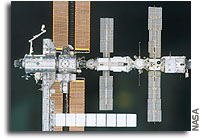 All ISS systems continue to function nominally, except as noted previously or below. FD 9 for 11A.
After yesterday’s EVA-3, the docked phase is now approaching its end. The Shuttle crew had half a day off today, and the ISS crew was given a relatively light-duty schedule.
Thanks to MCC-H’s great job of spacewalk replanning in real time, caused by the MT’s (mobile transporter) translation along the tracks being obstructed by the undeployed P1 UHF (ultra-high frequency) antenna), EVA-3 accomplished all objectives. In addition, one radiator beam launch lock (of eight total released) was verified with a pull test to be not loose, as it appeared to be; also, the P1 radiator beam SFU (squib firing unit) was reconfigured, the P1 UHF antenna was deployed, and a DDCU (dc-to-dc converter unit) thermal cover was installed. In the course of the three 11A spacewalks, a total of 43 SPDs (spool positioning devices) were installed on ammonia QDs (quick disconnects) in order to prevent potential lockup of the double-seal QDs on future assembly missions.
The MT was moved last night to WS7 (worksite 7) at the end of P1. It is latched down in good configuration, and the MBS (mobile base system) is on Keep Alive power. [Overnight the ground cleaned up some hardware settings on the MT to get it ready for a move back to WS4, the preferred parking location as it minimizes TUS (trailing umbilical system) cable exposure to MMOD (micrometeoroid/orbital debris). Current thinking is that the MT move will be performed the morning of the Stage EVA in mid-December. The UHF antenna sustained a
The final reboost was performed at 11:38am EST and completed nominally after 45 min. Reboost-3 yielded 4.5 km (2.8 s.mi.) in altitude increase, bringing total altitude gain of the three 11A reboost burns to 10.2 km (6.4 s.mi.). The reboosts depleted Shuttle maneuvering propellant margins down to zero (with end-of-mission (EOM) plus four days protected).
Mike Lopez-Alegria, Ken Bowersox and Nikolai Budarin completed the necessary resizing of EMU/spacesuits for the upcoming Stage EVA in mid-December (on or about 12/12). [The spacewalk will be conducted by Bowersox and Budarin for some additional tasks associated with the P1 installation, and it will be the first time that a Russian cosmonaut performs an EVA in an American EMU (extravehicular mobility unit), not in an Orlan-M.]
Expedition 6 FE-2/SO Don Pettit reconfigured the O2 pre-breathing equipment in the Shuttle, now no longer needed.
Expedition 5 FE-1/SO Peggy Whitson and Pettit had two hours reserved on their timeline for additional troubleshooting on the MSG (microgravity science glovebox), which resulted in the decision to return the failed hardware to Earth. The data on continuity and resistances upstream and downstream from the failed PDC (power distribution controller) was unable to show the failure source which caused the MSG’s internal ESEM3 circuit breaker to trip. The additional work was considered well worth the effort since the MSG would have supported 30-40 percent of the science activities planned for Increment 6. [Today’s work was to reinstall the PDC (power distribution controller), until Pettit discovered damaged cabling. The original plan was for the ground to close the associated RPC (remote power controller) to provide power the MSG for one last test of the ESEM3. The discovery of damaged cabling aborted this plan.]
Procedures were uplinked for Peggy Whitson’s PFE (physical fitness evaluation) for configuring the required biomedical equipment on the CEVIS cycle for troubleshooting purposes in manual mode. She was assisted by Don Pettit. [The task included setting up the blood pressure/electrocardiograph (BP/ECG) hardware, connected to the MEC (medical equipment computer) and CheCS (crew health care systems) outlet, configuring ECG software, setting up the CEVIS, placing five skin electrodes, and performing the test workout under manual control of the workload.]
Pettit conducted a post-spacewalk EVARM (EVA radiation monitoring) session, first powering up the EVARM badge reader at about 11:10am EST, and later taking background dosage readings from the twelve badges used in yesterday’s spacewalk. With the return of these data to Earth, EVARM will be complete on ISS.
Nikolai Budarin took readings of the SP toilet flush and SVO water supply counters for calldown to MCC-M.
Budarin also completed the daily routine task of SOSh life support systems maintenance in the SM, while Peggy Whitson conducted two status checkups of the Shuttle middeck payloads, and Bowersox did the daily Lab payload status inspection.
Cargo transfers to the US segment continued today. All payload transfers have been completed, including the Russian/European COSMIC and GCF-B (Granada Crystallization Facility B) payloads. Specialists reviewed the installation of the PGBA (plant generic bioprocessing apparatus) on the payload mounting plate in the Orbiter middeck, where only six of eight bolts could be inserted, and determined that it was safe for landing. No additional action was taken.
There are no plans for O2 (oxygen) or N2 (nitrogen)( transfers from the Shuttle to the ISS HPGT (high-pressure gas tank) storage.
Besides COSMIC, GCF-B and air/surface samples, Russian hardware prioritized for return on STS-113 include DVCAM digital video cassettes, Betacam cassettes, and a VP1-1 fuse from the Vozdukh system.
The second of two scheduled Metox (metal oxide) canister regenerations was initiated following EVA-3, with a peak ppCO2 (partial pressure of CO2) reading of approx 6.5 mmHg in the Joint Airlock.
FE-1 Nikolai Budarin was scheduled to conduct surface sampling in the FGB for microbial analysis from behind selected wall panels. The test tube kit was to be stowed in the Shuttle for return.
CDRA (carbon dioxide removal assembly) continues to operate nominally, having completed 31+ half cycles by this morning.
Troubleshooting data from the failed Shuttle-to-ISS hardline intercom (ICOM-A) or DAIU (docked audio interface unit) are currently being analyzed. The docked air-to-ground 1 (A/G1) channel from ISS to Orbiter, which functioned intermittently, is now working fine.
ISS and Shuttle crewmembers, particularly John Herrington, a member of the Chickasaw Indian nation, participated in a live televised interview exchange with two media stations, viz., Indian Country Today, and Native America Calling Radio Network. A planned connection with CNN Espanol could not be established.
Endeavour’s undocking is scheduled for tomorrow at 3:05pm EST, with all 11A mission objectives accomplished. The undock maneuver will be preceded by hatch closure at about 12:30pm and feathering of SM and FGB solar arrays at 2:34-2:35pm. The undocking is followed by a “Vbar” separation (i.e., in the direction of ISS flight), with a



