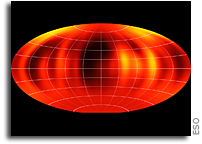
A global cloud map of the nearest known brown dwarf
Brown dwarfs — substellar bodies more massive than planets but not massive enough to initiate the sustained hydrogen fusion that powers self-luminous stars — are born hot and slowly cool as they age. As they cool below about 2,300 K, liquid or crystalline particles composed of calcium aluminates, silicates and iron condense into atmospheric ‘dust’, which disappears at still cooler temperatures (around 1,300 K).
Models to explain this dust dispersal include both an abrupt sinking of the entire cloud deck into the deep, unob- servable atmosphere and breakup of the cloud into scattered patches (as seen on Jupiter and Saturn). Thus far, observations of brown dwarfs have been limited to globally integrated measurements, which can reveal surface inhomogeneities but cannot unambiguously resolve surface features.
Here we report a two-dimensional map of a brown dwarf’s surface that allows identification of large-scale bright and dark features, indicative of patchy clouds.
I. J. M. Crossfield, B. Biller, J. E. Schlieder, N. R. Deacon, M. Bonnefoy, D. Homeier, F. Allard, E. Buenzli, Th. Henning, W. Brandner, B. Goldman, T. Kopytova (Submitted on 31 Jan 2014)
Comments: 17 pages, 8 figures. Spectra and map available upon request
Subjects: Earth and Planetary Astrophysics (astro-ph.EP); Instrumentation and Methods for Astrophysics (astro-ph.IM); Solar and Stellar Astrophysics (astro-ph.SR) Journal reference: Nature 2014, 505, 654-656 DOI: 10.1038/nature12955
Cite as: arXiv:1401.8145 [astro-ph.EP] (or arXiv:1401.8145v1 [astro-ph.EP] for this version)
Submission history From: Ian Crossfield [view email] [v1] Fri, 31 Jan 2014 11:57:51 GMT (1450kb)
X