
ISS On-orbit Status 20 Dec 2002
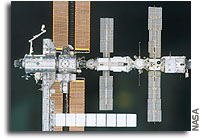
All ISS systems continue to function nominally, except as noted previously or below.
After wake-up at the normal 1:00am EST, the crew received thanks for their great work yesterday on the SSRMS (space station remote manipulator system) and on PAO’s Christmas message (today on NASA News television).
Robotics ops yesterday went very well. All the outstanding OOCRs (on-orbit checkout requirements) for SSRMSgrapples while collecting FMS (force moment sensor) data have now been accomplished. Some small software quirks remain puzzling, but work is underway to get explanations. [“Flying the SSRMS is like driving a big fancy backhoe” Anonymous Spacefarer.]
CDR Ken Bowersox and FE-2/SO Don Pettit worked on the Lab IATCS (internal active thermal control system), preparing for and performing routine coolant fills of the IATCS and spare Gas Trap. [Due to the frequent sampling of the ITCS loops for coolant composition monitoring, accumulator levels in the LTL and MTL (low temperature loop, moderate temperature loop) decrease over time. To insure that the accumulators maintain a relatively nominal reserve of fluid, the crew periodically performs an ITCS resupply activity using the FSS (fluid system servicer). This resupply activity consists of setting up the FSS and using the PWRs (payload water reservoirs) that contain the ITCS coolant. Crew and ground monitor the accumulator quantity level and terminate the fill when the quantity reads approximately 75%. Today’s activity resupplied both the LTL and the MTL. Prior to the ITCS resupply, the spare Gas Trap was also filled proactively, because ground engineers have been trending the pressure difference (dP) across the MTL Gas Trap and are predicting that this ORU (orbit replaceable unit) will reach its dP limit at some point during Increment 6. Today’s fill readied the spare Gas Trap for an R&R if/when needed.]
Troubleshooting instructions for the SSC4 (station support computer #4) were uplinked to Bowersox who had inquired about the laptop’s slow performance.
FE-1 Nikolai Budarin worked in the FGB, removing the failed battery #4 and replacing it with a new type A-800 accumulator unit, discarding the old battery.
After yesterday’s successful replacement of the SKV-K2M condensate pump (HOK), Budarin today took hydraulic resistance measurements in the gas/liquid line and tagged up with a ground specialist via S-band.
Don Pettit transferred storage files with exercise data from the exercise equipment to the MEC (medical equipment computer) via PCMCIA cards (personal computer memory card international association) for subsequent downlink to Earth. Later, Don also transferred the stored results of the recent on-board microbial analyses to the MEC.
Bowersox continued monitoring the ZCG (Zeolite crystal growth) payload in operation. He also performed the daily routine status check of Lab payloads, while Budarin completed the daily SOSh life support systems maintenance and prepared the IMS inventory update file for downlink.
Sox and Don readied the new HCOR (high rate communications outage recorder) hardware for its installation in the Lab’s AV3 (avionics #3) rack.
All crewmembers completed their daily physical exercise regimen.
The current XPOP flight attitude will be maintained until Monday (12/23), then moded to YVV/”barbecue” at about 1:47am EST to protect Progress batteries from overheating.
Today’s targets for the CEO (crew earth observations program) were West Africa (unusually cloudfree. Crew was to try for near-nadir views of the coast both sides of track. About 2 min later, they were to attempt oblique shots to illustrate the grand vegetation line between the greener coastal forests and the drier inland savannasfor educational views of the planet), Sao Paulo, Brazil (nadir pass over this vast city of ~22 million. Crew was asked to try getting the entire city in one or two views with the ESC [electronic still camera]), Dakar, Senegal (nadir pass; ESC), Andes landscapes, N Chile (ideal pass for mapping strip just left of nadir, of the entire long western slope of the Andeswhich includes various datable land surfaces and a landslide site. The swath includes one of the largest copper mines in the world: the Chuquicamata open pit is a primary visual cue with shots requested on either side [overlapping views for stereoscopic analysis would be very useful]. Land surface mapping, with soil dating on these surfaces, will assist in determining the age of the Atacama Desert), Caracas, Venezuela (nadir pass over this troubled city; ESC), Papua New Guinea (crew to shoot a continuous swath across this large islandwhich is almost never seen due to persistent equatorial cloud), Rock structures, central Libya (another opportunity to capture structures in oil-rich rock layers–look left 1-2 degrees off track. Views of this remote region from low Earth orbit may reveal margins of ancient infilled glacial valleys, primary conduits for oil exploration), Central France pass (the first clear weather for many weeks–from Bordeaux in the SW to Strasbourg in the eastern tip of France), and St Lawrence pass, NE America (first opportunity in many weeks with clear weather and enough light. Pass tracked along the axis of the waterway from Lake Erie to Newfoundland).
CEO images can be viewed at the website http://eol.jsc.nasa.gov
U.S. and Russian Segment Status (as of yesterday).
Environmental Control and Life Support (ECLSS) and Thermal Control (TCS):
- Elektron O2 generator is powered On (32 Amp mode). Vozdukh CO2 scrubber is On. U.S. CDRA CO2 scrubber is Off. TCCS is operational. BMP Harmful Impurities unit: Absorbent bed #1 in Purify mode, bed #2 in Purify mode.
Propulsion System (PS):
- Total propellant load available (SM + FGB + Progress) — 3781 kg (8335 lb) [as of 12/19/02].
Electrical Power Systems (EPS):
- Both P6 channels fully operational. Beta Gimbal Assembly (BGA) 2B and BGA 4B both in Autotrack (sun-tracking) mode.
- SM batteries: Battery #2 in “Cycle” mode. Batteries #5 and 7 disconnected (suspected failed) All other batteries (5) are in “Partial Charge”: mode.
- FGB batteries: Batteries #4 was replaced today; all other batteries (5) are in “Partial Charge” mode.
- Plasma Contactor Unit PCU-1 is in Standby; PCU-2 is in Standby.
Thermal Control Systems:
- Air conditioner SKV-1 is On, SKV-2 is Off.
Command & Data Handling Systems:
- C&C-1 MDM is prime, C&C-2 is back-up, and C&C-3 is in standby.
- GNC-1 MDM is prime; GNC-2 is Backup (new patches loaded on both).
- EXT-2 is On (primary), EXT-1 is off.
- LA-1, LA-2 and LA-3 MDMs are all operating.
- PL-1 MDM is On (primary); PL-2 MDM is off (diagnostic
- APS-1 (automated payload switch #1) and APS-2 are both On.
- SM Terminal Computer (TVM): 2 redundant lanes (of 3) operational. Lane 1 is down (as of 11/14).
- SM Central Computer (TsVM): 3 redundant lanes (of 3) operational.
Attitude Source:
- 3 CMGs on-line (CMG-1 failed).
- State vector — U.S. SIGI-1
- Attitude — U.S. SIGI-2
- Angular rates — U.S. RGA-1
Flight Attitude:
- XPOP 3-CMG Momentum Management (yaw/pitch/roll = 0.52/-8.81/-0.04 deg)
- Solar Beta Angle: -63.8 deg (magnitude increasing)
Communications & Tracking Systems:
- FGB MDM-1 is powered Off; FGB MDM-2 is operating.
- All other Russian communications & tracking systems are nominal.
- S-band is operating nominally.
- Ku-band is operating nominally (except for occasionally parking of antenna due to XPOP increasing thermal temperatures).
- Audio subsystem operating nominally.
- Video subsystem operating nominally.
- MCOR (medium-rate communications outage recorder) is operating nominally.
Robotics:
- SSRMS/Canadarm2 based at Lab PDGF with Keep Alive (KA) power on both strings.
- MBS: KA power on both strings. MT: latched and mated at WS7, with KA power. POA: KA power on both strings.
- RWS (robotics workstations): Lab RWS is Off; Cupola RWS is Off.



