ISS On-Orbit Status 27 Nov 2002
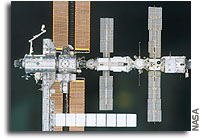 All ISS systems continue to function nominally, except as noted previously
or below. Week 25 and Day 175 in space for Expedition 5. Flight Day 5
for 11A/STS-114, and Week 1 for Expedition 6.
After wake-up at 8:20am (all times EST) for the ISS crew and 8:50am for
the Shuttle crew, the crewmembers received rave reviews for their outstanding
work yesterday "both inside and outside".
After its flawlessly conducted installation, the P1 truss was activated
last night with no issues. The successful activations included its two
MDMs (multiplexer/demultiplexer) computers P1-1 and P1-2.
EVA-1, begun yesterday at 2:49pm EST, was completed in an exceedingly
smooth performance by Mike Lopez-Alegria and John Herrington at 9:35pm,
after a duration of 6h 45 min. [All objectives were accomplished with
complete success and no issues: (1) power, data and fluid umbilicals between
the S0 and P1 trusses were connected; (2) 24 launch lock bolts on the
new CETA (crew and equipment translation aid) cart were released; (3)
six SPDs (spool positioning devices) were installed on ammonia line quick
disconnects (NH3 QDs); (4) two "drag links" (large metal launch
restraint rods) were removed; and (5) the first WETA (wireless video system
external transceiver assembly) was installed, which relays video imagery
from EVA helmet cameras (ERCAs) to the inside of the station and thence
to Earth without requiring the presence of a docked Shuttle, as before.
It was the 47th spacewalk of station construction (22 from the station
itself), dating back to December 1998. Total time for station spacewalks
is now at 292h 10 min.]
The planned activation/checkout of the WETA (wireless video system external
transceiver assembly), could not be performed, due to an unmated connector
in the Node’s "swing arm" between its forward end cone and the
S0 cable tray. The swing arm was deployed as a "get-ahead" task
on 8A, but the three connectors in the S0 tray, one of which (P652/J652)
provides video/sync-2 data, were not mated to the Node end cone. The missing
connections will most likely be finished tomorrow during EVA-2.
Other minor EVA items being attended to today in preparation for tomorrow’s
spacewalk include (1) non-working biomed instrumentation on both spacewalkers;
(2) one of the two light bulbs in EV1/Lopez-Alegria’s spacesuit helmet
requiring replacement.
The SSRMS/Canadarm2 "walk-off" to the Lab PDGF (power and data
grapple fixture) was successfully completed last night by Whitson, Bowersox
and Pettit. MBS (mobile base system) was released, and the arm is now
in the EVA-2 viewing position.
The ISS CEVIS (cycle ergometer with vibration isolation) was not used
during yesterday’s pre-breathe procedure for EVA-1, as reported last night.
During her test run yesterday morning, Peggy Whitson encountered periodic
transitions between protocol (automatic) mode and manual mode. Due to
the lengthened times required at each CEVIS load level (because of the
transitions back and forth from manual mode), the Shuttle bike/ergometer
was selected for the prebreathe protocol. As troubleshooting of the failed
microswitch of the ISS CEVIS continues, a procedure is being developed
to allow easier setting of workloads (Watts) by the crew in manual mode.
Whitson is scheduled to perform a checkout run of the procedure tomorrow.
Most of today’s crew schedules are taken up by handovers and transfer
operations. Walkthroughs and handover include the onboard laptops, which
the Expedition 5 crewmembers show and demonstrate to their replacements
for the various modes, applications and procedures, such as communications
on OCA and Regul-Packet, and the new integrated OpsLAN network. Logistics
transfer operations are proceeding well, having approximately reached
the halfway point.
The first of three reboosts was performed today at 12:10pm for 45 min.,
to increase mean ISS altitude by 4.5 km. Total altitude boost during 11A
is planned to be 10.5 km (5.7 n.mi.).
Expedition 5 CDR Valery Korzun and FE-2 Sergei Treschev had another exercise
session with the Russian MedOps MO-4 ODNT (lower body negative pressure,
LBNP) program, working out while wearing the "Chibis" suit.
The cosmonauts assisted each other as they took turns with the device.
Expedition 6 CDR Ken Bowersox performed his first payload activity on
board when he conducted the post-spacewalk EVARM (EVA radiation monitoring)
badge reading. After taking dose data from all 12 badges, Sox restowed
the four pouches in the EMU (extravehicular mobility unit) servicing kit
in preparation for EVA-2 tomorrow.
Expedition 6 FE-2 Don Pettit did the daily status checkup of the Shuttle
middeck payloads.
As he had done countless times before, Korzun completed the daily routine
task of SM life support system (SOSh) maintenance, while Sergei Treschev
prepared the IMS inventory delta file for downlinking, and Peggy Whitson
performed her routine status checkup of the autonomous Lab payloads (PCG-STES007,
CGBA, PGBA).
Jim Wetherbee, Paul Lockhart, Mike Lopez-Alegria, John Herrington and
Valery Korzun are scheduled tonight for a detailed procedures review of
tomorrow’s EVA-2. The spacewalk will begin at approximately 2:20pm EST
and last nominally 6:30h. Major tasks for EVA-2 are (1) installation of
two fluid jumpers (hoses) between the S0 and P1 trusses (for conducting
ammonia [NH3] between them); (2) installation of four SPDs (spool positioning
devices) on jumper connectors; (3) removal of the keel pin from the CETA
(crew and equipment translation aid) cart and stowage; (4) installation
of the second WETA assembly on the P1 (similar to the first WETA installed
yesterday on the Node); and (5) transfer of the CETA cart from the P1
truss to the S1, moving it around the MT (mobile transporter) on the S0
segment.
EVA-2 and -3 will be using recyclable Metox (metal oxide) canisters for
carbon dioxide (CO2) resorption. [Regarding the issue of Metox regeneration
in the Airlock (A/L) oven, both partner sides are in agreement that CO2
levels in the A/L after Metox regen must be less than 6 mmHg before crew
ingress, measured by both the TCCS (trace contaminant control subassembly)
and CSA-CP (compound specific analyzer-combustion products) simultaneously.
CDRA (carbon dioxide removal assembly) in the Lab is also planned to be
operating during this time.]
MCC-H uploaded new software patches to the EXT MDMs (external computers)
to account for the SSAS (segment-to-segment attach system) installation
of the P1 truss and MT ops PPL (prepositioned load) files. [In the process,
both EXT MDMs were swapped and reinitialized. The new backup EXT was brought
up and then powered off after the loads were completed.]
C&DH (command and data handling) software patches were also to be
uploaded to the P1 MDMs later tonight.
CDRA has become increasingly difficult to restart after shutdowns, due
to its recalcitrant ASV valves. Earlier today, it failed to restart altogether.
Spare ASV assemblies have been delivered by 11A, and R&R (removal
& replacement) is tentatively planned for later tonight.
VOA (volatile organics analyzer) shut itself down due to apparent fluctuation
in N2 (nitrogen) sensor readings. Flight controllers have verified that
N2 levels had remained constant.
Troubleshooting of the failed Shuttle-to-ISS hardline intercom (ICOM-A)
is planned for 11/29. Since this activity will require voice checks, some
crewtime may be required.
Microgravity Science Glovebox (MSG): Ground testing and data review continue
to better understand the situation associated with the failed PDC (power
distribution controller). The review, which also focuses on the possibility
of additional hardware impacted by the failure besides PDC, will determine
by tonight if the PDC is to be returned to Earth on 11A or is to remain
on board for in-space troubleshooting (which appears to be difficult).
If additional hardware is affected, it probably will require rotating
the MSG rack for equipment access and removal.
U.S. and Russian Segment Status (as of 3:15am EST).
Environmental Control and Life Support (ECLSS) and Thermal Control
(TCS):
Elektron O2 generator is powered On (32 Amp mode). Vozdukh CO2 scrubber
is On (manual mode 5, cycle time 10 min). U.S. CDRA CO2 scrubber is Off.
TCCS is operational. BMP Harmful Impurities unit: Absorbent bed #1 in
Purify mode, bed #2 in Purify mode.
SM Working Compartment: Pressure (mmHg) — 753; temperature (deg C) —
25.5; ppO2 (mmHg) — 140.7; ppCO2 (mmHg) — 2.5.
SM Transfer Compartment: Pressure (mmHg) — 756; temperature (deg C) —
20.0.
FGB Cabin: Pressure (mmHg) — 752; temperature (deg C) — 18.7.
Node: Pressure (mmHg) — 738.80; temperature (deg C) — 22.0 (shell);
ppO2 (mmHg) — 161.3; ppCO2 (mmHg) — 4.1.
U.S. Lab: Pressure (mmHg) — 737.53; temperature (deg C) — 24.5; ppO2
(mmHg) — n/a; ppCO2 (mmHg) — n/a;
Joint Airlock (Equip. Lock): Pressure (mmHg) — 739.87, temperature (deg
C) — 21.8; shell heater temp (deg C) — 21.8, ppO2 (mmHg) — 165.5; ppCO2
(mmHg) — 3.7.
PMA-1: Shell heater temp (deg C) — 23.5
PMA-2: Shell heater temp (deg C) — 20.9
(n/a = data not available)
Propulsion System (PS): Total propellant load available (SM + FGB + Progress)
— 3808 kg (8395 lb) [as of 11/21/02].
Electrical Power Systems (EPS):
Both P6 channels fully operational. Beta Gimbal Assembly (BGA) 2B and
BGA 4B both in dual-angle mode (directed position).
SM batteries: All batteries (8) are in "Partial Charge": mode.
FGB batteries: Batteries #4 is off line; battery #1 is in "Cycle"
mode; all other batteries (4) are in "Partial Charge" mode.
Plasma Contactor Unit PCU-1 in operating; PCU-2 is operating (supporting
EVA).
Thermal Control Systems:
Air conditioner SKV-1 is On; SKV-2 is Off.
Command & Data Handling Systems:
C&C-1 MDM is prime, C&C-2 is back-up, and C&C-3 is in standby.
GNC-1 MDM is prime; GNC-2 is Backup (new patches loaded on both).
EXT-2 is On (primary), EXT-1 is off.
LA-1, LA-2 and LA-3 MDMs are all operating.
PL-1 MDM is On (primary); PL-2 MDM is off (diagnostic
APS-1 (automated payload switch #1) and APS-2 are both On.
SM Terminal Computer (TVM): 2 redundant lanes (of 3) operational. Lane
1 is down.
SM Central Computer (TsVM): 3 redundant lanes (of 3) operational.
Attitude Source:
3 CMGs on-line.
State vector — U.S. SIGI-1
Attitude — Russian segment (RS)
Angular rates — U.S. RGA-1 (from RS attitude)
Communications & Tracking Systems:
FGB MDM-1 failed; FGB MDM-2 is operating.
All other Russian communications & tracking systems are nominal.
S-band is operating nominally.
Ku-band is operating nominally.
Audio subsystem operating nominally.
Video subsystem operating nominally.
MCOR (medium-rate communications outage recorder) is operating nominally.
Robotics:
SSRMS/Canadarm2 based at Lab PDGF in EVA-2 viewing position, with Keep
Alive power on both strings.
MBS: Keep Alive power on both strings. POA: Keep Alive power on both strings.
RWS (robotics workstations): Lab RWS is Off; Cupola RWS is Off.
For background on ISS orbit and worldwide naked-eye visibility dates/times,
see
http://www.hq.nasa.gov/osf/station/viewing/issvis.html