
ISS On-Orbit Status 16 Nov 2002
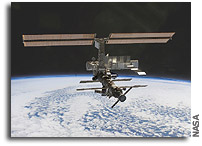 All ISS systems continue to function nominally, except as noted previously or below. Expedition 5 has a typical weekend Saturday, with sleep cycle kept shifted to 11:00am wakeup, 2:30am EST bedtime.
The crew is gaining several more days in space. Replacement of the OV-105/Endeavour GN2 (gaseous nitrogen) line along with the failed O2 flex hose (both having seen the same fatigue environment) appears to support an STS-113 launch attempt on 11/22 (Friday). Options are still being considered for the OV-105 RMS which has two small areas of delamination. If the P1 truss segment is to be transferred/installed with the SSRMS/Canadarm2 only, the RMS will be removed from the Orbiter. Schedule impact TBD. [For a launch on 11/22 evening, docking would be on Sunday, 11/24 (3:21pm EST), EVA-1,-2 and 3 on 11/26, 11/27 and 11/29, and undocking on 12/1 (3:37pm).]
The crew was thanked for “another great day” of robotic operations yesterday. During the P1 transfer dry run (assuming RMS use), the SSRMS performed as expected and is ready for 11A. After the dry run, the ground completed data collection on the SSRMS FMS (force moment sensor).
As normally on Saturdays, Valery Korzun, Peggy Whitson and Sergei Treschev are doing another weekly station cleanup. [The ?uborka? (house cleaning), classified as Bioenvironmental Surveillance, focuses on removal of food waste products, cleaning of compartments with vacuum cleaner, wet cleaning of surfaces with disinfectants and cleaning of fan screens to avoid temperature rises.]
FE-2 Treschev is scheduled for the regular daily maintenance of the SOSh life support system in the Service Module (SM).
POC (Payload Operations Center) uplinked thanks to Peggy Whitson for the video of the SAMS (space acceleration measurement system) and MAMS (microgravity acceleration measurement system) screen cleaning which Peggy performed on 11/14.
Peggy Whitson’s “Easter egg hunt” for missing dust caps of the ADVASC (advanced astroculture) payload, a task list item, was successful. The caps will be stowed for return on 11A.
Replanning of onboard research activities due to the 11A launch delay is underway. [As one of the big activities planned for Increment 6, installation of ARIS (active rack isolation system) into EXPRESS rack 3 (ER3), expected to take two crewmembers five hours, is now under consideration for 11/19 (Tuesday). There may also be more PuFF (pulmonary function in flight) activities on 11/20 (Wednesday). The PFMI (pore formation and mobility investigation) researchers received Peggy’s offer of conducting more runs and are considering all possibilities.]
As a new addition to the cosmonauts’ task list, CDR Korzun will conduct another session with the Uragan (“hurricane”) experiment today, using the LIV video camera to image panoramic scenes of ocean currents along the western and eastern coasts of South America (icebergs), tropical islands and atolls, and landscapes in Indonesia, Eastern Australia, and New Zealand.
For the Diatomeya program of observing and photo-imaging of color-contrasting formations of world oceans and cloud structures, Korzun will focus on Pacific Ocean tropical zone waters near the Coral Islands and reefs of Polynesia later tonight.
Science Update (Expedition Five — 22nd):
Lead Increment Scientist Vic Cooley to crew: “Thank you for tending to the EarthKAM set up and lens changes, SAMS and MAMS filter cleaning, EVARM reading, ARIS alignment guide removal, Interactions, and CEO. CEO and EarthKAM downlinks were excellent. Looking forward to having you back on the ground.”
Extra-Vehicular Activity Radiation Monitors (EVARM): Another pre-EVA reading will be scheduled for this week..
GASMAP/Pulmonary Function in Flight (PuFF): GASMAP is on standby. With the 11A launch delay, the crew may get another opportunity for a PuFF session.
Renal (Kidney) Stone Experiment: n/a
Interactions (NTXN): n/a
Human Research Facility/Workstation (HRF WS): n/a
Commercial Refrigerator Incubator Module-Commercial Stelsys (STELSYS): Returned on 9A.
Microencapsulation Electrostatic Processing (MEPS): Complete. Returned on 9A.
Advanced Astroculture (ADVASC): Complete. Returned on 9A.
Solidification Using a Baffle in Sealed Ampoules (SUBSA): Complete. Returned on 9A.
Pore Formation and Mobility Investigation (PFMI): Seven PFMI samples have been successfully processed during Increment 5. The remaining eight samples are to be processed during Increment 6.
Space Acceleration Measurement System (SAMS): SAMS is active after screen cleaning and continues to collect acceleration data for vibratory characterization of the microgravity environment.
Microgravity Acceleration Measurement System (MAMS): MAMS is active after screen cleaning and continuing measurement of microgravity environment in the quasi-steady regime for general characterization.
Active Rack Isolation System (ARIS) Support: The ARIS alignment guides are scheduled for installation on 11/25 in preparation for the ER2 (Express rack #2) power down for 11A joint ops.
Protein Crystal Growth-Single Locker Thermal Enclosure System (PCG-STES): Temperatures are stable. Team is looking forward to cylinder deactivation after 11A launch and before docking.
Materials ISS Experiment (MISSE): In progress. Deployed outside. Nominal and collecting data.
Educational Payload Operations (EPO-5): Completed.
EarthKAM (EK): The pictures using the 180mm lens, received on the ground, are clear and wonderfully detailed. Thirteen middle schools participated from across the U.S. and Japan. Many thanks were extended to the crew, as well as the Payload Ops and Mission Ops folks in Huntsville and Houston for making the EK mission a great success.
Zeolite Crystal Growth (ZCG): Samples stowed at ambient temp for return on 11A.
ARCTIC Refrigerator/Freezer 1 (ARCTIC-1): New drill bits will be coming up on 11A to help out with the trouble-shooting (stripped screw on access cover).
ARCTIC Refrigerator/Freezer 2 (ARCTIC-2): Pre-pack of the payload is in work for return on 11A.
Commercial Generic Bioprocessing Apparatus/Plant Generic Bioprocessing Apparatus (CGBA/PGBA): On 11/15, CGBA’s computer storage reached capacity and was generating messages to the display, as noticed by Peggy Whitson during her daily status checkup. The CGBA team will clean out old files so that there will bestorage room for newly archivedfiles. CGBA will likely not be returning on 11A to allow room for ARCTIC to be returned home. PGBA continues to operate nominally although no plants have been observed in downlinked images.Although a secondharvest is not being considered at this time,the PGBA team will continue to monitor the downlinked images, and if there are additional delays in 11A launch, may at some point request a second harvest.
Crew Earth Observation (CEO): To crew: “The desert shots this week were awesome.” Thanks were extended to the crew for their hard work, including keeping camera times accurate. Continued documentation of the Mt. Etna eruption gives a week’s worth of imagery to be compared with the TOMS aerosol satellite data. Numerous excellent city and desert views have been downlinked. ISS is significantly changing the style of handheld imaging with the 400 and 800 mm images.
Today’s target areas were Kingman Reef (nadir and a touch left of track), Palmyra Atoll (nadir and a touch left of track), Tuamotu Archipelago (nadir pass), American Samoa (this smaller island group is seldom seen. Nadir pass), and Manila, Philippines (nadir pass. ESC [electronic still camera] requested).
CEO images can be viewed at the website
http://eol.jsc.nasa.gov
ISS Orbit (as of this morning, 7:59am EST [= epoch]):
- Mean altitude — 390.4 km
- Apogee — 399.7 km
- Perigee — 381.0 km
- Period — 92.36 min.
- Inclination (to Equator) — 51.64 deg
- Eccentricity — 0.0013832
- Orbits per 24-hr. day — 15.59
- Altitude loss — 240 (mean) in last 24 hours
- Revolutions since FGB/Zarya launch (Nov. ?98) — 22773
- Current Flight Attitude — LVLH (local vertical/local horizontal = “earth-fixed”: z-axis in local vertical, x-axis in velocity vector [yaw: -13 deg, pitch: -9 deg, roll: 0 deg]). LVLH until 11A docking.
For more on ISS orbit and worldwide naked-eye visibility dates/times, see
http://www.hq.nasa.gov/osf/station/viewing/issvis.html



