
ISS On-Orbit Status 13 Nov 2002
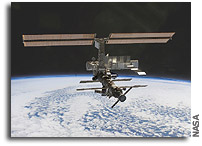 All ISS systems continue to function nominally, except as noted previously or below. For the Expedition 5 crew, this is Week 23 and their 161st day in space (159d onboard ISS).
After wake-up (11:00am EST), daily planning conference, and work preparation, FE-1/SO Peggy Whitson, assisted in parts by CDR Valery Korzun, started a busy day with the scheduled 3.5-hr. task of maintenance of the VOA (volatile organics analyzer) which looks for potentially toxic volatile organic compounds in the atmosphere. [After Peggy has powered the VOA off, she and Valery will remove it from the CHeCS (crew health care systems) rack to perform prescribed OMIs (on-orbit maintenance items), viz., change-out of sieve packs, pumps, hard disk drive, nitrogen dryer, oxygen dryer, and inlet nozzle. The VOA will then be installed back into the rack for activation and checkout.]
Later, Whitson is scheduled to perform filter cleaning activities on the SAMS (space acceleration measurement system) and MAMS (microgravity acceleration measurement system) instruments. [For SAMS, this requires powerdown of the two RTS (remote triaxial sensor) rack drawers, each drawer having a fan switch and a power switch; this also deactivates the SAMS ICU (interim control unit). After checkout and cleaning of the filters in all SAMS drawers, Peggy will reverse the deactivation process. Then, MAMS will be turned off and later turned on again after its filter screens have been cleaned with grey tape.]
Daily routine servicing tasks are to be performed by FE-2 Sergei Treschev (SOSh life support systems maintenance), Peggy Whitson (autonomous Lab payload status checkup on PCG-STES007, CGBA, PGBA), and Korzun (IMS inventory delta file preparation for downlink).
A new troubleshooting plan for fixing the ARCTIC-1 refrigerator/freezer should be available by tonight. [Engineers at POC/Huntsville and JSC are investigating ways to remove the back cover that could not be opened due to a stripped screw.]
Whitson was requested to add battery charging for the EVA power tool (drill) to her task list item of performing battery charge for the scopemeter. [This should ensure proper battery charge in case the power tool is needed for the bad screw on the ARCTIC panel. It takes the Scopemeter battery about 21 hours to charge and the power tool battery one hour.]
The EarthKAM (Earth Knowledge Acquired by Middle schools) payload continues its picture taking activity. Peggy Whitson is scheduled to perform a lens changeout on the camera tonight (8:15pm EST).
All crewmember performed their daily physical exercise on TVIS (treadmill with vibration isolation and stabilization), RED (resistive exercise device), and CEVIS (cycle ergometer with vibration isolation).
In spite of having spent 161 days in zero-G, both cosmonauts are currently exhibiting “high levels of speed endurance, strength endurance and overall exercise endurance”, according to findings of Russian MedOps experts from analysis of ten recent physical training sessions.
The crew was thanked for the repair of the TVIS in the SM pit. After Whitson and Korzun spent several hours yesterday replacing the damaged gyroscope wire ropes with new cables, ground engineers reviewed the TVIS recovery plan this morning.
The CDRA (carbon dioxide removal assembly) has been operating intermittently and is now turned off. Preparations are underway to replace two air selector valves (ASVs). The replacement procedure was uplinked this morning for Peggy Whitson’s review before it becomes final. [As demonstrated recently by Peggy, the R&R can be accomplished in minimum time by sliding the TCCS (trace contaminant control subassembly) out of the rack to create access. By correcting a potential software condition in which the MDM did not check the valve position sensor for confirmation of selector valve movement following a manual override command, some of the unique failure signatures seen in the past few days were eliminated, but the apparent problem of sticky valves remains. Two replacement ASVs have been delivered from Huntsville to KSC for launch on 11A.]
As a new item added to the “job jar” task list, the crew was requested to conduct a photo survey of the starboard US SAW (solar array wing) 2B, focusing on String 5. As part of the ongoing investigation into the failure of this electrical string, the survey is to determine if the panels or the FCC (flat circuit connector) corresponding to the failed string are damaged. [Using the Kodak 760 DCS (digital camera system) with 400mm lens from SM window #13 and/or #2, the SAW 2B survey focuses on panels 61 and 62 (right blanket only) and on the inboard FCC of the right blanket.]
The next Robotics/SSRMS activities are scheduled for 11/15 (Friday). Whitson and Korzun are to take the MSS (mobile service system) through another P1 installation dry run. [The sequence will include P1 grapple from the Shuttle RMS, maneuver to install, PO1 release, and maneuver to the Lab PDGF (power and data grapple fixture) pre-grapple position, exactly like the previous run performed three weeks ago.]
Sleep period begins tomorrow morning at 2:30am EST.
STS-113 Launch: Launch of Endeavour on 11A is still expected for NET 11/18 (not 11/28, as mistyped here yesterday), late in the evening, i.e. on 11/19 GMT. Docking would then be on 11/20 at 7:22pm EST, undocking on 11/28 (Thanksgiving) at 5:19pm. The three scheduled EVAs would take place on 11/21 (5:18pm), 11/23 (4:18pm), and 11/25 (4:18pm).
Today’s targets for the CEO (crew earth observations) program were Buenos Aires, Argentina (nadir pass; ESC [electronic still camera] requested), Jarvis Island (clouds usually make this a difficult site to image; crew was to try for as little cloud cover as possible, also as near nadir as possible. ESC), American Samoa (clouds typically cover the islands of American Samoa, however, the weather satellite indicates that ISS may have had an opportunity on this pass. Crew was to try for few clouds as possible, as close to nadir as possible. The station passed to the W of the main islands, scientists have no imagery of these islands [Swains Islands] to date. ESC), Irrawaddy River Delta (detailed views of the islands of the mouths of the Irrawaddy are highly desirable. These detailed views enable researchers to track individual island growth and/or erosion. ESC, nadir), Nairobi, Kenya (this was an excellent opportunity to take an image of Nairobi, Kenya. Scientists have very few images of this city in their earth imagery database and nothing has been taken recently. ESC, nadir).
CEO images can be viewed at the website
http://eol.jsc.nasa.gov
U.S. and Russian Segment Status (as of 1:47pm EST).
Environmental Control and Life Support (ECLSS) and Thermal Control (TCS):
- Elektron O2 generator is powered On (32mp mode). Vozdukh CO2 scrubber is ON in AUTO air flow mode (ppCO2 limit: 3.5 mmHg). U.S. CDRA CO2 scrubber is Off. TCCS is operational. BMP Harmful Impurities unit: Absorbent bed #1 in Purify mode, bed #2 in Purify mode.
- SM Working Compartment: Pressure (mmHg) — 748; temperature (deg C) — 24.9; ppO2 (mmHg) — 142.8; ppCO2 (mmHg) — 3.0.
- SM Transfer Compartment: Pressure (mmHg) — 752; temperature (deg C) — 19.1.
- FGB Cabin: Pressure (mmHg) — 744; temperature (deg C) — 22.0.
- Node: Pressure (mmHg) — 742.62; temperature (deg C) — 22.3 (shell); ppO2 (mmHg) — n/a; ppCO2 (mmHg) — n/a.
- U.S. Lab: Pressure (mmHg) — 744.82; temperature (deg C) — 25.5; ppO2 (mmHg) — n/a; ppCO2 (mmHg) — n/a;
- Joint Airlock (Equip. Lock): Pressure (mmHg) — 744.82, temperature (deg C) — 24.0; shell heater temp (deg C) — 22.6, ppO2 (mmHg) — n/a; ppCO2 (mmHg) — n/a.
- PMA-1: Shell heater temp (deg C) — 22.7
- PMA-2: Shell heater temp (deg C) — 18.9
(n/a = data not available)
Propulsion System (PS):
- Total propellant load available (SM + FGB + Progress) — 3805 kg (8388 lb) [as of 11/7/02].
Electrical Power Systems (EPS):
- Both P6 channels fully operational. Beta Gimbal Assembly (BGA) 2B and BGA 4B both in dual-angle mode (directed position).
- SM batteries: Battery data not available.
- FGB batteries: Battery #1 is offline; battery #2 in “Cycle” mode; all other batteries (4) are in “Partial Charge” mode.
- Plasma Contactor Unit PCU-1 in Standby mode; PCU-2 in Standby mode.
Thermal Control Systems:
- Air conditioner SKV-1 is On; SKV-2 is Off.
Command & Data Handling Systems:
- C&C-1 MDM is prime, C&C-2 is back-up, and C&C-3 is in standby.
- GNC-1 MDM is prime; GNC-2 is Backup (new patches loaded on both).
- EXT-1 is On (primary), EXT-2 is off.
- LA-1, LA-2 and LA-3 MDMs are all operating.
- PL-1 MDM is On (primary); PL-2 MDM is off (diagnostic
- APS-1 (automated payload switch #1) and APS-2 are both On.
- SM Terminal Computer (TVM): 3 redundant lanes (of 3) operational.
- SM Central Computer (TsVM): 3 redundant lanes (of 3) operational.
Attitude Source:
- 3 CMGs on-line.
- State vector — U.S. SIGI-1
- Attitude — Russian segment (RS)
- Angular rates — U.S. RGA-1 (from RS attitude)
Communications & Tracking Systems:
- All Russian communications & tracking systems are nominal.
- S-band is operating nominally.
- Ku-band is operating nominally.
- Audio subsystem operating nominally.
- Video subsystem operating nominally.
- MCOR (medium-rate communications outage recorder) is operating nominally.
Robotics:
- SSRMS/Canadarm2 at MBS PDGF3 (mobile base system/power & data grapple fixture 3) and 11A park position, with Keep Alive power on both strings.
- MBS: Keep Alive power on both strings. POA: Keep Alive power on both strings.
- RWS (robotics workstations): Lab RWS is Off; Cupola RWS is Off.
ISS Orbit (as of this morning, 9:12am EST [= epoch]):
- Mean altitude — 391.0 km
- Apogee — 400.4 km
- Perigee — 381.6 km
- Period — 92.38 min.
- Inclination (to Equator) — 51.64 deg
- Eccentricity — 0.0013878
- Orbits per 24-hr. day — 15.59
- Solar Beta Angle — 7.4 deg (magnitude increasing)
- Altitude loss — 200 (mean) in last 24 hours
- Revolutions since FGB/Zarya launch (Nov. ’98) — 22727
- Current Flight Attitude — LVLH (local vertical/local horizontal = “earth-fixed”: z-axis in local vertical, x-axis in velocity vector [yaw: -13 deg, pitch: -9 deg, roll: 0 deg]).
For more on ISS orbit and worldwide naked-eye visibility dates/times, see
http://www.hq.nasa.gov/osf/station/viewing/issvis.html



