
ISS On-Orbit Status 3 Nov 2002
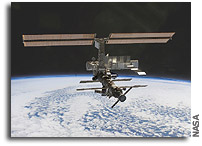 All ISS systems continue to function nominally, except as noted previously or below. Research activities ruled the day aboard the station, which virtually bustled with science in both Russian and US segments.
The day began at 3:30am EST with the VC-4 crew having to fill out a detailed sleep questionnaire after their first full day on ISS.
VC CDR Sergei Zalyotin and VC FE-1 Frank De Winne then completed another saliva sampling for the VIRUS program (determination of the frequency of induced reactivation of latent viruses, latent virus shedding and clinical disease under the stresses of space flight).
De Winne incubated the second microbial culture sample for the MESSAGE experiment (study of effects of microgravity on bacterial gene expression).
During the course of the day, De Winne, Zalyotin and VC FE-2 Yuri Lonchakov each conducted the CARDIOCOG experiment on himself (to study the effects of microgravity on the cardiovascular system expressed in the peripheral arteries, and the vegetative regulation of arterial blood pressure and heart rate). [This required donning appropriate harness equipment, putting on hearing protection, taking arterial blood pressure measurements with a sphygmomanometer, conducting the experiment with computer support, and performing close-out ops. Special safety instructions had been uplinked for the low-probability eventuality that the hazardous thionyl chloride batteries, which had not been cleared by Safety experts, should develop a leak.]
Zalyotin performed temperature checks (37 degC) of the running AQUARIUS-B experiment and later conducted close-out ops. [AQU-B has three experiments: VITAMIN-D (VTD), to characterize the effect of weightlessness on the mechanism of action of Vitamin D in osteoblasts, RHO-SIGNALS (RHO), to study the effect of weightlessness on specific signal molecules in human fibroblasts, and RAMIROS (RMR), to characterize the effects of heavy particle radiation on mammalian tissue in the space flight environment.]
De Winne also continued work in the MSG (microgravity science glovebox) in the Lab, changing out the videotapes for the PROMISS payload (protein crystal growth in microgravity using reverse diffusion) and DCCO payload (isothermal diffusion coefficients in two- and three-component mixtures simulating actual properties of crude oil).
FE-1/SO Peggy Whitson powered up EXPRESS Rack 2, removed the ARIS (active rack isolation system) alignment guides and readied the GASMAP (gas analyzer system for metabolic analysis physiology) in the HRF (human research facility) as well as the PuFF (pulmonary function in flight) equipment for operation. After an initial calibration run, she and then CDR Valery Korzun took the standard 40-min. PuFF test. Later, Peggy conducted final calibration and powered down the HRF GASMAP. This was the final PuFF session for Whitson and Korzun. [PuFF investigates the effects of EVA and long-term exposure to zero-G on the pulmonary (lung) function. It utilizes the GASMAP along with other equipment, such as disposable mouthpiece, manual breathing valve, flowmeter, pressure-flow module, pressure and volume calibration syringes. Each PuFF session, occurring monthly, involves five lung function tests.]
Valery Korzun completed his daily task of inspecting the Rasteniya-2 plant growth payload. He also performed the weekly collection of SP toilet flush and SVO water supply counter data for calldown to the ground.
FE-2 Sergei Treschev did the daily routine maintenance of the SOSh life support system, while Peggy Whitson conducted the regular status checkup of Lab payloads.
Treschev later set up and configured the equipment for the DIURESIS payload, another Russian medical experiment.
All three ISS crewmembers again had time reserved to prepare and prepack for their return on 11A.
Today it was Sergei Treschev’s turn with the Russian Chibis suit, conducting the MedOps MO-4 exercise protocol in the below-the-waist reduced-pressure device (US: LBNP), which provides gravity-simulating stress to the body‚s cardiovascular/circulatory system for evaluation of the body‚s orthostatic tolerance (e.g., the Gauer-Henry reflex) after 20 weeks in zero-G. Korzun, whose turn it was last week, assisted his flight engineer as CMO.
Further ARCTIC troubleshooting plans are to shut down ARCTIC-2 and leave ARCTIC-1 powered. Several steps will then be performed from the ground before Whitson can continue with the troubleshooting.
Peggy Whitson was requested by the MCC-H radiation experts to install the TEPC (tissue equivalent proportional counter) spectrometer in the TESS (temporary sleep station), her private bunk in the Lab. [The TEPC measurements are important for determining the shielding properties of the radiation bricks used in TESS, in order to support additional shielding of this type for all crewmembers.]
At 4:15 am EST, Frank De Winne conducted an amateur radio exchange with a ham radio group of pupils at the Koninklijke Technische (Royal Technical) School of Saint Truiden in Belgium. Later, De Winne downlinked videotaped scenes of his daily activities, and at 4:25pm EST, he sent down a live TV report to the city of Saint Truiden.
Today’s CEO (crew earth observations) targets were Istanbul, Turkey, and smog (crew was to look left for a good synoptic view of this major city [on both sides of the Bosporus waterway], using ESC [electronic camera system]. Then to look right for smog buildup in the Eastern Mediterranean basin. Recent views show smog accumulation in valleys along the south coast of Turkey. Recent views also show a strongly coherent smog plume emanating from Cairo into the Med), Damascus, Syria (nadir view. ESC requested), Puerto Rico (looking right for views of the entire island, ESC), W Africa (Dynamic event. West Africa unusually free of cloud. Crew was to try for [1] a mapping pass of nadir views; and [2] high obliques looking east along the Sahel to show the desert-forest line [very few such views exist of this major biome boundary]), and Lower Amazon River Basin (looking right for detailed views of the estuary shorelines).
CEO images can be viewed at the website http://eol.jsc.nasa.gov
U.S. and Russian Segment Status (as of 2:09 pm EST).
Environmental Control and Life Support (ECLSS) and Thermal Control (TCS):
- Elektron O2 generator is powered Off. Vozdukh CO2 scrubber is ON in AUTO air flow mode (ppCO2 limit: 4 mmHg). U.S. CDRA CO2 scrubber is On. TCCS is operational. BMP Harmful Impurities unit: Absorbent bed #1 in Purify mode, bed #2 in Purify mode.
- SM Working Compartment: Pressure (mmHg) — 758; temperature (deg C) — 26.9; ppO2 (mmHg) — 149.7; ppCO2 (mmHg) — 3.9.
- SM Transfer Compartment: Pressure (mmHg) — 762; temperature (deg C) — 20.5.
- FGB Cabin: Pressure (mmHg) — 756; temperature (deg C) — 22.0.
- Node: Pressure (mmHg) — 750.89; temperature (deg C) — 24.7 (shell); ppO2 (mmHg) — 164.7; ppCO2 (mmHg) — 3.5.
- U.S. Lab: Pressure (mmHg) — 752.59; temperature (deg C) — 25.5; ppO2 (mmHg) — n/a; ppCO2 (mmHg) — n/a;
- Joint Airlock (Equip. Lock): Pressure (mmHg) — 752.69, temperature (deg C) — 33.8; shell heater temp (deg C) — 27.2, ppO2 (mmHg) — 164.8; ppCO2 (mmHg) — 3.5.
- PMA-1: Shell heater temp (deg C) — 24.7
- PMA-2: Shell heater temp (deg C) — 14.6
(n/a = data not available)
Propulsion System (PS): Total propellant load available (SM + FGB + Progress) — 3903 kg (8605 lb) [as of 10/24/02].
Electrical Power Systems (EPS):
- Both P6 channels fully operational. Beta Gimbal Assembly (BGA) 2B and BGA 4B in Autotrack mode (solar-tracking).
- SM batteries: All batteries (8) are in “Partial Charge” mode.
- FGB batteries: Battery #1 is offline; all other batteries (5) are in “Partial Charge” mode.
- Plasma Contactor Unit PCU-1 in Standby mode; PCU-2 in Standby mode.
Thermal Control Systems:
- Air conditioner SKV-1 is On; SKV-2 is Off.
Command & Data Handling Systems:
- C&C-3 MDM is prime, C&C-2 is back-up, and C&C-1 is in standby.
- GNC-1 MDM is prime; GNC-2 is Backup (new patches loaded on both).
- EXT-1 is On (primary), EXT-2 is off.
- LA-1, LA-2 and LA-3 MDMs are all operating.
- PL-1 MDM is On (primary); PL-2 MDM is off (diagnostic
- APS-1 (automated payload switch #1) and APS-2 are both On.
- SM Terminal Computer (TVM): 3 redundant lanes (of 3) operational.
- SM Central Computer (TsVM): 3 redundant lanes (of 3) operational.
Attitude Source:
- 3 CMGs on-line.
- State vector — U.S. SIGI-1
- Attitude — Russian segment (RS)
- Angular rates — U.S. RGA-1 (from RS attitude)
Communications & Tracking Systems:
- All Russian communications & tracking systems are nominal.
- S-band is operating nominally.
- Ku-band is operating nominally.
- Audio subsystem operating nominally.
- Video subsystem operating nominally.
- MCOR (medium-rate communications outage recorder) is operating nominally.
Robotics:
- SSRMS/Canadarm2 at MBS PDGF3 (mobile base system/power & data grapple fixture 3) and 11A park position, with Keep Alive power on both strings.
- MBS: Keep Alive power on both strings. POA: Keep Alive power on both strings.
- RWS (robotics workstations): Lab RWS is Off; Cupola RWS is Off.



