ISS On-Orbit Status 2 Nov 2002
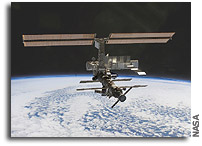 All ISS systems continue to function nominally, except as noted previously or below. This is the 150th day in space for Expedition 5, and their 148th day on board the ISS, of a planned 167-day stay.
Today is also the second anniversary of continuous station occupancy. [On 11/2/00, at 5:23 am EST, Expedition One members William Shepherd, Yuri Gidzenko and Sergej Krikalev opened the hatches from their Soyuz spacecraft and ingressed the ISS at the SM aft-end port. A total of 112 visitors have been aboard the station since FGB/Zarya was launched in November 1998, including men and women from six nations. In the past 12 months, the station has grown by more than 56,000 lbs in components added and by more than 200,000 lbs over the last two years. Its internal volume has increased from that of an efficiency apartment to a three-bedroom home. This year, construction has begun on the station’s backbone, a truss structure which, by the end of 2002, will stretch almost 133 feet. When completed in 2004, the truss will extend 356 feet; longer than a football field. This year has also seen assembly of the first “space railroad,” including a mobile base on the truss for the station’s Canadian robotic arm and a “hand car” for spacewalkers.]
Both crews awoke at 3:30am EST to a cordial “welcome aboard” from the ground for the “taksisty” visitors, which include a “nice Belgian bearing Belgian chocolate”.
The VC-4 crew, Sergei Zalyotin, Frank De Winne and Yuri Lonchakov immediately went to work today on their packed science program, assisted where necessary by the ISS crew. [Science activities included saliva sample collection for the experiment VIRUS, taking blood samples for SYMPATHO, starting strain incubation for MESSAGE, activating the EGE computer and setting up hardware for NEUROCOG, followed by De Winne doing virtual turns in fixed position in zero-G and Zalyotin experimenting with orientation in free floating position called for by the NEUROCOG protocol. The PROMISS payload is up and running; temperatures are being monitored for AQUARIUS-B, and DCCO is operating. VC FE-1 Frank De Winne also installed the experiment software for CARDIOCOG.]
For the Belgian program, De Winne’s activities as well as payload operations of DCCO, PROMISS and NEUROCOG were videotaped. The scenes are scheduled for downlink to MCC-M later today on two occasions, at 3:45pm and 5:20pm EST, via VHF activated by the Russian automated daily timeline software (SPP) over RGS (Russian ground site).
For the Diatomeya ocean observation program, VC FE-2 Yuri Lonchakov completed two sessions, at 5:15am and 8:25am EST, with the Nikon- F5 camera, focusing on bioproductive areas in the Gulf of Aden and the open section of the Indian Ocean, as well as the Niger River’s contribution to the formation of autumnal fields of color and transparency of the waters of the Gulf of Guinea.
Lonchakov also performed observations and photography for the Russian GFI-8 Uragan (“hurricane”) program, depending on cloud cover. Areas of interest were Novorossiysk and Tuapse (pollution of ports), glaciers of the Caucasus, Kolka Glacier at the Kazbek-Dzhimarai mountain junction, and northern mountain slopes on the south shore of the Caspian Sea.
The ISS crew, Korzun, Whitson and Treschev spent several hours with preparations and prepacking activities for their return on 11A/Endeavour on 11/21.
Korzun completed his daily task of inspecting the Rasteniya-2 plant growth payload, followed by the regular inspection of the BRPK condensate water separator and the checkup of the VR fan of the active SKV-1 air conditioner for accumulated humidity.
FE-2 Sergei Treschev conducted the regular daily maintenance of the SOSh life support system.
Both Korzun and Treschev completed the first training session on the new Soyuz-TMA Neptune-ME control panel, studying panel functions with the help of two training CD-ROMs delivered by Zalyotin to use with the electronic laptop simulator (InPU) for Neptune-ME.
Indications are that the CDRA (carbon dioxide removal assembly) blower overspeed problems of yesterday have been worked around by adjusting the adsorbent/desiccant bed temperatures. But when CDRA was up and running again, several failures occurred which were due to what appears to be a valve problem. For now, it will be attempted to continue CDRA operations while specialists try to determine the root cause and effective workaround to the valve issues. In the event that the CDRA is not effective, some LiOH (lithium hydroxide) canisters may have to be used to handle CO2 while the taxi crew is present (there are enough on board for that contingency).
The GNC MDM (guidance, navigation & control computer) swap was successful, and GPS (global position system) is being used for attitude data. The GPS firmware problem with NAN (not-a-number) values that caused both GNC MDMs to fail on 9/24 has been fixed with the new patches. [The patches were uplinked right after Soyuz docking and both GPS systems are powered on and configured to calculate attitude and state information (position & velocity). The GNC MDM is using the GPS state vector as its primary state source, butthe GPS attitude is currently a backup source tothe attitude calculatedon the Russian Segment. The plan is to remain in this configuration through flight 11A.]
The ISS is currently on the newly installed S-band string 1. It is planned to swap back over to string 2 tomorrow (11/3) and to stay in that config through 11A.
Two new items were added to the crew’s task list, viz., (1) locating the CBCS (centerline berthing camera system) video interface unit (VIU) which is required for ULF-1, along with some misplaced CBCS fittings and cables; and (2) some wrap-up questions from the FCT (flight control team) based on earlier emails and completed procedures.
Science Update (Expedition Five — 20th):
Lead Increment Scientist Vic Cooley to crew: “Thanks for yourinspirational and hard work completing science objectives and tasks this week: EVARM, Interactions, ZCG autoclave removal, PGBA harvest and planting, a bonus PFMI run, and PFMI removal and MSG cleanup. The CEO team has reported that the snapshots of Mt Etna are of excellent quality. We look forward to seeing you back on the planet. Thank you also for your assistance in starting the ESA MSG science.”
Extra-Vehicular Activity Radiation Monitors (EVARM): EVARM badge readings will continue weekly in preparation for the upcoming STS-113/11A EVAs.
GASMAP/Pulmonary Function in Flight (PuFF): GASMAP: The hardware team is looking into options for reducing the helium buildup following last week’s GASMAP 90-day health check. PuFF: The team is looking forward to what should be the crew’s last in-flight session on 11/2.
Renal (Kidney) Stone Experiment: To crew: “Continue to take those pills, we’ll see you on the ground soon!”
Interactions (NTXN): Continuing. To end next week for Expedition 5.
Human Research Facility/Workstation (HRF WS): n/a
Commercial Refrigerator Incubator Module-Commercial Stelsys (STELSYS): Returned on 9A.
Microencapsulation Electrostatic Processing (MEPS): Complete. Returned on 9A.
Advanced Astroculture (ADVASC): Complete. Returned on 9A.
Solidification Using a Baffle in Sealed Ampoules (SUBSA): Complete. Returned on 9A.
Pore Formation and Mobility Investigation (PFMI): Seven PFMI samples have been successfully processed during Increment 5, in part because of Peggy Whitson’s willingness to process samples outside the nominal schedule. The remaining eight samples are to be processed during Increment 6.
Space Acceleration Measurement System (SAMS): SAMS sensors are normal.
Microgravity Acceleration Measurement System (MAMS): The MAMS OARE sensor subsystem (OSS) continues to collect low-frequency, small-magnitude acceleration data for characterization of the station’s quasi-steady environment. HIRAP telemetry is disabled. The ground is collecting unique micro-G data during the BTF (Belgian taxi flight) joint ops period.
Active Rack Isolation System (ARIS) Support: The ARIS Support team will start transition transient testing on 11/4. These tests will produce data on small micro-G disturbances that are produced when the ARIS system transitions between the various operational modes.
Protein Crystal Growth-Single Locker Thermal Enclosure System (PCG-STES): Temperatures are well within the limits defined. Looking forward to deactivation of PCAM cylinders after 11A launch and before docking.
Materials ISS Experiment (MISSE): In progress. Deployed outside. Nominal and collecting data.
Educational Payload Operations (EPO-5): Completed.
EarthKAM: Planned.
Zeolite Crystal Growth (ZCG): An investigation into the early auto-shutdown has revealed that the time change from CDT to CST on 10/27 may have caused a problem with the software. No impact to science is expected from the early deactivation.
ARCTIC Refrigerator/Freezer 1 (ARCTIC-1): Thank you to the crew for their help with troubleshooting efforts on 10/31. Unfortunately, it appears that neither ARCTIC unit is cooling sufficiently to reach +4.0 C, and neither has a current draw over 0.5 Amps. The ARCTIC team is currently working on another troubleshooting plan that may be implemented as early as 11/3.
ARCTIC Refrigerator/Freezer 2 (ARCTIC-2): see ARCTIC-1.
Commercial Generic Bioprocessing Apparatus/Plant Generic Bioprocessing Apparatus (CGBA/PGBA): The PGBA team is still working on the video transmission problem.
ProMISS: The ProMISS team implemented a troubleshooting plan during crew sleep on 11/2. It is now activated and back on the planned processing times.
DCCO: DCCO was successfully activated on 11/1 and is currently operating nominally.
NANOSLAB: n/a
COSMIC: n/a
Crew Earth Observations (CEO): Today’s target areas were Athens, Greece (nadir pass. ESC [electronic still camera] requested), Nile River Delta (nadir pass. The delta is the source of a major Third World smog plume. Crew was to photograph oblique views to detect this phenomenon), Cairo, Egypt (nadir pass. ESC requested), Tel Aviv, Israel (nadir pass. ESC requested), Western Mediterranean Dust (plumes exiting off Algerian coast), Algiers, Algeria (nadir pass. ESC requested), Las Vegas, Nevada (nadir pass. ESC requested), Phoenix, AZ (nadir pass. ESC requested), Tucson, Arizona (nadir pass. ESC requested), Lake Poopo, Bolivia (lake levels should be slightly but noticeably lower as the present El Nino cycle sets in, causing reduced runoff to the high Andean basins. ESC camera), and Patagonian Glaciers ( crew was to look right of track for clear views of the southern ice field).
CEO images can be viewed at the website
http://eol.jsc.nasa.gov
U.S. and Russian Segment Status (as of 2:02 pm EST).
Environmental Control and Life Support (ECLSS) and Thermal Control (TCS):
- Elektron O2 generator is powered On (48 Amp mode, on backup pump). Vozdukh CO2 scrubber is ON in AUTO air flow mode (ppCO2 limit: 4 mmHg). U.S. CDRA CO2 scrubber is On (see above). TCCS is operational. BMP Harmful Impurities unit: Absorbent bed #1 in Purify mode, bed #2 in Purify mode.
Propulsion System (PS):
- Total propellant load available (SM + FGB + Progress) — 3903 kg (8605 lb) [as of 10/24/02].
Electrical Power Systems (EPS):
- Both P6 channels fully operational. Beta Gimbal Assembly (BGA) 2B and BGA 4B in Autotrack mode (solar-tracking).
- SM batteries: All batteries (8) are in “Partial Charge” mode.
- FGB batteries: Battery #1 is offline; battery #3 is cycling; all other batteries (4) are in “Partial Charge” mode.
- Plasma Contactor Unit PCU-1 in Standby mode; PCU-2 in Standby mode.
Thermal Control Systems:
- Air conditioner SKV-1 is On; SKV-2 is Off.
Command & Data Handling Systems:
- C&C-3 MDM is prime, C&C-2 is back-up, and C&C-1 is in standby.
- GNC-1 MDM is prime; GNC-2 is Backup (new patches loaded on both).
- EXT-1 is On (primary), EXT-2 is off.
- LA-1, LA-2 and LA-3 MDMs are all operating.
- PL-1 MDM is On (primary); PL-2 MDM is off (diagnostic
- APS-1 (automated payload switch #1) and APS-2 are both On.
- SM Terminal Computer (TVM): 3 redundant lanes (of 3) operational.
- SM Central Computer (TsVM): 3 redundant lanes (of 3) operational.
Attitude Source:
- 3 CMGs on-line.
- State vector — U.S. SIGI-1
- Attitude — Russian segment (RS)
- Angular rates — U.S. RGA-1 (from RS attitude)
Communications & Tracking Systems:
- All Russian communications & tracking systems are nominal.
- S-band is operating nominally.
- Ku-band is operating nominally.
- Audio subsystem operating nominally.
- Video subsystem operating nominally.
- MCOR (medium-rate communications outage recorder) is operating nominally.
Robotics:
- SSRMS/Canadarm2 at MBS PDGF3 (mobile base system/power & data grapple fixture 3) and 11A park position, with Keep Alive power on both strings.
- MBS: Keep Alive power on both strings. POA: Keep Alive power on both strings.
- RWS (robotics workstations): Lab RWS is Off; Cupola RWS is Off.
ISS Orbit (as of this morning, 6:51am EST [= epoch]):
- Mean altitude — 394.0 km
- Apogee — 403.9 km
- Perigee — 384.1 km
- Period — 92.44 min.
- Inclination (to Equator) — 51.64 deg
- Eccentricity — 0.0014613
- Orbits per 24-hr. day — 15.58
- Solar Beta Angle — -45.2 deg (magnitude decreasing)
- Altitude loss — 230 m (mean) in last 24 hours
- Revolutions since FGB/Zarya launch (Nov. ’98) — 22554
- Current Flight Attitude — XPOP (x-axis perpendicular to orbit plane = “sun-fixed” [yaw: -5.0, pitch: -8.6 deg., roll: 0.4 deg]),with CMG/Thruster Assist Momentum Management). XPOP remains nominal flight attitude until 11/9 (Beta at -10 deg).
For more on ISS orbit and worldwide naked-eye visibility dates/times, see
http://www.hq.nasa.gov/osf/station/viewing/issvis.html