Mars Odyssey THEMIS Image: Late Afternoon Sun
 |
|
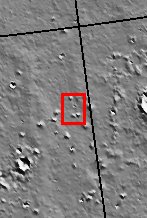
| This image of the northern plains of Mars shows a surface texture of hundreds of small mounds and numerous small impact craters. The THEMIS imaging team is taking advantage of the late afternoon sun illumination to image places like this where the surface may contain small scale features that are “washed-out” by higher illumination angles. As the sun dips towards the horizon (to the left side of the image), shadows are cast. The length of the shadows can be used to estimate the height of the feature casting them – or the depth of the crater that contains the shadow. In this image the craters – even very small ones – are now partially filled by shadow making it very easy to identify them. The small bumps are not casting shadows yet, but are easily seen. These small bumps were not easily identified when the sun angle was higher (earlier in the afternoon). As this image shows, late afternoon sun illumination is wonderful for making small scale morphologic features visible. [Questions? Email images@themis.asu.edu] [Source: ASU THEMIS Science Team] |
NASA’s Jet Propulsion Laboratory manages the 2001 Mars Odyssey mission for NASA’s Office of Space Science, Washington, D.C. The Thermal Emission Imaging System (THEMIS) was developed by Arizona State University, Tempe, in collaboration with Raytheon Santa Barbara Remote Sensing. The THEMIS investigation is led by Dr. Philip Christensen at Arizona State University. Lockheed Martin Astronautics, Denver, is the prime contractor for the Odyssey project, and developed and built the orbiter. Mission operations are conducted jointly from Lockheed Martin and from JPL, a division of the California Institute of Technology in Pasadena.
Image Credit: NASA/JPL/Arizona State University
| Parameter | Value | Parameter | Value | |
|---|---|---|---|---|
| Latitude | 38.7 |   | Instrument | VIS |
| Longitude | 339.7E (20.3W) |   | Resolution (m) | 19 |
| Image Size (pixels) | 1503×1084 |   | Image Size (km) | 28.6×20.6 |




