
Cassini-Huygens Status Report September 26, 2002
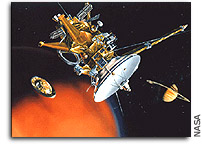 The Huygens probe, riding aboard the Saturn-bound Cassini
spacecraft, stepped flawlessly through a test run last week of
the activities it will perform when it descends through the
soupy atmosphere of Titan less than 28 months from now.
“All the probe subsystems and probe instruments did just
what they are supposed to do,” said European Space Agency
systems engineer Shaun Standley, stationed at NASA’s Jet
Propulsion Laboratory, Pasadena, Calif. For the multinational
Cassini-Huygens mission, NASA provided the large Cassini
spacecraft, which will begin orbiting Saturn July 1, 2004,
and the European Space Agency provided the Huygens probe,
which will parachute into the atmosphere of Titan, Saturn’s
largest moon, on Jan. 14, 2005.
Last week’s Huygens checkout was the 10th since launch
on Oct. 15, 1997. The probe is sleeping for most of the
seven-year journey. About every six months, though, engineers
wake it up to check its health and exercise the moving parts
in its valves and pumps.
“As nearly as possible, we put the probe through all the
stages of the real descent sequence,” Standley said. The
sequence lasts about five hours. Since Huygens remains inside
a protective shell, the simulation can’t include every
instrument activity nor, of course, one-time events such as
parachute deployment. The checkout does turn on each instrument
for the periods they will be used as the probe descends, take
data from each, and send the data to Cassini for transmission
to Earth. That allows evaluation of the subsystems, such as
power, computers and transmitter, as well as each instrument.
Results of the checkout have been evaluated by engineers
and scientists at the Huygens Probe Operations Center in
Darmstadt, Germany, and at the home institutions for each of the
probe’s instruments in France, United Kingdom, Germany, and
the United States.
The Huygens atmospheric structure instrument will analyze
features such as temperature, pressure and lightning at
different layers of Titan’s atmosphere. Instruments named the
gas chromatograph mass spectrometer and the aerosol collector
and pyrolyser will work in tandem to collect, break down and
identify particles and gases, including organic chemicals in
the atmosphere. The descent imager/spectral radiometer will
take pictures and spectra of the atmosphere and surface. The
Doppler wind experiment will track how winds carry the probe.
And the surface science package will investigate physical
properties of Titan’s surface.
Additional information about the Cassini-Huygens mission
is available online at



