
ISS Status Report Report #42 Sept. 20, 2002
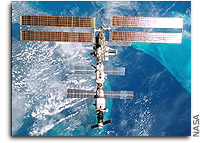 Expedition 5 Commander Valery Korzun, NASA International Space Station
Science Officer Peggy Whitson, and Cosmonaut Sergei Treschev wrapped up a
busy workweek on Friday, their 107th day in space. The week began with a
Monday repair by Whitson, with help from Korzun, of the Carbon Dioxide
Removal Assembly (CDRA) in the U.S. laboratory Destiny. The device, which
scrubs carbon dioxide from the space station’s atmosphere, had not
functioned at full capacity since its launch aboard Destiny in February
2001.
The problem was an elusive leak. Initial reports indicated the repair was a
success. On Thursday flight controllers at Mission Control Center activated
the device for a 24-hour run. Friday morning they said telemetry indicated
it is capable of functioning on both its sorbent beds for the first time
since it arrived on the station.
Whitson was named NASA ISS science officer Monday during a space-to-ground
conversation with NASA Administrator Sean O’Keefe, speaking with her from
the International Space Station Flight Control Room in the Mission Control
Center. O’Keefe said it was time to increase the station’s main mission,
scientific research.
Through the week, Korzun and Treschev spent time each day loading the
Progress 8 unpiloted supply spacecraft. It will undock from the station on
Tuesday with its cargo of trash and unneeded equipment and supplies. After
about two weeks during which Russian flight controllers will use its cameras
capture and downlink images of smog and smoke over northeastern Russia, it
will be deorbited to burn up in the Earth’s atmosphere. NASA TV coverage of
the 8:58 a.m. CDT undocking will begin at 8:30 a.m. Coverage of the docking
of Progress 9, scheduled to reach the aft docking port of the Zvezda Service
Module at 12:07 p.m. on Sept. 29, will begin on NASA TV at 11:30 a.m. that
day. Progress 9 is to be launched from the Baikonur Cosmodrome in Kazakhstan
Sept. 25.
On Tuesday Whitson activated the lab’s Microgravity Science Glovebox in
preparation for a new series of experiments. Those experiments called Pore
Formation and Mobility Investigation (PFMI) melt a transparent substance to
study how bubbles form and move in molten materials. She activated the first
in that series of experiments on Thursday.
Also on the crew’s schedule was packing of items to be returned to Earth on
the shuttle Atlantis. The spacecraft is scheduled to launch no earlier than
Oct. 2 on STS-112, bringing the Starboard 1 (S1) Truss to the station.
Atlantis crewmembers will do three spacewalks during the shuttle’s visit,
focusing on connecting fluid, power and data lines between the S1 and the
rest of the station. The spacewalks will be performed from the station’s
Joint Airlock, and E5 crewmembers devoted some of their attention this week
to spacewalk preparations.
Flight controllers did a major exercise with the station’s Canadarm2 on
Wednesday. The arm is functioning well after replacement of its wrist-roll
joint by spacewalkers during the STS-111 flight in June. This exercise
involved simulating a failure – essentially turning off power to an arm
joint — then devising a way to work around the problem. The exercise was
completed satisfactorily.
Late in the week, the crew completed repressurization of the station’s
atmosphere with oxygen from Progress 8.
Friday activities included additional work toward arrival of Atlantis,
packing transfer items and talking by radio with Atlantis crewmembers about
the spacewalks. Friday science focused on the Advanced Astroculture
experiment, which looks at soybean growth in space and wrapping up the first
of the PFMI experiments.
As science activity, station maintenance and crew medical and health
activities, including about two hours of exercise for each member daily,
continued through the week, Korzun, Whitson and Treschev did manage to take
time out on Tuesday to talk with students at Ashland, Wis., area schools.
Crewmembers showed a video of exercise devices aboard the station and
answered questions from the students.
Information on the crew’s activities aboard the space station, future launch
dates, as well as station sighting opportunities from anywhere on the Earth,
is available on the Internet at:
Details on station science operations can be found on an Internet site
administered by the Payload Operations Center at NASA’s Marshall Space
Flight Center in Huntsville, Ala., at:
http://www.scipoc.msfc.nasa.gov
The next ISS status report will be issued on Wednesday, Sept. 25, after the
Progress 9 launch, or sooner if events warrant.



