
ISS On-orbit Status 15 Sep 2002
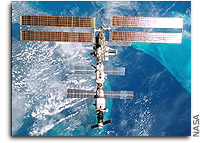 All ISS systems continue to function nominally, except as noted previously or below.
Regular Sunday schedule, giving the crew lots of free time for rest (and working off the task list).
FE-2 Sergei Treschev performed the weekly collection of SP toilet flush and SVO water supply counter data for calldown to the ground. Yesterday, he and CDR Valery Korzun had changed out the urine receptacle (MP) and filter insert (F-V) in the Service Module toilet (ASU), a periodic servicing task.
Today, Treschev also performed the daily routine maintenance of the SOSh life support system, while FE-1 Peggy Whitson completed the regular “day-off” autonomous payload status checkup, and Korzun inspected the BRPK-2 water condensate separator and the VR fan of the SKV-1 air conditioner system.
Peggy, Sergei and Valery had their weekly PFCs (private family conferences) by audio via U.S. S-band and Russian VHF (very high frequency).
During yesterday’s weekly station cleaning, the onboard vacuum cleaner was found to be down (and that in the infinite vacuum of space!). The failure may be due to a loose connector, and the crew was asked to perform some continuity checks to help narrowing down troubleshooting efforts.
Peggy Whitson’s work with the activation and checkout of the Ultrasound equipment on Friday went nominally, causing great delight among the Space Medicine team on the ground. Engineers and physicians were amazed how well FE-1 acquired images of internal organs, transitioned between modes, and swapped out probes. [The truly remarkable ultrasound (US) system in the HRF (human research facility) rack can perform in different modes, such as two-dimensional (2D), spectral Doppler, color Doppler, color power angiography, continuous wave Doppler, M-mode etc. For studies of the human heart in zero-G, for example, it allows cardiac flow determination (output, regional, femoral-arterial, carotid-arterial, etc.), simultaneous measurement of at least two flow studies and volume determination, pressure determination (arterial/venous, central venous), and Doppler tissue imaging.]
All crewmembers performed their full slate of physical exercise, which is increasingly important as the end of their station residency comes into sight. Workouts were done on the TVIS treadmill, RED (resistive exercise device), CEVIS (cycle ergometer with vibration isolation) and the Russian VELO with strength trainer. [The use of the strength trainer (NS-1) is limited by ISS structural constraints. Prescribed are medium tempo (0.33 Hz, one full motion in three seconds) and fast tempo (0.5 Hz, one full motion in two seconds), with medium tempo allowed for rowing, lean forward/back and trunk flexing exercises, and fast tempo for hammer throw and lower arm flexing/extending.]
Today’s targets for the Russian Diatomeya ocean surveillance program were in the Indian Ocean (northern front of the West Wind Drift near Madagascar), Atlantic Ocean (Orange River runoff, Brazilian Current, Falkland-Patagonian bioproductive area), and Pacific Ocean ( South Equatorial Current new Howland Island).
Optional target areas of the U.S. CEO program were Algiers, Algeria (nadir pass; ESC [electronic still camera] requested), Angolan Biomass Burning (high pressure expected to persist. Accumulation of aerosols should continue and become more visible), Congo-Zimbabwe Biomass Burning (crew to photograph any hazy atmosphere left and right of track), Industrialized SE Africa (crew to shoot any haze left or right of track. The Witwatersrand is the main pollution generator, right of track), Cape Town, South Africa (nadir and left of nadir; ESC. Crew to look for urban fringe way east of city center), Southern US haze event (Dynamic event. US haze mass transported as far as Cuba. Crew to shoot oblique left for best results), Caracas, Venezuela (nadir pass; ESC), Brasilia, Brazil (nadir pass; ESC), Las Vegas, Nevada (nadir and just right of nadir; ESC), Phoenix, AZ (nadir and just right of nadir; ESC), Tucson, Arizona (nadir and just right of nadir; ESC), Sabancaya Volcano, Peru (this volcano has been active at a low level since 1990. It is located between two larger volcanoes. Detailed views requested of small ice caps on all three of these high peaks [around 6000-6300 meters] to document diminishing ice area), Lake Poopo, Bolivia (crew was asked to shoot L. Poopo as a test of predictions that its area should start to diminish with progress of the present El Nino. Poopo lake level is the best proxy for precipitation in the whole southern Titicaca basin. Lake levels respond not seasonally but on multi-year El-Nino periodicities), Patagonian Glaciers (west side of the Andes, usually cloud covered, was clear), Pearl & Hermes reef (detailed nadir view of remote coral reefs for mapping project), Lisianski reef (detailed nadir view of remote mainly submerged coral reef for mapping project. Handheld photographs apparently contain good shallow bathymetric data, recent tests show), Tuamotu Archipelago (detailed nadir views and near-nadir views of atolls and coral reefs. Track followed axis of island chain. For mapping project), and Palmerston Island (detailed nadir view of remote coral island for mapping project. Reef encircles the seven-mile-long lagoon. Eight strong hurricanes have struck this remote atoll in the last 120 years. Shapes of reef masses and curvature of beaches probably relate to these high-energy events).
CEO images can be viewed at the website http://eol.jsc.nasa.gov
ISS Orbit (as of this morning, 7:39pm EDT [= epoch]):
- Mean altitude — 389.8 km
- Apogee — 402.2 km
- Perigee — 377.5 km
- Period — 92.3 min.
- Inclination (to Equator) — 51.64 deg
- Eccentricity — 0.0018278
- Orbits per 24-hr. day — 15.59
- Altitude decrease — 220 m (mean) in last 24 hours
- Revolutions since FGB/Zarya launch (Nov. ’98) — 21811
- Current Flight Attitude — LVLH (local vertical/local horizontal = “earth-fixed”: z-axis in local vertical, x-axis in velocity vector [yaw: -10 deg, pitch: -7.8 deg, roll: 0 deg]). Transition from LVLH (Russian: OSK) back to XPOP (Russian: RSO) will be on 9/20.
For more on ISS orbit and worldwide naked-eye visibility dates/times, see
http://www.hq.nasa.gov/osf/station/viewing/issvis.html



