Mars Odyssey THEMIS Image: Dust Devil Tracks
 |
|
| The Science | The Story | |||
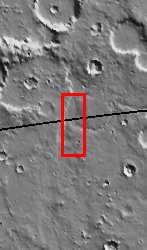
| This image, centered near 50.0 S and 17.7 W displays dust devil tracks on the surface. Most of the lighter portions of the image likely have a thin veneer of dust settled on the surface. As a dust devil passes over the surface, it acts as a vacuum and picks up the dust, leaving the darker substrate exposed. In this image there is a general trend of many of the tracks running from east to west or west to east, indicating the general wind direction. There is often no general trend present in dust devil tracks seen in other images. The track patterns are quite ephemeral and can completely change or even disappear over the course of a few months. Dust devils are one of the mechanisms that Mars uses to constantly pump dust into the ubiquitously dusty atmosphere. This atmospheric dust is one of the main driving forces of the present Martian climate. [Source: ASU THEMIS Science Team] | Vrrrrooooooooom. Think of a tornado, the cartoon Tasmanian devil, or any number of vacuum commercials that powerfully suck up swirls of dust and dirt. That’s pretty much what it’s like on the surface of Mars a lot of the time. Whirlpools of wind called “dust devils” whip up dust that has settled all over the surface.
In this image, the dust is a bright blanket of material. As the dust devils pass over the surface, they pick up this light dust and take it with them, exposing the darker surface below. It may look like a “clean up” effort on the ground, but it’s the atmosphere that suffers. Dust devils may vacuum the surface, but they sure churn up a dusty atmosphere that is the main driving force in current climate change on the red planet. That’s why these devilish winds on this hostile planet are so important to understand. Take a look at the faint tracings of dust devil tracks. Can you tell which way the wind usually blows in this area? While there’s some variation, the wind typically seems to move east to west . . . or is it west to east?! Regardless, this pattern is pretty regular . . . and that’s actually ODD. Dust devil tracks in other Martian areas are much more crazy and erratic in their path, and can completely change or disappear over the course of a few months. [Questions? Email marsoutreach@jpl.nasa.gov] [Source: NASA/JPL Mars Outreach] | |||
NASA’s Jet Propulsion Laboratory manages the 2001 Mars Odyssey mission for NASA’s Office of Space Science, Washington, D.C. The Thermal Emission Imaging System (THEMIS) was developed by Arizona State University, Tempe, in collaboration with Raytheon Santa Barbara Remote Sensing. The THEMIS investigation is led by Dr. Philip Christensen at Arizona State University. Lockheed Martin Astronautics, Denver, is the prime contractor for the Odyssey project, and developed and built the orbiter. Mission operations are conducted jointly from Lockheed Martin and from JPL, a division of the California Institute of Technology in Pasadena.
Image Credit: NASA/JPL/Arizona State University
| Parameter | Value | Parameter | Value | |
|---|---|---|---|---|
| Latitude | -50.1 |   | Instrument | VIS |
| Longitude | 17.7W (342.3E) |   | Resolution (m) | 19 |
| Image Size (pixels) | 3079×1157 |   | Image Size (km) | 58.5×22 |




