
NASA ISS On-Orbit Status 06 September 2012
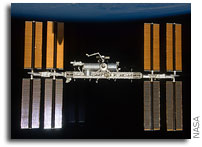
ISS On-Orbit Status 09/06/12
All ISS systems continue to function nominally, except those noted previously or below.
After wakeup, t FE-4 Malenchenko performed the routine inspection of the SM (Service Module) PSS Caution & Warning
panel as part of regular Daily Morning Inspection.
Also after wakeup, FE-2 Revin serviced the BTKh-26 KASKAD experiment, extracting the top of the bioreactor (#6) from the TBU-V incubator (+29 degC), shaking it with “moderately strong” movements for 2 minutes without taking it out of the case and inserting it again in TBU-V. [Started on 8/23, this activity is being carried out for 21 days, once in the morning and once in the evening.]
CDR Padalka terminated his 5th Sonocard experiment session, started last night for the long-term Russian sleep study MBI-12/Sonokard, taking the recording device from his Sonokard sports shirt pocket and later copying the measurements to the RSE-Med laptop for subsequent downlink to the ground. [Sonokard objectives are stated to (1) study the feasibility of obtaining the maximum of data through computer processing of records obtained overnight, (2) systematically record the crewmember’s physiological functions during sleep, (3) study the feasibility of obtaining real-time crew health data. Investigators believe that contactless acquisition of cardiorespiratory data over the night period could serve as a basis for developing efficient criteria for evaluating and predicting adaptive capability of human body in long-duration space flight.]
Before sleeptime tonight, Sergei Revin will also prepare the MBI-12 payload and start his 5th session with the Sonokard experiment.
FE-5 Williams began her 3rd (FD60) suite of sessions with the controlled Pro K diet protocol (Dietary Intake Can Predict and Protect against Changes in Bone Metabolism during Spaceflight and Recovery) with diet logging after the urine pH spot test, for a 5-day period after start of pH testing. After recording her diet input today, Sunita will begin the urine collections on Day, 4 Sunday (9/9) and blood sampling (fasted) on Day 5, Monday (9/10), with Pro K photography. [For the Pro K (Dietary Intake Can Predict and Protect against Changes in Bone Metabolism during Spaceflight and Recovery) protocol, there are five in-flight sessions (FD15, FD30, FD60, FD120, FD180) of samplings, to be shared with the NUTRITION w/Repository protocol, each one with five days of diet & urine pH logging and photography on the last day. The crewmember prepares a diet log and then annotates quantities of food packets consumed and supplements taken. Urine collections are spread over 24 hrs; samples go into the MELFI (Minus Eighty Laboratory Freezer for ISS) within 30 min after collection. Blood samples, on the last day, are centrifuged in the RC (Refrigerated Centrifuge) and placed in MELFI at -80 degC. There is an 8-hr fasting requirement prior to the blood draw (i.e., no food or drink, but water ingestion is encouraged). MELFI constraints: Maximum MELFI Dewar open time: 60 sec; at least 45 min between MELFI dewar door openings. Background on pH: In chemistry, pH (Potential Hydrogen) is a measure of the acidity or basicity of a watery solution. Pure water is neutral, with a pH close to 7.0 at 25 degC. Solutions with a pH less than 7 are “acidic” and solutions with a pH greater than 7 are “basic” or “alkaline”. pH measurements are important in medicine, biology, chemistry, agriculture, forestry, food science, environmental science, oceanography, civil engineers and many others.]
FE-6 Hoshide began his day servicing the WPA (Water Process Assembly) condensate collection by switching it from the Lab condensate tank to the WWT (Waste Water Tank). [The reverse switch, to the condensate tank, was performed by Aki on 8/31.]
Hoshide also closed out the pumping setup used by Joe Acaba on 9/4 for transferring water overnight from the degassed CWC-I (Contingency Water Container-Iodine) #2051 to the WPA Potable Water tank. [Aki removed the empty CWC from the MRF (Microbial Removal Filter) Inlet and the expended MRF filter cartridge from the MRF Housing, leaving the latter connected to the WPA “tee” hose.]
In Node-3, FE-3 Acaba later reconfigured the UPA (Urine Processor Assembly) to nominal operations by removing the ARFTA (Advanced Recycle Filter Tank) quick-disconnect depress hose along with the tank’s vent adapter.
After setting up the necessary equipment, Sunita Williams & Akihiko Hoshide took turns being subject and operator of their 4th session with the periodic 30-min US PHS (Periodic Health Status)/Without Blood Labs exam, with Aki acting as CMO (Crew Medical Officer) for Suni, and Suni then as CMO for Aki. FE-6 logged the data and stowed the equipment. A subjective evaluation was part of the test. [The assessment used the AMP (Ambulatory Medical Pack), stethoscope, oral disposable thermometer and ABPC (Automatic Blood Pressure Cuff) from the ALSP (Advanced Life Support Pack). All data were then logged on the MEC (Medical Equipment Computer) and the hardware stowed. The PHS exam is guided by special IFEP (In-Flight Examination Program) software on the MEC (Medical Equipment Computer) laptop.]
Working in the SM, Gennady Padalka & Yuri Malenchenko had several hours set aside to continue the IFM (In-Flight Maintenance) on the SBMP harmful impurities filtration system which they had started on 9/4, removing & replacing the PKF catalytic thermal cartridges in the SBMP with new spares. [Before continuing the R&R, the crewmembers had to search for & locate an extractor device of the SOA Vozdukh air purification hardware. For the IFM, the BITS2-12 onboard telemetry measurement system and VD-SU control mode were temporarily deactivated.]
Sergei Revin used the NIKON D2Х digital camera with flash to take photographs of the internal parts of the Russian TEKh-38 VETEROK (“Breeze”) science hardware which Sergei Volkov had set up a year ago (9/12/11) to take air ion concentration measurements twice during the day in the MRM1, MRM2 and SM (in the middle section and near the transfer hatches of the modules). [Purpose of today’s photo documentation of the VETEROK electrostatic fan module, electrostatic filter module and air scrubber fan was technical evaluation of hardware conditions and air scrubber fan efficiency. VETEROK uses an air scrubber fan (VOV), air ion concentration meter (IKAR-1) and anemometer-thermometer (TAN-1) for measuring charged particles at various locations near the running VOV. The experiment studies the implementation of alternative methods for cleaning & revitalizing the atmosphere by pumping the air with an electrostatic fan through an electric filter and saturating the airflow with light air ions of positive and negative polarity, which may solve the problem of removing organic trace contaminants from the air, both in the entire station volume and in the space behind the panels. Measurements are taken with IKAR-1 and TAN-1 of particle field polarity (plus/minus), concentration, temperature & velocity and downloaded to the RSE-1 laptop.]
In the DC1 Docking Compartment, Revin continued his work on the BTKh-39 ASEPTIK experiment in the TVU incubator, today installing the “Vozdukh” (Air) air sampler #7.2 in the Russian Glavboks-S (Glovebox-S) and activating its pump to let it run for ~3 hrs, automatically collecting air samples. Later, Sergei terminated the run and placed the samples in the TVU for incubation to check for asepsis. [Objective of ASEPTIK: Development of methods and onboard equipment to provide aseptic conditions to conduct biotechnological experiments in a space flight. Asepsis is the state of being free from microorganisms such as bacteria, viruses, fungi and parasites, or preventing contact with microorganisms.]
In the Lab, Acaba closed down the video equipment used during yesterday’s spacewalk, disconnecting the video cable and VTR (Video Tape Recorder) bypass cable from the AVIU (Advanced Video Interface Unit), reconfiguring the bypass cable with a barrel adapter, and shutting down the SSC (Station Support Computer) laptop with the video software.
Afterwards, Joe had ~2 hrs set aside for disconnecting & removing the SPDA (Secondary Power Distribution Assembly) jumper which he had installed on 8/29 between the fwd SPDA LA1B and the portside payload rack to transfer critical power loads from the failed MBSU1 (Main Bus Switching Unit 1) to MBSU4 during the recent power “rationing”. [The 2nd temporarily installed power cable, the Lab truss contingency jumper (connected to the starboard payload rack power outlet), will be taken down tomorrow. For its de-installation, the ITCS (Internal Thermal Control System) Loop A, the PMM (Permanent Multipurpose Module) and some other loads have to be taken down temporarily.]
As part of the SPDA jumper IFM, Acaba also removed the failed RPCM (Remote Power Controller Module) at LA1A_B and replaced it with a new spare from stowage.
With the GF-1 Relaksatsiya payload battery freshly charged in the morning, Sergei Revin conducted a 3-hr session with the KPT-2 payload suite of BAR science instruments, today using Relaksatsiya and BAR instruments (e.g., ТТМ-2 Anemometer-Thermometer) to monitor temperature and humidity parameters in TCS (Thermal Control System) feed-through plate areas and at ZG 26-ZG-27 outlet fitting caps in the PrK Transfer Compartment, and to study current-wavelength characteristics of the pressurized shell in optical spectrum wavelengths. [KPT-2 monitors problem areas, necessary to predict shell micro-destruction rate and to develop measures to extend station life. Data are copied to the RSE1 laptop for downlink to Earth via OCA, with photographs, and the activities are supported by ground specialist tagup as required. Objective of the Russian KPT-2/BAR science payload is to measure environmental parameters (temperature, humidity, air flow rate) and module shell surface temperatures behind RS panels and other areas susceptible to possible micro-destruction (corrosion), before and after insolation (day vs. night). Piren-V is a video-endoscope with pyrosensor, part of the methods & means being used on ISS for detecting tiny leaks in ISS modules which could lead to cabin depressurization. Besides KPT-2 Piren-V, the payload uses a remote infrared thermometer (Kelvin-Video), a thermohygrometer (Iva-6A), a heat-loss thermoanemometer / thermometer (TTM-2) and an ultrasound analyzer (AU-1) to determine environmental data in specific locations and at specific times. Activities include documentary photography with the NIKON D2X camera and flash.]
FE-6 Hoshide powered up the amateur/ham radio equipment in SM and COL (Columbus Orbital Laboratory) which had been turned off to prevent RF interference during the spacewalk.
FE-6 also had ~45 min for performing the continuing preventive inspection & cleaning of accessible AR (Atmosphere Revitalization) system bacteria filters in Node-1, Node-2 & Node-3.
Later, Aki worked in the JAL (JEM Pressurized Module Airlock), de-configuring it to its nominal post-EVA setup and returning the hardware gathered in support of the EVA-18 & -19 spacewalks to its stowage locations.
In the US A/L (Airlock), Sunita Williams serviced the EMU (Extravehicular Mobility Unit) suits worn yesterday by herself & Aki (3010 & 3011). [Activities included removing the METOX (Metal Oxide) CO2 absorption canisters & LLBs (Long-Life Batteries) from the PLSSs (Portable Lift Support Systems), removing the REBAs (Rechargeable EVA Battery Assemblies), installing vent port plugs, dumping & filling the EMU feedwater tanks to satisfy maintenance requirements for on-orbit stowage, and conducting the regular ionic & particulate filtration (scrubbing) and biocidal maintenance (iodination) of EMU, LCVG (Liquid Cooling Ventilation Garment) and A/L cooling water loops and SCUs (Service & Cooling Umbilicals).]
After ~1h 30m of completion of the iodination, Aki Hoshide set the TCV (Temperature Control Valve) on both EMUs to “2”.
Joe performed his weekly task of filling out the SHD (Space Headache) questionnaire which he started after his Soyuz launch on a daily basis and continues on ISS (on an SSC/Station Support Computer) for every week after his first week in space.
The Russian 30S crewmembers, Padalka & Revin, again had an hour set aside each for personal crew departure preparations which is standard pre-return procedure for homecoming crewmembers.
Before Presleep (~3:40pm), Acaba turns on the MPC (Multi-Protocol Converter) and starts the Ku-band data flow of video recorded during the day to the ground, with POIC (Payload Operations & Integration Center) routing the onboard HRDL (High-Rate Data Link). After about an hour, Joe turns MPC routing off again. [This is a routine operation which regularly transmits HD onboard video (live or tape playback) to the ground on a daily basis before sleeptime.]
Before sleeptime, Aki Hoshide starts his 3rd session with the ESA/German experiment CRHYT (Circadian Rhythms), instrumenting himself with the Thermolab Double Sensors, mounting the Thermolab Control Unit in the belt, then connecting & powering on the control unit for the next 36 hours during which the equipment is worn. For this session he was asked to count the cups of coffee he drank starting this morning at 2:00am EDT until CRHYT de-instrumentation on Saturday, 9/8. [The main objective of the experiment is to get a better basic understanding of any alterations in circadian rhythms in humans during long-term space flights. Such knowledge will not only provide important insights into the adaptations of the human autonomic nervous system in space over time, but also has significant practical implications by helping to improve physical exercise, rest- and work shifts as well as fostering adequate workplace illumination in the sense of occupational healthcare in future space missions. The Circadian Rhythms experiment is performed over 3 days (from Day 1 to Day 3) and involves: Instrumentation (Day 1); 36-hrs continuous measurement (Day 1 + 2 + 3), and De-instrumentation (Day 3). On-orbit measurements are planned for FD 15, FD30 and then at 30 day intervals until return. During day 1, the instrumentation is performed late in the afternoon. This consists of donning the Thermolab Double Sensors at the forehead and sternum positions. By powering on the Thermolab Control Unit the 36 hours measurement is started. During day 2, the Thermolab Control Unit will measure throughout the day. No interaction is required other than confirming the Thermolab Control Unit is measuring by checking the display from time to time.
At ~8:30am EDT, Acaba was debriefed via audio/phone patch on yesterday’s SSRMS Space Station Remote Manipulator System) operations in a tagup with Robotics specialists.
At ~10:00am, Sunita, Akihiko & Joe joined for a 30-min teleconference with ground specialists for a debriefing of yesterday’s successful EVA-19.
The crew worked out on the CEVIS cycle ergometer with vibration isolation (FE-5), TVIS treadmill with vibration isolation & stabilization (CDR/2x, FE-4), ARED advanced resistive exercise device (FE-2, FE-3, FE-6), T2/COLBERT advanced treadmill (FE-2, FE-3), and VELO ergometer bike with load trainer (FE-4). [FE-6 & FE-5 are on the special experimental SPRINT protocol which diverts from the regular 2.5 hrs per day exercise regime and introduces special daily sessions involving resistive and aerobic (interval & continuous) exercise, followed by a USND (Ultrasound) leg muscle self scan in COL. No exercise is being timelined for Suni on Friday, for Aki on Thursday. If any day is not completed, Suni & Aki pick up where they left off, i.e., they would be finishing out the week with the last day of exercise on her off day. Suni’s protocol for today showed ARED/CEVIS (continuous), with T2 (interval, 4min.), T2 (int., 2 min.), ARED/T2 (cont.), T2 (int., 30 sec.), ARED/VO2max, T2 (int., 4 min.) and ARED/CEVIS (cont.) for the next 7 days. Aki’s protocol showed T2 (int., 4 min.) for today, with ARED/T2 (cont.), T2 (int., 2 min.), ARED/CEVIS (cont.), T2 (int., 30 sec.), ARED/CEVIS (cont.) and T2 (int., 4 min.) on the following 6 days.]
Tasks listed for Revin, Malenchenko & Padalka on the Russian discretionary “time permitting” job for today were –
• More preparation & downlinking of reportages (written text, photos, videos) for the Roskosmos website to promote Russia’s manned space program (max. file size 500 Mb), and
• A detailed & general view photo session with TEKh-52 Vizir of the flooding which occurred overnight on 8/21-22 at the Black Sea; [the disaster zone includes the towns Novomikhalovsky, Lermontovo and Tenginka, the Shapsukho & Nechepsukho river valleys and the adjacent mountain region. Novomikhalovsky is located on the Tuapse-Novorossiisk Highway, 33 km from Tuapse and 14 km from Dzubgi. The town is situated in the Nechepsukho river valley and its tributary Psebe, where Nechepsukho is falling into Mikhalovsky Bay in the Black Sea. As a result of torrential rain the Nechepsukho River flooded. 600 houses, a hospital and a school were in the disaster zone. Four people died, 1500 were affected, including 275 children. Municipal infrastructures need to be restored. Lermontovo is located on the shores of Tenginsky Bay of the Black Sea, at the inflow of Shapsukho River. The valley of that river is approx. 40 km in length, 5 km to the east of Dzubgi on the Tuapse-Novorosskiisk highway and 55 km from Tuapse. The Tenginka village is located 4 km upriver],
• A ~30-min. session for Russia’s EKON Environmental Safety Agency, making observations and taking KPT-3 aerial photography of environmental conditions on Earth using the NIKON D3X camera with the RSK-1 laptop and
• The daily IMS (Inventory Management System) maintenance, updating/editing its standard “delta file” including stowage locations, for the regular weekly automated export/import to its three databases on the ground (Houston, Moscow, Baikonur).
ISS Orbit (as of this morning, 8:58am EDT [= epoch])
Mean altitude — 415.5 km
Apogee height — 425.9 km
Perigee height — 405.0 km
Period — 92.88 min.
Inclination (to Equator) — 51.64 deg
Eccentricity — 0.0015387
Solar Beta Angle — -45.3 deg (magnitude increasing)
Orbits per 24-hr. day — 15.50
Mean altitude loss in the last 24 hours — 101 m
Revolutions since FGB/Zarya launch (Nov. 98) — 79,066
Time in orbit (station) — 5039 days
Time in orbit (crews, cum.) — 4326 days.
CEO (Crew Earth Observation) targets uplinked for today were Volga – Ural Delta (the water level of the Caspian Sea, the world’s largest lake, is variable due to its land-locked condition and climate-induced changes in the discharge of its major rivers. This causes significant changes in the coastal wetlands in the north and northwest parts of the sea. ISS had a fair weather pass for this target today. At this time as the crew tracked northeastward over these two deltas in the northwestern Caspian Sea, they were to look nadir and try for an overlapping mapping strip of the wetland areas), Bishkek, Kyrgyzstan (Capital Cities Collection: ISS had a late afternoon pass in clear weather with approach from the WNW. This capital city of at least 1.25 million with its grid-like pattern is located in the fertile and agriculturally active Chui River Valley near the country’s northern border with Kazakhstan. At this time [noting the large, long Lake Balkhash to the left], the crew was to begin looking towards nadir for this urban area), Vienna, Austria (Capital Cities Collection: The renowned Austrian capital is located in the eastern part of the country on a gentle arc in the Danube River about 40 miles west of Bratislava, Slovakia. ISS had a fair weather, midday pass today with the city just left of track. At this time, as it approached from the WNW, the crew was to find the Danube and then try to capture this urban area within a single frame), and Valletta, Malta (Capital Cities Collection: The Maltese islands of Gozo and Malta in the central Mediterranean Sea lie about 100 miles south of the large island of Sicily. The capital city of Valletta with a population of just over 6,000 is located on the north coast of the larger island of Malta. ISS approach was from the NW at midday in fair weather. At this time as ISS tracked just south of Sicily, the crew was to aim right of track for this target).
Significant Events Ahead (all dates Eastern Time and subject to change):
————–Six-crew operations—————-
09/12/12 — HTV3 undocking
09/14/12 — HTV3 reentry
09/14/12 — ISS/ATV reboost
09/16/12 — Soyuz TMA-04M/30S undock/landing – 7:11pm/10:55pm
(End of Increment 32)
————–Three-crew operations————-
09/25/12 — ATV3 undocking
10/15/12 — Soyuz TMA-06M/32S launch – K.Ford (CDR-34)/O.Novitsky/E.Tarelkin
10/17/12 — Soyuz TMA-06M/32S docking
————–Six-crew operations————-
11/01/12 — Progress M-17M/49P launch
11/03/12 — Progress M-17M/49P docking
11/12/12 — Soyuz TMA-05M/31S undock/landing (End of Increment 33)
————–Three-crew operations————-
12/05/12 — Soyuz TMA-07M/33S launch – C.Hadfield (CDR-35)/T.Mashburn/R.Romanenko
12/07/12 — Soyuz TMA-07M/33S docking
————–Six-crew operations————-
12/25/12 — Progress M-16M/48P undocking
12/26/12 — Progress M-18M/50P launch
12/28/12 — Progress M-18M/50P docking
03/19/13 — Soyuz TMA-06M/32S undock/landing (End of Increment 34)
————–Three-crew operations————-
04/02/13 — Soyuz TMA-08M/34S launch – P.Vinogradov (CDR-36)/C.Cassidy/A.Misurkin
04/04/13 — Soyuz TMA-08M/34S docking
————–Six-crew operations————-
05/16/13 — Soyuz TMA-07M/33S undock/landing (End of Increment 35)
————–Three-crew operations————-
05/29/13 — Soyuz TMA-09M/35S launch – M.Suraev (CDR-37)/K.Nyberg/L.Parmitano
05/31/13 — Soyuz TMA-09M/35S docking
————–Six-crew operations————-
09/xx/13 — Soyuz TMA-08M/34S undock/landing (End of Increment 36)
————–Three-crew operations————-
09/xx/13 — Soyuz TMA-10M/36S launch – M.Hopkins/TBD (CDR-38)/TBD
09/xx/13 — Soyuz TMA-10M/36S docking
————–Six-crew operations————-
11/xx/13 — Soyuz TMA-09M/35S undock/landing (End of Increment 37)
————–Three-crew operations————-
11/xx/13 — Soyuz TMA-11M/37S launch – K.Wakata (CDR-39)/R.Mastracchio/TBD
11/xx/13 — Soyuz TMA-11M/37S docking
————–Six-crew operations————-
03/xx/14 — Soyuz TMA-10M/36S undock/landing (End of Increment 38)
————–Three-crew operations————-



