
NASA ISS On-Orbit Status 14 May 2012
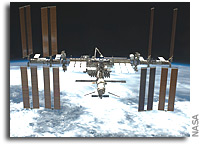
ISS On-Orbit Status 05/14/12
All ISS systems continue to function nominally, except those noted previously or below. Underway: Week 3 of Increment 31 (three-person crew).
Kuipers continued his current extended session of the ESA ENERGY experiment. FE-6 Pettit also contributed a urine sample later in the day as Control Subject. [Collection of a water sample from the PWD (Potable Water Dispenser) in the Lab and urine sampling (on 2nd void of the day) are continuing, as is adherence to the special ENERGY breakfast plus logging all ISS food & drinks consumed during ENERGY experiment performance from lunch and dinner on Day 1 until breakfast on Day 10. André wears an armband monitor, positioned on the right triceps where it started automatically on skin contact. The instrument must be worn for the entire 10-day ENERGY measurement period and removed only during showers or if needed during blood draws. Activities without the armband monitor on the triceps must be carefully logged. The monitor will be removed at the end of the 10-day period, then data will be downloaded from the device. Background: The observed loss of astronauts’ body mass during space flight is partly due to the systematic ongoing negative energy balance in micro-G, in addition to disuse. Unfortunately, the reason for such unbalanced match between intake and output is not clear, but appealing data suggest a relation between the degree of energy deficit and the exercise level prescribed as a countermeasure. Purpose of the ENERGY experiment is (1) to measure changes in energy balance during long term space flight, (2) to measure adaptations in the components of the Total Energy Expenditure TEE (consumption), and (3) to derive an equation for the energy requirements of astronauts. TEE is the sum of resting metabolic rate (RMR, measured), diet-induced thermogenesis (DIT, measured oxygen-uptake minus RMR) and activity-related energy expenditure (AEE, calculated).]
After breakfast, CDR Kononenko performed the routine inspection of the SM (Service Module) PSS Caution & Warning panel as part of regular Daily Morning Inspection.
The CDR also completed the weekly checkup behind ASU/toilet panel 139 in the SM of a fluid connector (MNR-NS) of the SM-U urine collection system, looking for potential moisture.
In support of POIC (Payload Operations & Integration Center)/Huntsville on the CIR (Combustion Integrated Rack), FE-6 Pettit uninstalled & removed the three protective alignment guides from the rack, re-engaged the snubber pins and locked the safety pins to allow the PaRIS (Passive Rack Isolation System) to be active before begin of ground-commanded CIR operations requiring a microgravity environment.
FE-5 Kuipers set up an EDV-U urine container and started filling the UPA (Urine Processor Assembly) to 70% for processing. Later tonight, André will connect a second EDV-U for filling the UPA to 50%, then disconnect the container and stow it.
For more routine maintenance on the WRS (Water Recovery System), André later used the LFTP (Low Flow Transfer Pump) to initiate transfer of the water contents of one EDV (#972) to the WPA (Water Processor Assembly) and offloading it, using a particulate filter. [Estimated offload time: ~70 min.]
Kononenko conducted the periodic maintenance of the active Russian BMP (Harmful Impurities Removal System) by starting the “bake-out” cycle to vacuum on absorbent bed #1 of the regenerable dual-channel filtration system. The process will be terminated at ~5:05pm EDT. Bed #2 regeneration will be done tomorrow. [Regeneration of each of the two cartridges takes about 12 hours and is conducted only during crew awake periods. The BMP’s regeneration cycle, normally done every 20 days, is currently performed four times more frequently (last time: 4/23 & 4/24).]
Afterwards, Oleg performed an audit/inventory of Russian VKS auxiliary laptop computer equipment, found on 3/28 and stowed as “unidentified” in a container. The items were photographed and re-stowed or discarded as specified on an uplinked listing, and the empty container was stashed with empty bags.
Later, the CDR verified proper functioning of the Matryoshka RBO-3-2 Lulin-5 electronics box which is connected to the spherical sensor-equipped “phantom” in the MRM1 Rassvet module. [The complex Matryoshka payload suite is designed for sophisticated radiation studies. Note: Matryoshka is the name for the traditional Russian set of nested dolls.]
Kuipers & Pettit had several hours allotted for troubleshooting the failed GPS-1 (Global Positioning System 1) component of the ACS SIGI (Attitude Control System / Space Integrated GPS/Inertial Navigation System) in the Lab. [After first performing a check of the data connections to GPS-1, André & Don later were to press on with an R&R (removal & replacement) of GPS-1 if the connection check, monitored by the ground, was unsuccessful in regaining communications.]
Afterwards, Don Pettit started another sampling run with the AQM (Air Quality Monitor), deactivating the system ~5 hrs later. [Consisting of the EHS GC/DMS (Environmental Health Systems Gas Chromatograph / Differential Mobility Spectrometer), the system is controlled with “Sionex” expert software from the SSC (Station Support Computer)-12 laptop. The AQM demonstrates COTS (Commercial Off-the-Shelf) technology for identifying volatile organic compounds, similar to the VOA (Volatile Organics Analyzer). This evaluation will continue over the course of several months as it helps to eventually certify the GC/DMS as nominal CHeCS (Crew Health Care Systems) hardware],
In the FGB, André relocate containers from Compartment 48 to the GA/Pressurized Adapter section of Zarya and later moved 3 FDS PBAs (Fire Detection & Suppression / Portable Breathing Apparatus) units from the Node-1 ZSR (Zero-G Storage Rack) to the now empty Zone 48, securing them with bungees. [FE-5 was also to determine how many additional PBAs can fit into the GA box while maintaining safety requirements.]
Kononenko collected the regular air samples for return to Earth, using a Russian AK-1M absorber in the SM for air, plus IPD-CO Draeger tubes, on a cartridge belt with a pump, to check the SM cabin air for CO (Carbon Monoxide) and subsequently also for NH3 (Ammonia).
Later, Oleg completed the routine daily servicing of the SOZh system (Environment Control & Life Support System, ECLSS) in the SM. [Regular daily SOZh maintenance consists, among else, of checking the ASU toilet facilities, replacement of the KTO & KBO solid waste containers, replacement of EDV-SV waste water and EDV-U urine containers and filling EDV-SV, KOV (for Elektron), EDV-ZV & EDV on RP flow regulator.]
Working from the Russian discretionary “time permitting” task list, Oleg also performed the daily IMS (Inventory Management System) maintenance, updating/editing its standard “delta file” including stowage locations, for the regular weekly automated export/import to its three databases on the ground (Houston, Moscow, Baikonur).
Don Pettit unstowed and set up the USND-2 (Ultrasound 2) for his 4th SPRINT leg scan, scheduled tomorrow. [SPRINT (Integrated Resistance and Aerobic Training Study) evaluates the use of high intensity, low volume exercise training to minimize loss of muscle, bone, and cardiovascular function in ISS crewmembers during long-duration missions.]
As part of today’s SOZh activities, Kononenko worked in the DC1 Docking Compartment to start the regular urine transfer from EDV-U containers (921,955, 701, 991, 992) to the BV1 Rodnik water storage tank of Progress M-15M/47P (#415), docked at DC1, using the usual pumping equipment with the electric compressor (#41). The BV1 bladder was checked for leak-tightness on 5/11. [Each of the spherical Rodnik tanks BV1 & BV2 consists of a hard shell with a soft membrane (bladder) composed of elastic fluoroplastic. The bladder is used to expel water from the tank by compressed air pumped into the tank volume surrounding the membrane and is leak-tested before urine transfers, i.e., with empty tanks, the bladders are expanded against the tank walls and checked for hermeticity.]
Oleg also conducted the regular quarterly maintenance of the TVIS (Treadmill with Vibration Isolation & Stabilization). [Required was an inspection of the condition of harnesses, belt slats, corner bracket ropes, SLD (Subject Load Device) cables & exit pulley housing, IRBAs (Isolation Restorative Bungee Assemblies) and gyroscope wire ropes for any damage or defects, lubricating as required plus recording control panel time & date values, and making sure that the display cable and skirt were properly secured afterwards. Wire ropes have reached certified and historical life. The CDR was to provide a thorough visual inspection and photo document condition.]
Pettit had another time slot reserved for making entries in his electronic Journal on the personal SSC (Station Support Computer). [Required are three journaling sessions per week.]
At ~10:30am, André powered up the SM’s amateur radio equipment (Kenwood VHF transceiver with manual frequency selection, headset, & power supply) and at 10:40am conducted a ham radio session with students at Simon Alaittuq Middle School, Rankin Inlet, Nunavut, Canada.
The crew worked out with their regular 2-hr physical exercise protocol on the CEVIS cycle ergometer with vibration isolation (FE-5), TVIS treadmill with vibration isolation & stabilization (CDR), ARED advanced resistive exerciser (FE-5, FE-6), T2/COLBERT advanced treadmill (FE-6) and VELO ergometer bike with load trainer (CDR). [FE-6 is on the special experimental SPRINT protocol which diverts from the regular 2.5 hrs per day exercise regime and introduces special daily sessions, followed by a USND (Ultrasound) leg muscle self scan in COL. No exercise is being timelined for Fridays. If any day is not completed, Don picks up where he left off, i.e., he would be finishing out the week with his last day of exercise on his off day. Today’s exercise called for T2 (aerobic), with ARED+T2 (resistive+aerobic), CEVIS & ARED+T2 following in the next 3 days. If any day is not completed, Don picks up where he left off, i.e., he would be finishing out the week with his last day of exercise on his off day.]
Tasks listed for Kononenko on the Russian discretionary “time permitting” job for today were –
• A ~30-min. session for Russia’s EKON Environmental Safety Agency, making observations and taking KPT-3 aerial photography of environmental conditions on Earth using the NIKON D3X camera with the RSK-1 laptop, and
More preparation & downlinking of reportages (written text, photos, videos) for the Roskosmos website to promote Russia’s manned space program (max. file size 500 Mb).
Soyuz TMA-04M/30S Update: Yesterday morning at the usual time, the Soyuz launch vehicle was rolled out to the launch site and erected on the pad, starting L-2 launch activities. Earlier today, the State Commission held its meeting at the Baikonur Cosmodrome in Kazakhstan to approve the primary and backup crews for Soyuz TMA-04M/30S and confirm the readiness of the space launch system. Prime crew: Gennady Ivanovich Padalka (Roskosmos/Russia; ISS-31 Flight Engineer, ISS-32 Commander, Soyuz TMA-04M CDR), Sergey Nikolaevich Revin (Roskosmos/Russia; ISS-31/32 FE, Soyuz TMA-04M FE), and Joseph Michael Acaba (NASA/USA; ISS-31/32 FE, Soyuz TMA-04M FE). Backup crew: Oleg Viktorovich Novitsky (Roskosmos/Russia; ISS-31 FE, ISS-32 CDR, Soyuz TMA-04M CDR); Evgeny Igorevich Tarelkin (Roskosmos/Russia; ISS-31/32 FE, Soyuz TMA-04M FE), and Kevin Ford (NASA/USA; ISS-31/32 FE, Soyuz TMA-04M FE). The members of the primary and backup crews reported their readiness for the mission.
Soyuz TMA-04M/30S Launch: Launch is scheduled for tonight at 11:01:23pm EDT at a phase angle (ISS leading by) 340 deg. Launch Escape System will be jettisoned at L+1m 54s (~46 km altitude, ~115 km downrange); first stage (four strap-on boosters) separate at L+1:58; launch shroud separates at L+2:37; 2nd (core) stage separates at L+4:47; 3rd stage shuts down at orbital insertion at L+8:45 (~202 km altitude, ~520 km downrange, ~7.50 km/s), followed by separation of 3rd stage at L+8:48 and later deployment of antennas (Kurs-A, Rassvet, BITS) and two solar arrays at L+8:56.
No CEO (Crew Earth Observation) targets uplinked for today.
ISS Orbit (as of this morning, 9:28am EDT [= epoch])
Mean altitude – 398.9 km
Apogee height – 406.0 km
Perigee height – 391.9 km
Period — 92.54 min.
Inclination (to Equator) — 51.64 deg
Eccentricity — 0.0010436
Solar Beta Angle — -28.7 deg (magnitude decreasing)
Orbits per 24-hr. day — 15.56
Mean altitude loss in the last 24 hours — 61 m
Revolutions since FGB/Zarya launch (Nov. 98) — 77,277
Time in orbit (station) — 4924 days
Time in orbit (crews, cum.) — 4211 days
Significant Events Ahead (all dates Eastern Time and subject to change):
————–Three-crew operations————-
05/14/12 — Soyuz TMA-04M/30S launch – G.Padalka (CDR-32)/J.Acaba/S.Revin (~11:02 pm EDT)
05/17/12 — Soyuz TMA-04M/30S docking (MRM2) (~12:39am EDT)
05/19/12 — SpaceX Falcon/Dragon launch (~4:55am EDT)
05/22/12 — SpaceX Dragon berthing (~12:15pm EDT)
————–Six-crew operations—————-
07/01/12 — Soyuz TMA-03M/29S undock/landing (End of Increment 31)
————–Three-crew operations————-
07/15/12 — Soyuz TMA-05M/31S launch – S.Williams (CDR-33)/Y.Malenchenko/A.Hoshide
07/17/12 — Soyuz TMA-05M/31S docking
07/20/12 — HTV3 launch (~10:18pm EDT)
07/22/12 — Progress M-15M/47P undock
07/24/12 — Progress M-15M/47P re-docking
07/30/12 — Progress M-15M/47P undocking/deorbit
07/31/12 — Progress M16M/48P launch
08/02/12 — Progress M16M/48P docking
————–Six-crew operations—————-
09/17/12 — Soyuz TMA-04M/30S undock/landing (End of Increment 32)
————–Three-crew operations————-
10/15/12 — Soyuz TMA-06M/32S launch – K.Ford (CDR-34)/O.Novitsky/E.Tarelkin
10/17/12 — Soyuz TMA-06M/32S docking
————–Six-crew operations————-
11/01/12 — Progress M-17M/49P launch
11/03/12 — Progress M-17M/49P docking
11/12/12 — Soyuz TMA-05M/31S undock/landing (End of Increment 33)
————–Three-crew operations————-
12/05/12 — Soyuz TMA-07M/33S launch – C.Hadfield (CDR-35)/T.Mashburn/R.Romanenko
12/07/12 — Soyuz TMA-07M/33S docking
————–Six-crew operations————-
12/26/12 — Progress M-18M/50P launch
12/28/12 — Progress M-18M/50P docking
03/19/13 — Soyuz TMA-06M/32S undock/landing (End of Increment 34)
————–Three-crew operations————-
04/02/13 — Soyuz TMA-08M/34S launch – P.Vinogradov (CDR-36)/C.Cassidy/A.Misurkin
04/04/13 — Soyuz TMA-08M/34S docking
————–Six-crew operations————-
05/16/13 — Soyuz TMA-07M/33S undock/landing (End of Increment 35)
————–Three-crew operations————-
05/29/13 — Soyuz TMA-09M/35S launch – M.Suraev (CDR-37)/K.Nyberg/L.Parmitano
05/31/13 — Soyuz TMA-09M/35S docking
————–Six-crew operations————-
09/xx/13 — Soyuz TMA-08M/34S undock/landing (End of Increment 36)
————–Three-crew operations————-
09/xx/13 — Soyuz TMA-10M/36S launch – M.Hopkins/TBD (CDR-38)/TBD
09/xx/13 — Soyuz TMA-10M/36S docking
————–Six-crew operations————-
11/xx/13 — Soyuz TMA-09M/35S undock/landing (End of Increment 37)
————–Three-crew operations————-
11/xx/13 — Soyuz TMA-11M/37S launch – K.Wakata (CDR-39)/R.Mastracchio/TBD
11/xx/13 — Soyuz TMA-11M/37S docking
————–Six-crew operations————-
03/xx/14 — Soyuz TMA-10M/36S undock/landing (End of Increment 38)
————–Three-crew operations————-



