
NASA ISS On-Orbit Status 10 April 2012
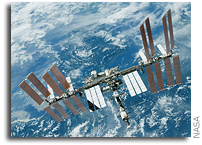
ISS On-Orbit Status 04/10/12
All ISS systems continue to function nominally, except those noted previously or below.
Upon wakeup, CDR Dan Burbank, FE-5 André Kuipers & FE-6 Don Pettit each completed another post-sleep session of the Reaction Self-Test (Psychomotor Vigilance Self-Test on the ISS) protocol, the 40th for Dan, the 34th for André & Don. [RST is done twice daily (after wakeup & before bedtime) for 3 days prior to the sleep shift, the day(s) of the sleep shift and 5 days following a sleep shift. The experiment consists of a 5-minute reaction time task that allows crewmembers to monitor the daily effects of fatigue on performance while on ISS. The experiment provides objective feedback on neurobehavioral changes in attention, psychomotor speed, state stability, and impulsivity while on ISS missions, particularly as they relate to changes in circadian rhythms, sleep restrictions, and extended work shifts.]
After breakfast, FE-2 Ivanishin performed the routine inspection of the SM (Service Module) PSS Caution & Warning panel as part of regular Daily Morning Inspection.
FE-6 Pettit continued his 4th (FD120) suite of sessions with Day 5 of the medical protocol Pro K (Dietary Intake Can Predict and Protect against Changes in Bone Metabolism during Spaceflight and Recovery), with diet logging after the urine pH spot test, for a 5-day period. In addition to recording his diet input, Don terminated his associated 24-hr urine collections at ~7:26am EDT and completed the blood sampling, assisted by André Kuipers in the blood draw. [For Pro K, there are five in-flight sessions (FD15, FD370, FD60, FD120, FD180) of samplings, to be shared with the NUTRITION w/Repository protocol, each one with five days of diet & urine pH logging and photography on the last day (science sessions are often referred to by Flight Day 15, 30, 60, etc. However, there are plus/minus windows associated with these time points so a “Flight Day 15” science session may not actually fall on the crewmember’s 15th day on-orbit). The crewmember prepares a diet log and then annotates quantities of food packets consumed and supplements taken. On Days 4 & 5, urine collections are spread over 24 hrs; samples go into the MELFI (Minus Eighty Laboratory Freezer for ISS) within 30 min after collection. Blood samples, on the last day, are centrifuged in the RC (Refrigerated Centrifuge) and placed in MELFI at -80 degC. There is an 8-hr fasting requirement prior to the blood draw (i.e., no food or drink, but water ingestion is encouraged). MELFI constraints: Maximum MELFI dewar open time: 60 sec; at least 45 min between MELFI dewar door openings.]
Afterwards, Don Pettit tended to the JAXA SSHDT (Super Sensitive High Definition TV), transferred from the JPM (JEM Pressurized Module) to the Node-3/Cupola for taking video of North Pole auroras and night views of Japan for 5 days (i.e., 4/9 – 4/13). [About 4 hrs later, Don exchanged the 32GB memory card and restarted recording (once a day). For the first 3 days, the SSHDTV uses a single 4.8mm focus lens with IR Cut Filter 3 and for the remaining 2 days a single focus 8mm lens.]
After starting charging of the BAR TTM-2 battery at wakeup, Anton & Anatoly used the KPT-2 payload and its BAR science instruments suite for measuring environmental data in the RS (Russian Segment). [KPT-2 monitors problem areas, necessary to predict shell micro-destruction rate and to develop measures to extend station life. Data are copied to the RSE1 laptop for downlink to Earth via OCA, with photographs, and the activities are supported by ground specialist tagup as required. Objective of the Russian KPT-2/BAR science payload is to measure environmental parameters (temperature, humidity, air flow rate) and module shell surface temperatures behind RS (Russian Segment) panels and other areas susceptible to possible micro-destruction (corrosion), before and after insolation (day vs. night). Piren-V is a video-endoscope with pyrosensor, part of the methods & means being used on ISS for detecting tiny leaks in ISS modules which could lead to cabin depressurization. Besides KPT-2 Piren-V, the payload uses a remote infrared thermometer (Kelvin-Video), a thermohygrometer (Iva-6A), a heat-loss thermoanemometer/thermometer (TTM-2) and an ultrasound analyzer (AU-1) to determine environmental data in specific locations and at specific times. Activities include documentary photography with the NIKON D2X camera and flash.]
CDR Dan Burbank started another sampling run with the AQM (Air Quality Monitor), deactivating the system ~5 hrs later. [Consisting of the EHS GC/DMS (Environmental Health Systems Gas Chromatograph / Differential Mobility Spectrometer), the system is controlled with “Sionex” expert software from the SSC (Station Support Computer)-12 laptop. The AQM demonstrates COTS (Commercial Off-the-Shelf) technology for identifying volatile organic compounds, similar to the VOA (Volatile Organics Analyzer). This evaluation will continue over the course of several months as it helps to eventually certify the GC/DMS as nominal CHeCS (Crew Health Care Systems) hardware.]
Next, Dan completed the standard 30-day inspection of the AED (Automated External Defibrillator) in the CHeCS (Crew Health Care Systems) rack. [AED is a portable electronic device that automatically diagnoses the potentially life threatening cardiac arrhythmias of ventricular fibrillation and ventricular tachycardia in a patient. It then can treat them through defibrillation, i.e., the application of electrical therapy which stops the arrhythmia, allowing the heart to re-establish an effective rhythm.]
Pettit & Burbank completed another session each with the MedOps psychological evaluation experiment WinSCAT (Spaceflight Cognitive Assessment Tool for Windows), logging in on the MEC (Medical Equipment Computer) laptop and going through the psychological evaluation exercise on the PC-based WinSCAT application. It was Don’s 4th, Dan’s 6th run. [WinSCAT is a monthly time-constrained questionnaire test of cognitive abilities, routinely performed by astronauts aboard the ISS every 30 days before or after the PHS (periodic health status) test or on special CDR’s, crewmembers or flight surgeons request. The test uses cognitive subtests that measure sustained concentration, verbal working memory, attention, short-term memory, spatial processing, and math skills. The five cognitive subtests are Coding Memory – Learning, Continuous Processing Task (CPT), Match to Sample, Mathematics, and Coding Delayed Recall. These WinSCAT subtests are the same as those used during NASA’s long-duration bed rest studies.]
FE-4 Kononenko completed the routine verification of yesterday’s automated refreshes of the IUS AntiVirus program on all Russian VKS auxiliary network laptops RSS1, RSS2, RSK1-T61p & RSK2. [Antivirus update procedures have changed since the recent SSCV4 software update. Before the installation on 8/8/11 of the new automated procedure, the refresh was done manually on Mondays on RSS2, copying the files to the RSS2 service folder, then launching update scripts on the network laptops RSS1, RSK1-T61p & RSK2 and finally manually updating non-network laptops RSE-Med & RSE1. On Tuesdays, the anti-virus scanning results are regularly verified on all laptops. Nominally, Russian network laptops have software installed for automatic anti-virus update; fresh data is copied on RSK1-T61p & RRSK2 every time a computer is rebooted with a special login, and on RSS1 once daily. On Russian non-network laptops antivirus definition file update is done by the crew once every two weeks on Monday.]
Afterwards, Oleg had ~2 hrs allotted to continue loading trash and discarded equipment on Progress 46P for disposal, while concurrently updating the IMS database.
FE-5 Kuipers had ~1h 45m set aside for ATV-3 cargo transfer operations, followed later by a ground tagup to report status.
Working later in the JAXA JPM (JEM Pressurized Module) on the FPEF (Fluid Physics Experiment Facility), André replaced all fasteners on the experiment cell brackets, cover body and front cover plate with new fasteners, trashing the old ones.
Afterwards, Don relocated the SSC-9 (Station Support Computer 9) & SSC-18 laptops from the US Lab to the ROBoT simulator workstation to support upcoming ROBoT training for the SpaceX “Dragon” arrival.
In preparation for his return to Earth on 4/27, FE-1 Shkaplerov & FE-2 Ivanishin completed their first preliminary orthostatic hemodynamic endurance test session with the Russian Chibis (“Lapwing”) suit by conducting the MedOps MO-4 exercise protocol in the below-the-waist reduced-pressure device (ODNT, US: LBNP/Lower Body Negative Pressure) on the TVIS treadmill, assisted by Oleg Kononenko as CMO (Crew Medical Officer). Anton was supported in his one-hour session by ground specialist tagup via VHF at ~12:10pm, Anatoly at ~1:38pm. [The Chibis provides gravity-simulating stress to the body’s cardiovascular/circulatory system for evaluation of the crewmember’s orthostatic tolerance (e.g., the Gauer-Henry reflex) after his long-term stay in zero-G. Data output includes blood pressure readings. The preparatory training generally consists of first imbibing 150-200 milliliters of water or juice, followed by one cycle of a sequence of progressive regimes of reduced (“negative”) pressure, set at -25, -35, -40 and -45 mmHg for five min. each, while shifting from foot to foot at 10-12 steps per minute, while wearing a sphygmomanometer to measure blood pressure and the REG SHKO Rheoencephalogram Biomed Cap. The body’s circulatory system interprets the pressure differential between upper and lower body as a gravity-like force pulling the blood (and other liquids) down. Chibis data and biomed cardiovascular readings are recorded. The Chibis suit (not to be confused with the Russian “Pinguin” suit for spring-loaded body compression, or the “Kentavr” anti-g suit worn during reentry) is similar to the U.S. LBNP facility (not a suit) used for the first time on Skylab in 1973/74, although it appears to accomplish its purpose more quickly.]
Afterwards, Anton Shkaplerov & Anatoly Ivanishin also conducted a 35-min training run on the TVIS treadmill in their Chibis ODNT suits in lieu of their regular physical exercise.
With the Elektron oxygen generator currently off, FE-4 was to refresh ISS cabin atmosphere with another 1-hr O2 repress from Progress M-14/46P (#414) SRPK tankage on TsUP Go.
Working in the Lab on the CIR (Combustion Integrated Rack), Dan Burbank disconnected the MTL (Moderate Temperature Loop), VES (Vacuum Exhaust System) and Station N2 (nitrogen) lines of the Optics Bench, translated & rotated it out of the way and replaced an FCF DCM (Fluids & Combustion Facility / Diagnostic Control Module) on its back. Afterwards, Dan backed out, returning the Optics Bench to its nominal position and reconnected the MTL, VES and Station N2 lines. [DCM is the software controller of a CIR HiBMS (High Bit-Depth Multi-Spectral) Imaging Package.]
The CDR also retrieved & readied partially assembled hardware from PMM (Permanent Multipurpose Module) stowage in preparation for tomorrow’s schedule Amine Swingbed IFM (Inflight Maintenance). [The Amine hardware included Amine Swingbed, Controller with Vacuum Line, Amine Swingbed Mounting Plate, Amine Swingbed Mounting Hardware, Strain Relief Mounting Hardware & Electrostatic Symbol Decal.].
Kuipers conducted the periodic (approx. weekly) WRS (Water Recovery System) sampling in Node-3 using the TOCA (Total Organic Carbon Analyzer), after first initializing the software and priming (filling) the TOCA water sample hose. [After the approximately 2-hr TOCA analysis, results were transferred to the SSC-5 (Station Support Computer 5) laptop via USB drive for downlink, and the data were also logged.]
Performing periodic TOCA (Total Organic Carbon Analyzer) maintenance, André primed the TOCA fluid line with water from the WPA and buffer solution from the TOCA BC (Buffer Container) to wet the dry GLS (Gas/Liquid Separator), then conducted the periodic (approx. weekly) WRS TOCA sampling in Node-3. [After the approximately 2-hr TOCA analysis, results were transferred to the SSC-5 (Station Support Computer 5) laptop via USB drive for downlink, and the data were also logged.]
Ivanishin took care of the daily IMS (Inventory Management System) maintenance, updating/editing its standard “delta file” including stowage locations, for the regular weekly automated export/import to its three databases on the ground (Houston, Moscow, Baikonur).
Shkaplerov completed the routine daily servicing of the SOZh system (Environment Control & Life Support System, ECLSS) in the SM. [Regular daily SOZh maintenance consists, among else, of checking the ASU toilet facilities, replacement of the KTO & KBO solid waste containers, replacement of EDV-SV waste water and EDV-U urine containers and filling EDV-SV, KOV (for Elektron), EDV-ZV & EDV on RP flow regulator.]
Pettit inserted two (out of four) small ECCO cartridges from stowage into MELFI-3 (Minus Eighty Laboratory Freezer for ISS 3) at -19 degC to ensure proper thermal conditioning for planned ECCO sampling operations in about two weeks.
Afterwards, Don undertook the regular monthly session of the CHeCS (Crew Health Care Systems) emergency medical operations OBT (On-Board Training) drill, a 30-min. exercise to refresh his CMO (Crew Medical Officer) acuity in a number of critical health areas. The video-based proficiency drill today focused on a review of all topics. At the end, FE-6 completed a self-assessment questionnaire. Answers were provided at test conclusion. [The HMS (Health Maintenance Systems) hardware, including ACLS (Advanced Cardiac Life Support) equipment, may be used in contingency situations where crew life is at risk. To maintain proficiency, crewmembers spend one hour per month reviewing HMS and ACLS equipment and procedures via the HMS and ACLS CBT (computer-based training). The training drill, each crewmember for him/herself, refreshes their memory of the on-orbit stowage and deployment locations, equipment etc. and procedures.]
In the SM, Ivanishin collected the periodic KAV condensate water samples from the SRV-K2M Condensate Water Processor (water recovery system) upstream of the BKO water purification (multifiltration) unit, then removed sampler & separator and disposed of flush water.
Anatoly also completed another 30-min. session for the DZZ-13 “Seiner” ocean observation program, obtaining SONY HDV-Z7E camcorder footage of color bloom patterns in the waters of the South-Eastern Pacific and off the Chile coastline, then copying the images to the RSK-1 laptop.
Don Pettit serviced the ARED (Advanced Resistive Exercise Device) workout machine, performing periodic maintenance by evacuating its cylinder flywheels to reestablish proper vacuum condition & sensor calibration.
In the JAXA JPM, Don reconfigured the MMA (Microgravity Measurement Apparatus) from the Ryutai Rack for experimentation on the Kobairo Rack. [This required powering off MMA RSUs (Remote Sensor Units), reconnecting UDC (Utility DC-to-DC Converter) power cable and powering up the Kobairo MMA RSU.]
The CDR & FE-6 had another time slot reserved each for making entries in their electronic Journals on the personal SSC. [Required are three journaling sessions per week.]
FE-1 Shkaplerov closed out the running Russian technical experiment KPT-24 TEST. The equipment was unbolted and packed for return on Soyuz 28S. [KPT-24 TEST studies look for potential microdestruction of structures in RS (Russian Segment) pressurized compartments by deposits of aggressive products and components of the cabin atmosphere.]
FE-1, FE-2, FE-4 & FE-5 had their regular weekly PMCs (Private Medical Conferences) via S- & Ku-band audio/video, André at ~6:25am, Oleg at ~11:00am, Anatoly at ~11:30am, Anton at ~1:00pm EDT.
At ~4:20am, Anton, Anatoly & Oleg conducted a brief telephone downlink with radio station “Retro-FM” in Moscow.
At ~10:40am, the Russian crewmembers supported a PAO TV downlink for three events: (1) on the 75th anniversary of pilot-cosmonaut I. Volk (I. Volk, honored test pilot and pilot-cosmonaut, turns 75 on April 12, 2012. Igor Petrovich Volk is President of International Association “Earth and Cosmonautics”, President of National Aero Club of Russia, President of Cultural and Educational Nonprofit Partnership “Earth and Space of German Titov”); (2) to the participants of Mars-500 International Symposium (the International Symposium on Mars-500 results is planned in Russian Academy of Sciences on April 23-25, 2012. The Symposium is arranged by Russian Academy of Sciences (RAS) and Institute of Biomedical Problems of RAS. Leading Russian and world scientists are expected to take part in the Symposium as well as experts from Gagarin Cosmonaut Training Center, RSC Energia and some other organizations engaged in Mars-500 implementation); (3) to the participants of «Yuri’s Night» space celebration (the PARADOX club in Moscow will host international online marathon Yuri’s Night on the night of 19-20 April. «Yuri’s Night» is an international celebration held on April 12 every year to commemorate first human space flight. Yuri’s Night is celebrated all over the world – in Los Angeles, Stockholm, Antarctica, San Francisco, Tel Aviv, Tokyo. The goal of the celebration is to increase interest of the public and youth in space exploration and inspire a new generation of explorers, unite young people committed to shaping the future of cosmonautics, develop responsible leaders and innovators with a global perspective. This year Yuri’s Night will be held for the second time in Russia and organized by RSC Energia.)
The crew worked out with their regular 2-hr physical exercise protocol on the CEVIS cycle ergometer with vibration isolation (CDR), TVIS treadmill with vibration isolation & stabilization (FE-1, FE-2/2x, FE-4), ARED advanced resistive exerciser (CDR, FE-1, FE-5, FE-6), T2/COLBERT advanced treadmill (CDR, FE-5, FE-6), and VELO ergometer bike with load trainer (FE-4). [FE-6 is on the special experimental SPRINT protocol which diverts from the regular 2.5 hrs per day exercise regime and introduces special daily sessions, followed by a USND (Ultrasound) leg muscle self scan in COL. Today’s exercise called for T2, with ARED+T2 & CEVIS, following in the next 2 days. If any day is not completed, Don picks up where he left off, i.e., he would be finishing out the week with his last day of exercise on his off day If any day is not completed, Don picks up where he left off, i.e., he would be finishing out the week with his last day of exercise on his off day If any day is not completed, Don picks up where he left off, i.e., he would be finishing out the week with his last day of exercise on his off day.]
FE-5 Kuipers performed a session of the Treadmill Kinematics program on the T2/COLBERT advanced treadmill, setting up the HD camcorder in Node-1, placing tape markers on his body, recording a calibration card in the FOV (Field of View) and then conducting the workout run within a specified speed range. The video was then downlinked via MPC. André’s session is a repeat of the previous session, since the FOV (Field-of-View) from the last run was not suitable for analysis. The entire treadmill belt should be visible. [Purpose of the Kinematics T2 experiment is to collect quantitative data by motion capture from which to assess current exercise prescriptions for participating ISS crewmembers. Detailed biomechanical analyses of locomotion will be used to determine if biomechanics differ between normal and microgravity environments and to determine how combinations of external loads and exercise speed influence joint loading during in-flight treadmill exercise. Such biomechanical analyses will aid in understanding potential differences in gait motion and allow for model-based determination of joint & muscle forces during exercise. The data will be used to characterize differences in specific bone and muscle loading during locomotion in the two gravitational conditions. By understanding these mechanisms, appropriate exercise prescriptions can be developed that address deficiencies.]
After his T2 session, FE-6 Pettit closed down the T2 software on its laptop for data transfer, then turned off the T2 display.
Tasks listed for Shkaplerov, Kononenko & Ivanishin on the Russian discretionary “time permitting” job for today were –
* A ~30-min. run of the GFI-8 “Uragan” (hurricane) earth-imaging program with the NIKON D3X digital camera with Sigma AF 300-800mm telelens, focusing on the volcanoes Hudson & Huascaran, Mount Nevado del Ruiz, Colombia, and the glaciers of Patagonia;
* A ~30-min. session for Russia’s EKON Environmental Safety Agency, making observations and taking KPT-3 aerial photography of environmental conditions on Earth using the NIKON D3X camera with the RSK-1 laptop, and
* More preparation & downlinking of reportages (written text, photos, videos) for the Roskosmos website to promote Russia’s manned space program (max. file size 500 Mb).
No CEO (Crew Earth Observation) targets uplinked for today.
ISS Orbit (as of this morning, 9:20am EDT [= epoch])
Mean altitude – 389.5 km
Apogee height – 398.4 km
Perigee height – 380.5 km
Period — 92.34 min.
Inclination (to Equator) — 51.64 deg
Eccentricity — 0.001327
Solar Beta Angle — 49.0 deg (magnitude increasing)
Orbits per 24-hr. day — 15.59
Mean altitude loss in the last 24 hours — 101 m
Revolutions since FGB/Zarya launch (Nov. 98) — 76,669
Time in orbit (station) — 4890 days
Time in orbit (crews, cum.) — 4177 days
Significant Events Ahead (all dates Eastern Time and subject to change):
————–Six-crew operations—————-
04/19/12 — Progress M-14M/46P undock (7:03am EDT)
46P Orbital Operations
04/20/12 — Progress M-15M/47P launch (8:50:26am EDT)
04/22/12 — Progress M-15M/47P docking (~10:40am)
04/27/12 — Soyuz TMA-22/28S undock (4:19am EDT)
04/27/12 — Soyuz TMA-22/28S landing (7:45am EDT; 2:45pm DMT/Moscow) (End of Increment 30)
04/28/12 — Progress M-14M/46P deorbit burn (6:33am EDT)
————–Three-crew operations————-
04/30/12 — SpaceX Dragon launch (12:22pm EDT; target date)
05/15/12 — Soyuz TMA-04M/30S launch – G.Padalka (CDR-32)/J.Acaba/S.Revin
05/17/12 — Soyuz TMA-04M/30S docking (MRM2)
————–Six-crew operations—————-
07/01/12 — Soyuz TMA-03M/29S undock/landing (End of Increment 31)
————–Three-crew operations————-
07/15/12 — Soyuz TMA-05M/31S launch – S.Williams (CDR-33)/Y.Malenchenko/A.Hoshide
07/17/12 — Soyuz TMA-05M/31S docking
07/20/12 — HTV3 launch (~10:18pm EDT)
07/31/12 — Progress M16M/48P launch
08/02/12 — Progress M16M/48P docking
————–Six-crew operations—————-
09/17/12 — Soyuz TMA-04M/30S undock/landing (End of Increment 32)
————–Three-crew operations————-
10/15/12 — Soyuz TMA-06M/32S launch – K.Ford (CDR-34)/O.Novitskiy/E.Tarelkin
10/17/12 — Soyuz TMA-06M/32S docking
————–Six-crew operations————-
11/01/12 — Progress M-17M/49P launch
11/03/12 — Progress M-17M/49P docking
11/12/12 — Soyuz TMA-05M/31S undock/landing (End of Increment 33)
————–Three-crew operations————-
12/05/12 — Soyuz TMA-07M/33S launch – C.Hadfield (CDR-35)/T.Mashburn/R.Romanenko
12/07/12 — Soyuz TMA-07M/33S docking
————–Six-crew operations————-
12/26/12 — Progress M-18M/50P launch
12/28/12 — Progress M-18M/50P docking
03/19/13 — Soyuz TMA-06M/32S undock/landing (End of Increment 34)
————–Three-crew operations————-
04/02/13 — Soyuz TMA-08M/34S launch – P.Vinogradov (CDR-36)/C.Cassidy/A.Misurkin
04/04/13 — Soyuz TMA-08M/34S docking
————–Six-crew operations————-
05/16/13 — Soyuz TMA-07M/33S undock/landing (End of Increment 35)
————–Three-crew operations————-
05/29/13 — Soyuz TMA-09M/35S launch – M.Suraev (CDR-37)/K.Nyberg/L.Parmitano
05/31/13 — Soyuz TMA-09M/35S docking
————–Six-crew operations————-
09/xx/13 — Soyuz TMA-08M/34S undock/landing (End of Increment 36)
————–Three-crew operations————-
09/xx/13 — Soyuz TMA-10M/36S launch – M.Hopkins/TBD (CDR-38)/TBD
09/xx/13 — Soyuz TMA-10M/36S docking
————–Six-crew operations————-
11/xx/13 — Soyuz TMA-09M/35S undock/landing (End of Increment 37)
————–Three-crew operations————-
11/xx/13 — Soyuz TMA-11M/37S launch – K.Wakata (CDR-39)/R.Mastracchio/TBD
11/xx/13 — Soyuz TMA-11M/37S docking
————–Six-crew operations————-
03/xx/14 — Soyuz TMA-10M/36S undock/landing (End of Increment 38)
————–Three-crew operations————-



