
NASA ISS On-Orbit Status 11 March 2012
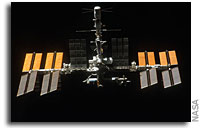
All ISS systems continue to function nominally, except those noted previously or below. Sunday – Crew off duty. Ahead: Week 16 of Increment 30 (six-person crew).
. After this morning’s Daylight Saving Time switch, nominal crew wake/sleep cycle remains on GMT: Wake – 6:00am GMT (2:00am EDT/1:00am CDT); sleep – 21:30 GMT (5:30pm EDT/4:30pm CDT).
After breakfast, FE-2 Ivanishin performed the routine inspection of the SM (Service Module) PSS Caution & Warning panel as part of regular Daily Morning Inspection.
Anatoly also completed the routine daily servicing of the SOZh system (Environment Control & Life Support System, ECLSS) in the SM and FGB. [This included the weekly collection of the toilet flush (SP) counter and water supply (SVO) readings for calldown to TsUP-Moscow, as well as the weekly checkup on the Russian POTOK-150MK (150 micron) air filter unit of the SM’s & FGB’s SOGS air revitalization subsystem, gathering weekly data on total operating time & “On” durations for calldown. SOZh servicing includes checking the ASU toilet facilities, replacement of the KTO & KBO solid waste containers and replacement of EDV-SV waste water and EDV-U urine containers.]
CDR Burbank performed his 5th session with the MedOps psychological evaluation experiment WinSCAT (Spaceflight Cognitive Assessment Tool for Windows), logging in on the MEC (Medical Equipment Computer) laptop and going through the psychological evaluation exercise on the PC-based WinSCAT application. [WinSCAT is a monthly time-constrained questionnaire test of cognitive abilities, routinely performed by astronauts aboard the ISS every 30 days before or after the PHS (periodic health status) test or on special CDR’s, crewmembers or flight surgeons request. The test uses cognitive subtests that measure sustained concentration, verbal working memory, attention, short-term memory, spatial processing, and math skills. The five cognitive subtests are Coding Memory – Learning, Continuous Processing Task (CPT), Match to Sample, Mathematics, and Coding Delayed Recall. These WinSCAT subtests are the same as those used during NASA’s long-duration bed rest studies.]
FE-5 Andre Kuipers unstowed & set up the equipment for his 3rd (FD75) session of the ESA ICV (Integrated Cardiovascular) Ambulatory Monitoring assessment, scheduled tomorrow. [ICV activities consist of two separate but related parts over a one-week time period: an ultrasound echo scan & an ambulatory monitoring session. The sessions are scheduled at or around FD14, FD30, FD75, FD135 and R-15 (there will be fewer sessions if mission duration is less than six months). The FD75 echo scan includes an exercise component with a second scan (subset of the first) completed within 5 minutes after the end of exercise. The primary objective of the accompanying CCISS (Cardiovascular Control on return from the ISS) experiment is to maximize the information about changes in cardiovascular and cerebrovascular function that might compromise the ability of astronauts to meet the challenge of return to an upright posture on Earth.]
Upon TsUP-Moscow Go, at ~9:00am EDT FE-4 Oleg Kononenko was to conduct the periodic refresh of the ISS cabin atmosphere with another O2 repress from Progress M-14M/46P SRPK tankage.
Before sleeptime, Anton Shkaplerov will initiate battery charging for the Russian GFI-8 “Uragan” (hurricane) earth-imaging program with FSS science hardware. [The FSS system consists of an image recording module with lens and a spectroradiometer module with an electronics module. FSS includes the ME Electronics Module & MRI Image Recording Module.]
At ~5:40am EDT, the three Russian Flight Engineers supported a Russian PAO TV event, downlinking messages of greetings and congratulations to the participants and winners of the current “I Want to Know Everything” competition in Korolev. [The 6th municipal competition game “I Want to Know Everything!” for pre-schoolers is being held from 3/1 through 3/30 in Korolev. This year this competition is dedicated to the 300th birthday of M. V. Lomonossov and the 100th birthday anniversary of S. P. Korolev. 335 children from 36 pre-school educational institutions of Korolev are participating in the “I Want to Know Everything!” competition. The closing celebration of the competition, at which the ISS recording will be replayed, will take place on 4/3 in the Kostino Palace of Culture in Korolev.]
CDR, FE-5 & FE-6 were scheduled for their weekly PFCs (Private Family Conferences), via S-band/audio and Ku-band/MS-NetMeeting application (which displays the uplinked ground video on an SSC laptop), Andre at ~10:00am, Don at ~11:35am, Dan at ~4:20pm EDT.
The crew worked out with their regular 2-hr physical exercise protocol on the CEVIS cycle ergometer with vibration isolation (CDR, FE-6), TVIS treadmill with vibration isolation & stabilization (FE-1, FE-2, FE-4), ARED advanced resistive exerciser (CDR, FE-1, FE-2, FE-5, FE-6), T2/COLBERT advanced treadmill (FE-5), and VELO ergometer bike with load trainer (FE-4). [FE-6 is on the special experimental SPRINT protocol which diverts from the regular 2.5 hrs per day exercise regime and introduces special daily sessions, followed by a USND leg muscle self scan in COL. No exercise is being timelined for Fridays. If any day is not completed, Don picks up where he left off, i.e., he would be finishing out the week with his last day of exercise on his off day.]
Tasks listed for Shkaplerov, Kononenko & Ivanishin on the Russian discretionary “time permitting” job for today were –
. A ~30-min. run of the GFI-8 “Uragan” (hurricane) earth-imaging program with the NIKON D3X digital camera with Sigma AF 300-800mm telelens, focusing on the volcanoes Hierro, Karangetan, Lock-Empung, Dukono, Ibu, Gamalama, Stromboli and Marapi, Lipetsk, Volga River delta, the Caspian & Aral Sea, Pamir Glaciers RGS, Bear & Mabuza, Laganakskoe plateau, Krasnaya Polyana, and the Allalin Glacier,
* A 10-min. photography session for the DZZ-13 “Seiner” ocean observation program, obtaining HDV (Z1) camcorder footage of color bloom patterns in the waters of the Central-Eastern Atlantic, then copying the images to the RSK-1 laptop,
. A ~30-min. session for Russia’s EKON Environmental Safety Agency, making observations and taking KPT-3 aerial photography of environmental conditions on Earth using the NIKON D3X camera with the RSK-1 laptop, and
. More preparation & downlinking of reportages (written text, photos, videos) for the Roskosmos website to promote Russia’s manned space program (max. file size 500 Mb).
No CEO (Crew Earth Observation) targets uplinked for today.
ISS Orbit (as of this morning, 9:06am EDT [= epoch])
Mean altitude – 390.4 km
Apogee height – 402.2 km
Perigee height – 378.5 km
Period — 92.36 min.
Inclination (to Equator) — 51.64 deg
Eccentricity — 0.0017525
Solar Beta Angle — -54.9 deg (magnitude decreasing)
Orbits per 24-hr. day — 15.59
Mean altitude loss in the last 24 hours — 140 m
Revolutions since FGB/Zarya launch (Nov. 98) — 76,279
Time in orbit (station) — 4860 days
Time in orbit (crews, cum.) — 4147 days
Significant Events Ahead (all dates Eastern Time and subject to change):
————–Six-crew operations—————-
03/23/12 — ATV3 launch (12:34am EDT)
03/28/12 — ATV3 docking (~6:34pm EDT)
04/19/12 — Progress M-14M/46P undock
04/20/12 — Progress M-15M/47P launch
04/22/12 — Progress M-15M/47P docking
04/30/12 — Soyuz TMA-22/28S undock/landing (End of Increment 30)
————–Three-crew operations————-
05/15/12 — Soyuz TMA-04M/30S launch – G.Padalka (CDR-32)/J.Acaba/S.Revin
05/17/12 — Soyuz TMA-04M/30S docking (MRM2)
————–Six-crew operations—————-
07/01/12 — Soyuz TMA-03M/29S undock/landing (End of Increment 31)
————–Three-crew operations————-
07/15/12 — Soyuz TMA-05M/31S launch – S.Williams (CDR-33)/Y.Malenchenko/A.Hoshide
07/17/12 — Soyuz TMA-05M/31S docking
07/31/12 — Progress M16M/48P launch
08/02/12 — Progress M16M/48P docking
————–Six-crew operations—————-
09/17/12 — Soyuz TMA-04M/30S undock/landing (End of Increment 32)
————–Three-crew operations————-
10/15/12 — Soyuz TMA-06M/32S launch – K.Ford (CDR-34)/O.Novitskiy/E.Tarelkin
10/17/12 — Soyuz TMA-06M/32S docking
————–Six-crew operations————-
11/01/12 — Progress M-17M/49P launch
11/03/12 — Progress M-17M/49P docking
11/12/12 — Soyuz TMA-05M/31S undock/landing (End of Increment 33)
————–Three-crew operations————-
12/05/12 — Soyuz TMA-07M/33S launch – C.Hadfield (CDR-35)/T.Mashburn/R.Romanenko
12/07/12 — Soyuz TMA-07M/33S docking
————–Six-crew operations————-
12/26/12 — Progress M-18M/50P launch
12/28/12 — Progress M-18M/50P docking
03/19/13 — Soyuz TMA-06M/32S undock/landing (End of Increment 34)
————–Three-crew operations————-
04/02/13 — Soyuz TMA-08M/34S launch – P.Vinogradov (CDR-36)/C.Cassidy/A.Misurkin
04/04/13 — Soyuz TMA-08M/34S docking
————–Six-crew operations————-
05/16/13 — Soyuz TMA-07M/33S undock/landing (End of Increment 35)
————–Three-crew operations————-
05/29/13 — Soyuz TMA-09M/35S launch – M.Suraev (CDR-37)/K.Nyberg/L.Parmitano
05/31/13 — Soyuz TMA-09M/35S docking
————–Six-crew operations————-
09/xx/13 — Soyuz TMA-08M/34S undock/landing (End of Increment 36)
————–Three-crew operations————-
09/xx/13 — Soyuz TMA-10M/36S launch – M.Hopkins/TBD (CDR-38)/TBD
09/xx/13 — Soyuz TMA-10M/36S docking
————–Six-crew operations————-
11/xx/13 — Soyuz TMA-09M/35S undock/landing (End of Increment 37)
————–Three-crew operations————-
11/xx/13 — Soyuz TMA-11M/37S launch – K.Wakata (CDR-39)/R.Mastracchio/TBD
11/xx/13 — Soyuz TMA-11M/37S docking
————–Six-crew operations————-
03/xx/14 — Soyuz TMA-10M/36S undock/landing (End of Increment 38)
————–Three-crew operations————-



