
NASA ISS On-Orbit Status 27 February 2012
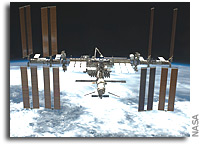
All ISS systems continue to function nominally, except those noted previously or below. Underway: Week 14 of Increment 30 (six-person crew).
After breakfast, FE-1 Shkaplerov performed the routine inspection of the SM (Service Module) PSS Caution & Warning panel as part of regular Daily Morning Inspection.
FE-2 Ivanishin completed the weekly checkup behind ASU/toilet panel 139 in the SM on a fluid connector (MNR-NS) of the SM-U urine collection system, looking for potential moisture.
Anatoly also conducted the periodic (every Monday) verification of the automatic IUS AntiVirus program on the Russian VKS auxiliary network laptops RSS1, RSS2, RSK1-T61p & RSK2, as well as the manual update on the non-network laptops RSE-Med & RSE1. [Antivirus update procedures have changed since the SSCV4 software update. Before the installation (on 8/8) of the new automated procedure, the refresh was done manually on Mondays on RSS2, copying the files to the RSS2 service folder, then launching update scripts on the network laptops RSS1, RSK1-T61p & RSK2 and finally manually updating non-network laptops RSE-Med & RSE1. On Tuesdays, the anti-virus scanning results are regularly verified on all laptops. Nominally, Russian network laptops have software installed for automatic anti-virus update; fresh data is copied on RSK1-T61p & RRSK2 every time a computer is rebooted with a special login, and on RSS1 once daily. On Russian non-network laptops antivirus definition file update is done by the crew once every two weeks on Monday.]
FE-5 Kuipers concluded his 3rd (FD60) Pro K session with Day 5 for a 5-day period, with diet logging after the urine pH spot test. In addition to recording his diet input, Andre terminated his associated 24-hr urine collections at ~5:10am EST and completed the blood sampling. Later, Andre took a documentary photo of the Pro K logsheet and transferred it with the data updates to the Pro K folder for downlink. [For Pro K, there are five in-flight sessions (FD15, FD370, FD60, FD120, FD180) of samplings, to be shared with the NUTRITION w/Repository protocol, each one with five days of diet & urine pH logging and photography on the last day (science sessions are often referred to by Flight Day 15, 30, 60, etc. However, there are plus/minus windows associated with these time points so a “Flight Day 15” science session may not actually fall on the crewmember’s 15th day on-orbit). The crewmember prepares a diet log and then annotates quantities of food packets consumed and supplements taken. On Days 4 & 5, urine collections are spread over 24 hrs; samples go into the MELFI (Minus Eighty Laboratory Freezer for ISS) within 30 min after collection. Blood samples, on the last day, are centrifuged in the RC (Refrigerated Centrifuge) and placed in MELFI at -80 degC. There is an 8-hr fasting requirement prior to the blood draw (i.e., no food or drink, but water ingestion is encouraged). MELFI constraints: Maximum MELFI Dewar open time: 60 sec; at least 45 min between MELFI Dewar door openings.]
FE-4 Kononenko did the (currently daily) inspection of the KOB2 cooling loop in the SM, checking a liquid connector on the 4SPN2 panel for coolant leaks. [In case there were any large droplets (10-20 cm3), FE-2 was to report to TsUP-Moscow.]
After switching STTS communications to MRM2 Poisk occupancy and setting up the MPEG2 (Moving Pictures Expert Group 2) multicasting television equipment from MRM2 (which required FE-6 Pettit to switch any used wireless laptops to wired SSCs as during the MPEG test on 2/24), Kononenko today installed and prepared the equipment for another run of the new KPT-21 PK-3+ Plasma Crystal-3+ (Plazmennyi-Kristall-3 plus) Telescience payload, the 2nd time for Expedition 30. [Activities included making electrical connections, installing a video hard drive and loading new software. Afterwards, Oleg conducted a test session of the video downlink to TsUP-Moscow, monitoring the TV signal on the VKU “Klest” video monitor, then closed out the hardware and reconfigured STTS comm to nominal settings. The PK-3+ equipment comprises the EB (Eksperimental’nyj Blok) Experiment Module with a turbopump for evacuation, Ts laptop, video monitor, vacuum hoses, electrical circuitry, four hard storage disks for video, and one USB stick with the control application. The experiment is performed on plasma, i.e., fine particles charged and excited by HF (high frequency) radio power inside the evacuated work chamber. Main objective is to obtain a homogeneous plasma dust cloud at various pressures and particle quantities with or without superimposition of an LF (low frequency) harmonic electrical field. The experiment is conducted in automated mode. PK-3+ has more advanced hardware and software than the previously used Russian PKE-Nefedov payload.]
CDR Burbank had ~2 hrs set aside to pre-gather and prepare tools, hardware and the Lab MWA WSA (Maintenance Work Area Work Surface Area) for the scheduled upgrade IFMs (Inflight Maintenance) on the PL-1 (Payload 1) and PL-2 MDM (Multiplexer/Demultiplexer) computers. [IFM objective is to install EPIC (Enhanced Processor & Integrated Communications) hardware in the MDMs in the AV-3 (Avionics-3) Rack, starting tomorrow with PL-2. This will include removing the PL-2 MDM, installing a new circuit card, Ethernet Cable, and MDM front cover, and replacing the MDM into the AV-3 Rack. Upgrade of PL-1 will follow on 2/29.]
The 28S crewmembers Shkaplerov, Ivanishin & Burbank joined up in their Soyuz TMA-22 spacecraft (docked at the MRM2 Poisk module) for the standard 3-hr Soyuz Emergency Descent Drill, a regular procedure for each station crew. The exercise, which does not involve any command activation, uses computer simulation (Trenasher Spusk/”descent trainer”) on the RSK1 A31p laptop (swapped with RSK1 T61p for this exercise), with a descent hand controller (RUS) in manual mode to set up reentry conditions and switch between modes. Operators were Anton & Anatoly, each performing 3 runs, with max-g and deviation results logged. The two RSK1 laptops were later swapped again. [The OBT (onboard training) session, supported by TsUP instructor tagup, included a review of the pertinent RODF (Russian Operations Data Files), specifically the books on Soyuz Insertion & Descent Procedures, Emergency Descents, and Off-Nominal Situation Procedures such as manual undocking.]
FE-5 Kuipers deployed four passive FMK (Formaldehyde Monitoring Kit) sampling assemblies in the Lab (at bay P3, below CEVIS) and SM (at the most forward handrail, on panel 307) for two days, to catch any atmospheric formaldehyde on a collector substrate for subsequent analysis on the ground. [Two monitors each are usually attached side by side, preferably in an orientation with their faces perpendicular to the direction of air flow.]
Afterwards, Andre started another sampling run with the AQM (Air Quality Monitor), deactivating the system ~5 hrs later. [Consisting of the EHS GC/DMS (Environmental Health Systems Gas Chromatograph / Differential Mobility Spectrometer), the system is controlled with “Sionex” expert software from the SSC (Station Support Computer)-12 laptop. The AQM demonstrates COTS (Commercial Off-the-Shelf) technology for identifying volatile organic compounds, similar to the VOA (Volatile Organics Analyzer). This evaluation will continue over the course of several months as it helps to eventually certify the GC/DMS as nominal CHeCS (Crew Health Care Systems) hardware.]
Later, FE-5 collected air samples with new GSCs (Grab Sample Containers) in the SM, Lab and COL (Columbus Orbital Laboratory), sequenced with the AQM sampling for postflight comparison. [GSC samples are taken 1-3 hrs after AQM start.]
Andre also conducted the periodic (approx. weekly) WRS (Water Recovery System) sampling in Node-3 using the TOCA (Total Organic Carbon Analyzer), after first initializing the software and priming (filling) the TOCA water sample hose. [After the approximately 2-hr TOCA analysis, results were transferred to the SSC-5 (Station Support Computer 5) laptop via USB drive for downlink, and the data were also logged.]
Next, FE-5 conducted the periodic manual transfer of urine from an EDV-U container (#974, ~10.8L) to the UPA WSTA (Urine Processor Assembly / Waste Storage Tank Assembly) for UPA processing. [During such transfers, the crewmember always wears protective safety goggles, dust mask and nitrile gloves.]
Anton, Anatoly & Oleg spent several hours unloading Progress 46P and transferring its cargo to the ISS while logging moves in the IMS (Inventory Management System).
Kononenko broke out and set up the Russian Chibis suits PVK-1 & PVK-2 and a new kit with Chibis replacement parts which will be used tomorrow to turn the suits into the advanced version Chibis-M. [The specially designed PVK “Chibis” suit, known as LBNP (Lower Body Negative Pressure) device at NASA, applies suction on the lower body ranging from 10 to 60 mm Hg, thereby exerting a functional loading roughly equivalent to 10-60 kg of force on the musculoskeletal system to test the body’s adaptation to prolonged exposure to microgravity. Thus, its basic function is the opposite of a G-suit. Instead of pushing blood and fluids away from the legs back toward torso and head, the Chibis suit draws fluid back down to the legs, in order to counteract the tendency of fluids to accumulate in the head in weightlessness. Chibis is also sometimes used post-flight for recovery after long flights. Chibis means ‘Lapwing’ in Russian. The suit has a mass of 8.7 kg; the vacuum attachment adds another 3.7 kg.]
In the RS (Russian Segment), Shkaplerov supported the ground-controlled shutdown of the Elektron O2 generator (~5:30am EST). [As part of the standard deactivation process Anton purged the Elektron with N2 (nitrogen), controlled from laptop. Elektron will remain off for approximately a week in support of a performance assessment of the US OGS (Oxygen Generator System).]
Anton also performed the routine daily servicing of the SOZh system (Environment Control & Life Support System, ECLSS) in the SM. [Regular daily SOZh maintenance consists, among else, of checking the ASU toilet facilities, replacement of the KTO & KBO solid waste containers, replacement of EDV-SV waste water and EDV-U urine containers and filling EDV-SV, KOV (for Elektron), EDV-ZV & EDV on RP flow regulator.]
Anatoly Ivanishin took care of the daily IMS maintenance, updating/editing its standard “delta file” including stowage locations, for the regular weekly automated export/import to its three databases on the ground (Houston, Moscow, Baikonur).
Later today, FE-1 Shkaplerov is to work on the Russian high-speed RSPI Data Transmission Radio Link to load upgraded software on its BZU Onboard Memory Device.
With the MSG (Microgravity Science Glovebox) activated and the G1 camcorder set up in the Lab for real-time ground monitoring, Don Pettit configured the SLICE (Structure & Liftoff In Combustion Experiment) pyrometry hardware and performed the 4th flame test operation. The test was conducted with 100% methane. Later, FE-6 installed another burner tube in the SPICE Experiment Assembly, replaced the flash/memory card with a new one and ran the flame test a second time. MSG was later deactivated. [The research goal is to gain unique data to extend scientists’ predictive capability. Earth application: Increased efficiency and reduced pollutant emission for practical combustion devices, improved numerical modeling, hence improved design tools, hence improved practical combustion on Earth (currently, the good modeling-experiment agreement breaks down when flames are lean or heavily sooting). Measurements: still images (with camera that was blackbody calibrated for pyrometry), video & radiometer. Hardware: SLICE is conducted in the MSG using the SPICE hardware.]
In the Kibo JPM (JEM Pressurized Module), Pettit worked ~1h 10m to start a new run of the BCAT-6 (Binary Colloidal Alloy Test-6) experiment after preparing (homogenizing) a new sample, #5, for the experiment. Andre Kuipers assisted by taking documentary photography. Before “Presleep” period tonight, Don will replace the BCAT-6 battery with a fresh one. [Activities included readying the G1 high-resolution camcorder for MPC (Multi-Protocol Converter) video capture and preparing the SGSM (Slow Growth Sample Module) for photography with the NIKON D2Xs with EarthKAM software running on an SSC (Station Support Computer). After arranging the lighting for “clear” sample (as opposed to “turbid”), Don homogenized (mixed) Sample 5 and then set it up for automated flash photography controlled by EarthKAM software. The new EK software photographs Sample 5 once every two hours for seven days, and the crew performs three camera battery changes and a camera check each day. The camera battery changes are scheduled to be performed approximately every 8 hours per Mike Fossum’s recommendation during past BCAT-6 activities.]
Oleg broke out & readied the equipment for his and Andre’s 2nd session with the periodic Russian MedOps test “Hematokrit” (MO-10), to be conducted tomorrow right after wake-up. [MO-10 measures the red cell count of the blood. It is a well-known phenomenon of space flight that red blood cell count (normal range: 30-45%) tends to go down over time.]
The CDR had another time slot reserved for making entries in his electronic Journal on the personal SSC. [Required are three journaling sessions per week.]
Before Presleep, Burbank will turn on the MPC and start the Ku-band data flow of video recorded during the day to the ground, with POIC (Payload Operations & Integration Center) routing the onboard HRDL (High-Rate Data Link). After about an hour, Dan was to turn MPC routing off again. [This is a routine operation which regularly transmits HD onboard video (live or tape playback) to the ground on a daily basis before sleeptime.]
The crew worked out with their regular 2-hr physical exercise protocol on the CEVIS cycled ergometer with vibration isolation (FE-5), TVIS treadmill with vibration isolation & stabilization (FE-1, FE-2), ARED advanced resistive exerciser (CDR, FE-4, FE-5, FE-6), T2/COLBERT advanced treadmill (CDR, FE-6), and VELO ergometer bike with load trainer (FE-1, FE-2, FE-4). [FE-6 is on the special experimental SPRINT protocol which diverts from the regular 2.5 hrs per day exercise regime and introduces special daily sessions, followed by a USND leg muscle self scan in COL. Today’s exercise called for ARED+T2, with T2, ARED+T2 & CEVIS following in the next 3 days. No exercise is being timelined for Fridays. If any day is not completed, Don picks up where he left off, i.e., he would be finishing out the week with his last day of exercise on his off day.]
Tasks listed for Shkaplerov, Kononenko & Ivanishin on the Russian discretionary “time permitting” job for today were –
* A ~30-min. run of the GFI-8 “Uragan” (hurricane) earth-imaging program with the NIKON D3X digital camera with Sigma AF 300-800mm telelens, focusing on the Pamir glaciers Bear, RGS, Mabuza, Lakes Baikal and Aral, the Kerch Strait, Laganakskoe Plateau, glacier Kolka, Volga River Delta, the Caspian Sea, Lipetsk, Allalin Glacier and the volcanoes Sangay, Tanguraua, Reventador, Galeras, Santa Maria, Fuego and San Cristobal,
* A ~30-min. session for Russia’s EKON Environmental Safety Agency, making observations and taking KPT-3 aerial photography of environmental conditions on Earth using the NIKON D3X camera with the RSK-1 laptop, and
* More preparation & downlinking of reportages (written text, photos, videos) for the Roskosmos website to promote Russia’s manned space program (max. file size 500 Mb).
Conjunction Advisory: Flight controllers are monitoring multiple conjunctions with Object 28471 (Chinese CZ-4B rocket body) on 2/29 (Wednesday) with TCAs (Times of Closest Approach) of 7:41am & 9:13am EST. Currently predicted radial miss distances are ~356 m and ~77 m, resp. The close approaches occur after the time of the planned reboost on 2/29 (preliminary reboost TIG/Time of Ignition: 5:21am EST), so the reboost option will be selected to gain sufficient separation from this object.
No CEO (Crew Earth Observation) targets uplinked for today.
ISS Orbit (as of this morning, 7:51am EST [= epoch])
Mean altitude – 389.5 km
Apogee height – 403.2 km
Perigee height – 375.9 km
Period — 92.35 min.
Inclination (to Equator) — 51.64 deg
Eccentricity — 0.0020184
Solar Beta Angle — -21.4 deg (magnitude increasing)
Orbits per 24-hr. day — 15.59
Mean altitude loss in the last 24 hours — 74 m
Revolutions since FGB/Zarya launch (Nov. 98) — 76,076
Time in orbit (station) — 4847 days
Time in orbit (crews, cum.) — 4134 days
Significant Events Ahead (all dates Eastern Time and subject to change):
————–Six-crew operations—————-
03/09/12 — ATV3 launch — 5:00pm EST
03/18/12 — ATV3 docking — ~9:31pm EST
04/19/12 — Progress M-14M/46P undock
04/20/12 — Progress M-15M/47P launch
04/22/12 — Progress M-15M/47P docking
04/30/12 — SpaceX Falcon 9/Dragon launch (target date)
05/03/12 — SpaceX Falcon 9/Dragon berthing (target date)
xx/xx/12 — SpaceX Falcon 9/Dragon unberth
04/30/12 — Soyuz TMA-22/28S undock/landing (End of Increment 30)
————–Three-crew operations————-
05/15/12 — Soyuz TMA-04M/30S launch – G.Padalka (CDR-32)/J.Acaba/K.Volkov
05/17/12 — Soyuz TMA-04M/30S docking (MRM2)
————–Six-crew operations—————-
07/01/12 — Soyuz TMA-03M/29S undock/landing (End of Increment 31)
————–Three-crew operations————-
07/15/12 — Soyuz TMA-05M/31S launch – S.Williams (CDR-33)/Y.Malenchenko/A.Hoshide
07/17/12 — Soyuz TMA-05M/31S docking
07/31/12 — Progress M16M/48P launch
08/02/12 — Progress M16M/48P docking
————–Six-crew operations—————-
09/17/12 — Soyuz TMA-04M/30S undock/landing (End of Increment 32)
————–Three-crew operations————-
10/15/12 — Soyuz TMA-06M/32S launch – K.Ford (CDR-34)/O.Novitskiy/E.Tarelkin
10/17/12 — Soyuz TMA-06M/32S docking
————–Six-crew operations————-
11/01/12 — Progress M-17M/49P launch
11/03/12 — Progress M-17M/49P docking
11/12/12 — Soyuz TMA-05M/31S undock/landing (End of Increment 33)
————–Three-crew operations————-
12/05/12 — Soyuz TMA-07M/33S launch – C.Hadfield (CDR-35)/T.Mashburn/R.Romanenko
12/07/12 — Soyuz TMA-07M/33S docking
————–Six-crew operations————-
12/26/12 — Progress M-18M/50P launch
12/28/12 — Progress M-18M/50P docking
03/19/13 — Soyuz TMA-06M/32S undock/landing (End of Increment 34)
————–Three-crew operations————-
04/02/13 — Soyuz TMA-08M/34S launch – P.Vinogradov (CDR-36)/C.Cassidy/A.Misurkin
04/04/13 — Soyuz TMA-08M/34S docking
————–Six-crew operations————-
05/16/13 — Soyuz TMA-07M/33S undock/landing (End of Increment 35)
————–Three-crew operations————-
05/29/13 — Soyuz TMA-09M/35S launch – M.Suraev (CDR-37)/K.Nyberg/L.Parmitano
05/31/13 — Soyuz TMA-09M/35S docking
————–Six-crew operations————-
09/xx/13 — Soyuz TMA-08M/34S undock/landing (End of Increment 36)
————–Three-crew operations————-
09/xx/13 — Soyuz TMA-10M/36S launch – M.Hopkins/TBD (CDR-38)/TBD
09/xx/13 — Soyuz TMA-10M/36S docking
————–Six-crew operations————-
11/xx/13 — Soyuz TMA-09M/35S undock/landing (End of Increment 37)
————–Three-crew operations————-
11/xx/13 — Soyuz TMA-11M/37S launch – K.Wakata (CDR-39)/R.Mastracchio/TBD
11/xx/13 — Soyuz TMA-11M/37S docking
————–Six-crew operations————-
03/xx/14 — Soyuz TMA-10M/36S undock/landing (End of Increment 38)
————–Three-crew operations————-



