
NASA ISS On-Orbit Status 13 February 2012
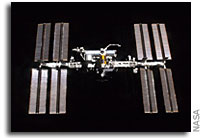
All ISS systems continue to function nominally, except those noted previously or below. Underway: Week 12 of Increment 30 (six-person crew).
After wakeup this morning, FE-1 Shkaplerov performed the routine inspection of the SM (Service Module) PSS Caution & Warning panel as part of regular Daily Morning Inspection.
Anton also completed the weekly checkup behind ASU/toilet panel 139 in the SM on a fluid connector (MNR-NS) of the SM-U urine collection system, looking for potential moisture.
In the Kibo JPM (JEM Pressurized Module), CDR Burbank serviced the running BCAT-6 (Binary Colloidal Alloy Test-6) by replacing the BCAT-6 battery early in the morning with a fresh one and repeating the replacement about 8 hrs later. [The NIKON D2Xs with EarthKAM software running on an SSC laptop takes automated flash photography controlled by the software, photographing Sample 4 once every two hours for seven days. Crew performs three camera battery changes and a camera check each day. The camera battery changes are scheduled to be performed approximately every 8 hours per Mike Fossum’s recommendation during past BCAT-6 activities.]
FE-5 Kuipers started another sampling run with the AQM (Air Quality Monitor), deactivating the system ~5 hrs later. [Consisting of the EHS GC/DMS (Environmental Health Systems Gas Chromatograph / Differential Mobility Spectrometer), the system is controlled with “Sionex” expert software from the SSC (Station Support Computer)-12 laptop. The AQM demonstrates COTS (Commercial Off-the-Shelf) technology for identifying volatile organic compounds, similar to the VOA (Volatile Organics Analyzer). This evaluation will continue over the course of several months as it helps to eventually certify the GC/DMS as nominal CHeCS (Crew Health Care Systems) hardware.]
Andre also conducted the periodic (approx. weekly) WRS (Water Recovery System) sampling in Node-3 using the TOCA (Total Organic Carbon Analyzer), after first initializing the software and priming (filling) the TOCA water sample hose. [After the approximately 2-hr TOCA analysis, results were transferred to the SSC-5 (Station Support Computer 5) laptop via USB drive for downlink, and the data were also logged.]
Later, FE-5 pre-installed the NES/NeuroSpat payload equipment in COL (Columbus Orbital Laboratory) at the EPM (European Physiology Module) for his upcoming 2nd session and set up the MPPLL (Multipurpose Laptop). [NeuroSpat (Effect of Gravitational Context on EEG Dynamics: A Study of Spatial Cognition, Novelty Processing and Sensorimotor Integration) is composed of two principal experimental tasks: Visual Orientation and Visuomotor Tracking, plus additional, standardized EEG (electroencephalogram) tasks performed as a means of assessing general effects of the space station environment on EEG signals.]
Next, Kuipers reviewed background material on the upcoming commissioning of the MARES (Muscle Atrophy Resistive Exercise System) Part 1. [Commissioning will consist of MARES deployment, functional verifications and stowage for Checkout. It will be split in two days with main activities as follows: Day 1: Deployment/connection on ISPR (International Standard Payload Rack) F3 Auxiliary Power, VIF (Vibration isolation Frame) functional test, battery charge, guided crew procedures load & spares MARES main box hard drive test. Day 2: MARES functional test, battery discharge, disassembly/disconnection, stowage & log files copying.]
In COL (Columbus Orbital Laboratory), CDR Burbank completed the periodic reboot of all active PWS (Portable Workstation) laptops (once/month) and recorded the battery state of each active PWS.
Afterwards, Dan worked on the ventilation system in the Kibo JPM, removing screen covers from FD1, FD2, AD1 & AD2 return grilles for an inspection/investigation by the ground of screen clogging. The covers were then re-installed. [Photos taken by Dan were copied to SSC-16 (Station Support Computer 16) for downlink to JAXA.]
Continuing their paced preparations for the Russian EVA-30 on 2/16, Shkaplerov & Kononenko today –
* Relocated their pressurized Orlan-MK suits to the SM PkhO Transfer Compartment and removed their OTA detachable components for stowage in DC1 airlock, such as tethers, wire ties & bungees,
* Configured the PkhO compartment for the subsequent training run,
* Conducted the pressurized Orlan suit translation training in the PkhO (i.e., rehearsing suited emergency PkhO ingress) with assistance by Anatoly Ivanishin,
* Consolidated EVA take-out equipment in the DC1 (KPU/EVA tool carrier, Crewlock bag with the “Test” exposure experiment & SMDP tool, the “Vinoslivost” assembly, and EVA ladder support struts),
* Staged two DPP Debris Panel Package stacks with SMDP micrometeoroid protection shields for SM in the DC1, and
* Reviewed the external translation path using the US DOUG (Dynamic Onboard Ubiquitous Graphics) application.
After activating the MSG (Microgravity Science Glovebox) and setting up the G1 camcorder in the Lab for real-time monitoring by the PI (Principal Investigator), Don Pettit configured the SLICE (Structure & Liftoff In Combustion Experiment) pyrometry hardware and performed the 2nd flame test operation, preceded by pyrometry calibration using heated ceramic fibers. The test was then conducted with 40% methane, i.e., fuel-lean flames. Later, FE-6 installed another burner tube in the SPICE Experiment Assembly, replaced the flash/memory card with a new one and ran the flame test a second time. Before powering off, Don performed SLICE fan calibration to evaluate the air flow. [The research goal is to gain unique data to extend scientists’ predictive capability. Earth application: Increased efficiency and reduced pollutant emission for practical combustion devices, improved numerical modeling, hence improved design tools, hence improved practical combustion on Earth (currently, the good modeling-experiment agreement breaks down when flames are lean or heavily sooting). Measurements: still images (with camera that was blackbody calibrated for pyrometry), video & radiometer. Hardware: SLICE is conducted in the MSG using the SPICE hardware.]
FE-2 Ivanishin conducted the periodic (every Monday) verification of the automatic IUS AntiVirus program on the Russian VKS auxiliary network laptops RSS1, RSS2, RSK1-T61p & RSK2, as well as the manual update on the non-network laptops RSE-Med & RSE1. [Antivirus update procedures have changed since the SSCV4 software update. Before the installation (on 8/8) of the new automated procedure, the refresh was done manually on Mondays on RSS2, copying the files to the RSS2 service folder, then launching update scripts on the network laptops RSS1, RSK1-T61p & RSK2 and finally manually updating non-network laptops RSE-Med & RSE1. On Tuesdays, the anti-virus scanning results are regularly verified on all laptops. Nominally, Russian network laptops have software installed for automatic anti-virus update; fresh data is copied on RSK1-T61p & RRSK2 every time a computer is rebooted with a special login, and on RSS1 once daily. On Russian non-network laptops antivirus definition file update is done by the crew once every two weeks on Monday.]
Later, Anatoly worked several hours with Oleg Kononenko in the SM, replacing all 10 DS-7A VM Signal smoke detectors with new spares and making appropriate telemetry connections. The detectors were subsequently to be test activated by ground commanding.
Andre Kuipers had more time set aside for continuing the cleanup of the PMM (Permanent Multipurpose Module) endcone area to enable creation of a trash staging area prior to Progress loading.
FE-5 relocated & stowed critical hardware back in the JAXA JLP (JEM Pressurized Logistics Module).
With the Lab video camcorder set up to cover the CIR (Combustion Integrated Rack) on its Node-1 side, FE-6 Pettit accessed the CIR rack and installed the MDCA (Multi-user Droplet Combustion Apparatus) “boot selector” inside the combustion chamber. Both rack doors were then closed, two switches activated and POIC (Payload Operations Integration Center) notified that the rack was ready to be commanded on RPC (Remote Power Controller) for checkout. [On 1/19, CIR was unable to establish communication with the MDCA Avionics Package, i.e., the software controller for the MDCA CIA (Chamber Insert Assembly). It appears that the MDCA boot parameters are corrupted, as has happened before in 2009 (8/12). As permanent solution, new firmware will be installed onto the MDCA Avionics Package. The firmware is a “boot loader” that self-checks for corrupt boot parameters and reloads them as necessary to ensure successful booting every time. After today’s installation of the boot selector, the next step will be to install the boot loader from a laptop, then removing the boot selector again.]
FE-1 performed the routine daily servicing of the SOZh system (Environment Control & Life Support System, ECLSS) in the SM. [Regular daily SOZh maintenance consists, among else, of checking the ASU toilet facilities, replacement of the KTO & KBO solid waste containers, replacement of EDV-SV waste water and EDV-U urine containers and filling EDV-SV, KOV (for Elektron), EDV-ZV & EDV on RP flow regulator.]
Anton also took care of the daily IMS (Inventory Management System) maintenance, updating/editing its standard “delta file” including stowage locations, for the regular weekly automated export/import to its three databases on the ground (Houston, Moscow, Baikonur).
Andre Kuipers had ~1h 15m reserved for installing extra HDDs (Hard Disk Drives) in Lab SSC Client laptops for the purpose of staging on-orbit imagery prior to downlink without affecting SSC Client performance. [Fresh HDDs were to be placed in Lab SSC-8, -10, -12, -16 & -18, at which point MCC-Houston was to initialize and create a shortcut for crew usage. The crew was advised to use the new drives for imagery to be downlinked, rather than on external drives.]
Andre also performed routine maintenance on the WRS (Water Recovery System), filling its PWR (Payload Water Reservoir) with iodinated water from WPA (Water Processor Assembly) to assist with water balance, using the H2O transfer common hose.
In Node-2, Dan Burbank spent several hours in the Port CQ (Crew Quarters) at P5 for a thorough cleaning of the ventilation intake and exhaust ducts, fans and airflow sensor.
At ~5:05am, Burbank powered up the SM’s amateur radio equipment (Kenwood VHF transceiver with manual frequency selection, headset, & power supply) and at 5:15am conducted a ham radio session with students at Kochi Junior High School, Kochi, Japan.
Before Presleep, Pettit will turn on the MPC (Multi-Protocol Converter) and start the Ku-band data flow of video recorded during the day to the ground, with POIC (Payload Operations & Integration Center) routing the onboard HRDL (High-Rate Data Link). After about an hour, Don will turn MPC routing off again. [This is a routine operation which regularly transmits HD onboard video (live or tape playback) to the ground on a daily basis before sleeptime.]
The crew worked out with their regular 2-hr physical exercise protocol on the CEVIS cycle ergometer with vibration isolation (FE-5), TVIS treadmill with vibration isolation & stabilization (FE-1, FE-2, FE-4), ARED advanced resistive exerciser (CDR, FE-4, FE-5, FE-6), T2/COLBERT advanced treadmill (CDR, FE-6), and VELO ergometer bike with load trainer (FE-1, FE-2).
Tasks listed for Shkaplerov, Kononenko & Ivanishin on the Russian discretionary “time permitting” job for today were –
* A ~30-min. run of the GFI-8 “Uragan” (hurricane) earth-imaging program with the NIKON D3X digital camera with Sigma AF 300-800mm telelens, focusing on Volcanoes Papandyayan, Semeru, Hudson & Huascaran, and the glaciers of Patagonia (Upsala, Viedma, Chico),
* A ~30-min. session for Russia’s EKON Environmental Safety Agency, making observations and taking KPT-3 aerial photography of environmental conditions on Earth using the NIKON D3X camera with the RSK-1 laptop, and
* More preparation & downlinking of reportages (written text, photos, videos) for the Roskosmos website to promote Russia’s manned space program (max. file size 500 Mb).
Conjunction Update: Flight controllers are standing down from planning a DAM (Debris Avoidance Maneuver) for tonight’s conjunction with Object 34284 (COSMOS 2251) at 8:43pm EST. The debris has moved into the Green zone and is currently no longer of concern.
No CEO (Crew Earth Observation) targets uplinked for today.
ISS Orbit (as of this morning, 7:06am EST [= epoch])
. Mean altitude – 390.9 km
. Apogee height – 404.7 km
. Perigee height – 377.1 km
. Period — 92.37 min.
. Inclination (to Equator) — 51.64 deg
. Eccentricity — 0.0020396
. Solar Beta Angle — 32.3 deg (magnitude decreasing)
. Orbits per 24-hr. day — 15.59
. Mean altitude loss in the last 24 hours — 56 m
. Revolutions since FGB/Zarya launch (Nov. 98) — 75,857
. Time in orbit (station) — 4833 days
. Time in orbit (crews, cum.) — 4120 days
Significant Events Ahead (all dates Eastern Time and subject to change):
————–Six-crew operations—————-
02/14/12 — Russian EVA-30 Dry-run
02/16/12 — Russian EVA-30
03/09/12 — ATV3 launch — (target date)
03/19/12 — ATV3 docking — (target date)
04/19/12 — Progress M-14M/46P undock
04/20/12 — Progress M-15M/47P launch
04/22/12 — Progress M-15M/47P docking
xx/xx/12 — SpaceX Falcon 9/Dragon launch
xx/xx/12 — SpaceX Falcon 9/Dragon berthing
xx/xx/12 — SpaceX Falcon 9/Dragon unberth
04/30/12 — Soyuz TMA-22/28S undock/landing (End of Increment 30)
————–Three-crew operations————-
05/15/12 — Soyuz TMA-04M/30S launch – G.Padalka (CDR-32)/J.Acaba/K.Volkov (target date)
05/17/12 — Soyuz TMA-04M/30S docking (MRM2) (target date)
————–Six-crew operations—————-
07/01/12 — Soyuz TMA-03M/29S undock/landing (End of Increment 31)
————–Three-crew operations————-
07/15/12 — Soyuz TMA-05M/31S launch – S.Williams (CDR-33)/Y.Malenchenko/A.Hoshide
07/17/12 — Soyuz TMA-05M/31S docking
07/31/12 — Progress M16M/48P launch
08/02/12 — Progress M16M/48P docking
————–Six-crew operations—————-
09/17/12 — Soyuz TMA-04M/30S undock/landing (End of Increment 32)
————–Three-crew operations————-
10/15/12 — Soyuz TMA-06M/32S launch – K.Ford (CDR-34)/O.Novitskiy/E.Tarelkin
10/17/12 — Soyuz TMA-06M/32S docking
————–Six-crew operations————-
11/01/12 — Progress M-17M/49P launch
11/03/12 — Progress M-17M/49P docking
11/12/12 — Soyuz TMA-05M/31S undock/landing (End of Increment 33)
————–Three-crew operations————-
12/05/12 — Soyuz TMA-07M/33S launch – C.Hadfield (CDR-35)/T.Mashburn/R.Romanenko
12/07/12 — Soyuz TMA-07M/33S docking
————–Six-crew operations————-
12/26/12 — Progress M-18M/50P launch
12/28/12 — Progress M-18M/50P docking
03/19/13 — Soyuz TMA-06M/32S undock/landing (End of Increment 34)
————–Three-crew operations————-
04/02/13 — Soyuz TMA-08M/34S launch – P.Vinogradov (CDR-36)/C.Cassidy/A.Misurkin
04/04/13 — Soyuz TMA-08M/34S docking
————–Six-crew operations————-
05/16/13 — Soyuz TMA-07M/33S undock/landing (End of Increment 35)
————–Three-crew operations————-
05/29/13 — Soyuz TMA-09M/35S launch – M.Suraev (CDR-37)/K.Nyberg/L.Parmitano
05/31/13 — Soyuz TMA-09M/35S docking
————–Six-crew operations————-
09/xx/13 — Soyuz TMA-08M/34S undock/landing (End of Increment 36)
————–Three-crew operations————-
09/xx/13 — Soyuz TMA-10M/36S launch – M.Hopkins/TBD (CDR-38)/TBD
09/xx/13 — Soyuz TMA-10M/36S docking
————–Six-crew operations————-
11/xx/13 — Soyuz TMA-09M/35S undock/landing (End of Increment 37)
————–Three-crew operations————-
11/xx/13 — Soyuz TMA-11M/37S launch – K.Wakata (CDR-39)/R.Mastracchio/TBD
11/xx/13 — Soyuz TMA-11M/37S docking
————–Six-crew operations————-
03/xx/14 — Soyuz TMA-10M/36S undock/landing (End of Increment 38)
————–Three-crew operations————-



