NASA ISS On-Orbit Status 26 October 2011
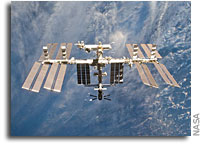
All ISS systems continue to function nominally, except those noted previously or below.
FE-4 Volkov performed the routine inspection of the SM (Service Module) PSS Caution & Warning panel as part of regular Daily Morning Inspection.
At wakeup, CDR Fossum checked the running BCAT-6 (Binary Colloidal Alloy Test-6)-Phase Separation experiment for camera & flashlight battery charge and later in the day performed additional checks on the payload, looking for crystals, changing camera battery, downloading images and restarting the Intervalometer for automated flash photography. [The camera is running for a total of 7 days, taking a photo of the turbid Sample 1 every hour. While Sample 1 is running, crystal checks on Samples 6-10 will be performed each day. Camera battery change and Intervalometer restart is done three times a day. Objective of BCAT-6-Phase Separation: to gain unique insights into how gas and liquid phases separate and come together in microgravity. These fundamental studies on the underlying physics of fluids could provide the understanding needed to enable the development of less expensive, longer shelf-life household products, foods, and medicines.]
FE-5 Furukawa started his 3rd 24-hour urine collections under the Generic HRF (Human Research Facility) NUTRITION/Repository protocol, beginning at wakeup with the first void, with samples deposited in MELFI (Minus Eighty Laboratory Freezer for ISS). Later in the day, Satoshi set up the equipment for the associated blood collection, scheduled tomorrow with Mike Fossum’s assistance. [The operational products for blood & urine collections for the HRP (Human Research Program) payloads were revised in the past, based on crew feedback, new cold stowage hardware, and IPV capabilities. Generic blood & urine procedures have been created to allow an individual crewmember to select their payload complement and see specific requirements populated. Individual crewmembers will select their specific parameter in the procedures to reflect their science complement. Different crewmembers will have different required tubes and hardware configurations, so they must verify their choice selection before continuing with operations to ensure their specific instruction.]
Furukawa also completed Day 2 (of 3) of his 2nd onboard session with the experimental JAXA DK (Diagnostic Kit) which involves a series of medical diagnostic measurements including cardio/heart, brainwave, and oxygen data. [After recording the 2nd overnight electroencephalographic BW (brainwave) measurements this morning, Satoshi later in the day recorded the 3rd set of Biorhythm data, using the Digital Walk Holter ECG for collecting measurements including heart sound values. Before sleeptime, FE-5 will take his 2nd oxygen level measurement with the Pulse Oximeter and start overnight brainwave recording during sleep. These measurements will be repeated one more times later in the Increment. Purpose of these activities is to perform diagnostic measurements with medical equipment in order to evaluate the equipment for development of a future diagnostic system on board. DK includes: Medical laptop, USB Camera, Pulse Oximeter, Stethoscope, Sleep Monitor and Electroencephalograph (for brain waves).]
CDR Fossum & FE-5 Furukawa each conducted another session with the U.S. HMS VIS (Health Maintenance Systems / Visual Acuity) testing program which uses an eye chart for both far & near visual acuity and an eye questionnaire (DCT/Data Collection Tool), to be filled out with test data and downloaded on a laptop for ground access.
After conducting, at day break, a leak check on the EB vacuum chamber of the new KPT-21 PK-3+ Plasma Crystal-3+ (Plazmennyi-Kristall-3 plus) Telescience payload, Sergey Volkov configured the RS (Russian Segment) STTS communications system for working in the MRM2 Poisk module, then ran another KPT-21 experiment session. Later, FE-4 copied and downlinked data & log files, returned the STTS comm system to nominal and checked EB vacuum chamber hermeticity afterwards and before sleeptime (any pressure increase above the vacuum should stay within 5 mmHg). [Main objective of PK-3 is to continue previous plasma crystal experiments, aimed at studying features of plasma including the critical points, where the temperature and pressure at which the liquid and gaseous phases of a substance become identical. Plasma, or collections of charged particles, is the most common state of matter in the universe. In microgravity, large 3-dimensional plasma crystals can be grown, allowing better observation of their structure and basic processes, which will provide a better understanding of plasma. Under Earth conditions, gravity “squeezes” the plasma crystal and it becomes 2-D, not 3-D. Experiments in space aboard the ISS allow researchers to see the real property of the crystals.]
Mike Fossum conducted periodic routine maintenance on the WHC (Waste & Hygiene Compartment) toilette facility by changing out the filter insert (F-V) and the urine receptacle (MP), then trashing the old items. WHC was unavailable for use during the 90-min activity.
Mike also looked in Node-1 for three EPS (Electrical Power System) contingency jumpers to verify their IMS (Inventory Management System)-listed stowage location. [The EPS jumpers would be used in a contingency if ISS/USOS (US Segment) experienced a failure of MBSU-1 (Main Bus Switching Unit 1).]
Later, the CDR followed up yesterday’s corrective relocation of the MCA VGA (Major Constituent Analyzer / Verification Gas Assembly) to Node-3 by opening the HV01 valve to initiate MCA vacuum pumpout. The pumpout valve will be closed again about 11 hrs later.
Working in the SM, Sergey Volkov removed the failed SIGNAL-VM DS-7A smoke detector #5 behind panel 314 overhead and replaced it with a new spare. This required temporary disabling of BITS2-12 onboard telemetry measurement system power and VD-SU control mode. With these system reactivated later, the new DS-7A was turned on from the ground.
Later, Volkov completed the routine daily servicing of the SOZh system (Environment Control & Life Support System, ECLSS) in the SM. [Regular daily SOZh maintenance consists, among else, of checking the ASU toilet facilities, replacement of the KTO & KBO solid waste containers, replacement of EDV-SV waste water and EDV-U urine containers and filling EDV-SV, KOV (for Elektron), EDV-ZV & EDV on RP flow regulator.]
Sergey also had another 1.5 hrs set aside for loading waste and other excessed cargo on the resupply ship-turned-trash can Progress 42P, while logging the moves in the IMS database. [Progress M-10M/42P undocking is scheduled next Saturday (10/29).]
After removing stowage from in front of the HRF-1 (Human Research Facility 1) Rack & HRF-2 locations in COL (Columbus Orbital Laboratory, at F4 & A4) to gain access to the rack, CDR Fossum powered on the USND-2 (Ultrasound 2) and VPC (Video Power Converter) hardware, connected VPC to HRF-1, and performed his FD150 (Flight Day 150) SPRINT leg muscle self scan with remote guidance from the ground team. [Afterwards, Mike powered off the hardware, decabled the VPC from HRF Rack-1, and stowed the hardware. Fossum is currently following a special experimental “SPRINT” protocol which diverts from the regular 2.5hrs per day regime and introduces special daily sessions, followed by the USND scan. No exercise is being timelined for Fridays. If any day is not completed, Mike picks up where he left off, i.e., he would be finishing out the week with his last day of exercise on his off day.]
Furukawa performed the periodic reboot of the SLT (System Laptop Terminal) laptop in the JAXA JPM (JEM Pressurized Module).
Other activities on the Japanese flight engineer’s crowded work schedule for today, some carried over from yesterday, included:
* Conducting the regular monthly maintenance/inspection of the T2/COLBERT treadmill system and its components (after his T2 session), checking pin alignment, rack centering and the snubber jam nut witness marks; [witness marks (12 total) are applied to the X-, Y- & Z-axis jam nuts on each (of four) snubber arm. Their inspection serves to determine to what degree and which jam nuts are backing off].
* Performing the periodic check of the CEVIS (Cycle Ergometer with Vibration Isolation) exercise machine’s four isolators for wear & tear, checking for cable stop wear and wire pulling back into cable stop,
* Working on the recovery of the wireless SSC (Station Support Computer) -13 & -17 laptops by reloading them from partition, inserting the SSC-19 hard drive in SSC-17 and setting up their initial wireless configuration (with MCC-H to complete the remainder),
* Supporting ground controllers at COL-CC (Control Center) on the ERB2 (Erasmus Recording Binocular) experiment in COL by powering the payload on and checking it out for ground-commanded operations; [after this step an internal clock started running in ERB2, and all following activities till payload shutdown had to be performed within 1h20m. ERB uses a three-dimensional (3-D) video camera, the Sony DSR PD150P camcorder and a Nikon SSM-3DC-101 D photo camera for taking imagery of the environment onboard the ISS for an accurate map of the station’s interior. The images are transferred by a computer application into a 3D model to be viewed in the Virtual Reality Theater of ESA’s Erasmus Center],
* Conducting the regular (~weekly) inspection & maintenance, as required, of the CGBA-4 (Commercial Generic Bioprocessing Apparatus 4) and CGBA-5 payloads in their ERs (EXPRESS Racks) at Lab O2 & O1, focusing on cleaning the muffler air intakes, and
* Opening, after this morning’s ISS reboost, the protective window shutters of the Lab WORF (Window Observational Research Facility) for the ISSAC (ISS Agriculture Camera) equipment, so ground images could be captured today by ground commanding; [ISSAC takes frequent visible-light & infrared images of vegetated areas on the Earth. The camera focuses principally on rangelands, grasslands, forests, and wetlands in the northern Great Plains and Rocky Mountain regions of the United States. The images may be delivered directly upon request to farmers, ranchers, foresters, natural resource managers and tribal officials to help improve their environmental stewardship of the land. The images will also be shared with educators for classroom use],
Before Presleep tonight, Satoshi will set up his 2nd experiment with the onboard JAXA DK (Diagnostic Kit), to continue for 3 straight days with a series of medical diagnostic measurements including cardio/heart, brainwave, and oxygen measurements. [Starting tonight with the 3rd (of 3) oxygen level measurement with the Pulse Oximeter, Satoshi will record brainwaves overnight during sleep, followed tomorrow by Cardiograph measurements & Heart Sound recordings through tomorrow (10/27). These measurements will then be repeated one more times later during the Increment. Purpose of these activities is to perform diagnostic measurements with medical equipment in order to evaluate the equipment for development of a future diagnostic system on board. DK includes: Medical laptop, USB Camera, Pulse Oximeter, Stethoscope, Sleep Monitor and Digital Walk Holter/Electrocardiograph and Electroencephalograph (for brain waves).]
Also before Presleep, Satoshi will turn on the MPC (Multi Protocol Converter) and starts the Ku-band data flow of video recorded during the day to the ground, with POIC (Payload Operations & Integration Center) routing the onboard HRDL (High-Rate Data Link). After about an hour, Mike will turn MPC routing off again. [This is a routine operation which regularly transmits HD onboard video (live or tape playback) to the ground on a daily basis before sleeptime.]
At ~3:30am, Furukawa conducted the regular tagup with Japanese Program Management at SSIPC/Tsukuba via S-band/audio. [This conference is scheduled once every week, between the ISS crewmembers and SSIPC (Space Station Integration & Promotion Center).]
At ~8:10am, the Japanese flight engineer supported a JAXA PAO TV/Educational event, responding in Japanese to student questions from the Saga Prefecture Space & Science Museum and subsequently from Takayama Village Astronomical Observatory in Gunma Prefecture, Japan.
At ~8:45am, the entire Expedition 29 crew joined to support a Russian PAO TV event, downlinking their responses to questions from the participants of the 19th International Space Olympiad for school children being held on 10/19-10/29 in Korolev and assembled today at TsUP-Moscow. [230 youngsters from Russia, Great Britain, Germany, Israel, USA, China, and Sweden are participating. This year the Olympiad is dedicated to the 65th anniversary of RSC Energia. Olympiad participants are competing in math, physics, informatics, and literature skills. They will also have to defend their creative projects. The absolute winner, and also the best in the subject or creative project will be named on 10/28, the Olympiad official closing day. Some questions asked were: “School geography atlas contains many various maps: physical, climate, temperature. What kind of map does our real Earth resemble? How detailed information about our planet can one obtain based on your observations from the ISS window?”; “You observe the Earth from your side and can see it against the starry sky. What is your impression: the Earth is a living being or just a piece of matter used by people to live on?”; “How often can you observe eruptions of volcanoes?, Is it possible to observe an earthquake from space? Did you notice any development preceding or following an earthquake?; “Do you have musical instruments on the ISS? Do you sing in space?”; “How serious is the impact of zero gravity in long-duration flight on human body? Is it easy to get used to it? Does it have long-term effects?”; “Based on the observation of scientists, people get external signs of aging due to the gravity effects. Can long-duration stay in space slow down this process?”; “Do you have plants on the ISS? How do you care for them? Can you find room for a small greenhouse?”; “You have to perform activities not just inside of the station but outside as well. Is it comfortable to work in a space suit?”; “Did you see space debris? Was it close to your station? Do you think space debris poses a threat to the station and near-Earth satellites?”]
At ~1:00pm EDT, Sergey CDR & FE-5 had their standard weekly PMCs (Private Medical Conferences) via S- & Ku-band audio/video, Mike at ~10:25am, Satoshi at ~10:45am EDT.
The crew worked out with their regular 2-hr physical exercise protocol on the TVIS treadmill with vibration isolation & stabilization (FE-4), ARED advanced resistive exercise device (CDR, FE-4, FE-5), and T2/COLBERT advanced treadmill (CDR, FE-5).
Tasks listed for Sergey Volkov on the Russian discretionary “time permitting” job for today were –
* Continuing the preparation & downlinking of more reportages (written text, photos, videos) for the Roskosmos website to promote Russia’s manned space program (max. file size 500 Mb),
* The daily inspection of the recently activated Russian BIO-5 Rasteniya-2 (“Plants-2”) payload with its LADA-01 greenhouse, verifying proper watering of the KM A32 & A24 root modules; [Rasteniya-2 researches growth and development of plants (currently wheat) under spaceflight conditions in the LADA greenhouse from IBMP (Institute of Bio-Medical Problems, Russian: IMBP)],
* Taking care of the daily IMS maintenance, updating/editing its standard “delta file” including stowage locations, for the regular weekly automated export/import to its three databases on the ground (Houston, Moscow, Baikonur), and
* Another ~30-min. session for Russia’s EKON Environmental Safety Agency, making observations and taking KPT-3 aerial photography of environmental conditions on Earth using the NIKON D3X camera with the RSK-1 laptop.
JAXA Marangoni Experiment: The crew was advised of another Marangoni bridge building event tonight (7:00pm-1:00am), the 19th in 24 planned bridge buildings in Increment 29/30. The experiment is performed in the Kibo JPM during crew sleep (since the liquid bridge to be formed is sensitive to g-jitter), 4 days/week at most and 24 runs in total. After the liquid bridge has been formed, the ground imposes a temperature gradient on it to produce Marangoni convection. The crew, which is being informed regularly, has been asked to avoid any disturbances in this timeframe. Even disturbances in other modules can be transmitted and cause the liquid bridge in JPM to break up, resulting in science loss.
ISS Reboost Update: This morning’s ISS reboost by the two KD engines of the SM’s ODU (Integrated Propulsion System) was performed on time (8:52am EDT) with a burn duration of 1 min 54 sec, yielding a delta-V of 1.90 m/s/6.2 ft/s (planned: 1.82/5.9). Mean altitude gain: 3.20 km (1.73 nmi). ISS was afterwards at a mean altitude of 390.0 km (210.6 nmi), with 404.8 km (218.6 nmi) apogee & 375.2 km (202.6 nmi) perigee height. Attitude control authority handover from US Momentum Management to Russian MCS (Motion Control System) was at 7:15am and its return at 9:30am. No actual maneuver was required for the reboost which was performed in TEA (Torque Equilibrium Attitude). Purpose of the reboost was to set up phasing for 45P launch, 28S launch, and 27S landing.
CEO (Crew Earth Observation) targets uplinked for today were Victoria, Seychelles (nadir pass over this capital city–“the smallest African capital”), Ubinas Volcano., Peru (near nadir pass. Ubinas is easier to identify than many Andean volcanoes as it is an isolated peak lying on the flank of a very large canyon [half way between the coast and Lake Titicaca]. Requested were detailed, overlapping frames of the volcano summit and flanks. The caldera contains an ash cone, and debris avalanche deposits extending 10 km from the southeast flank of the volcano), Hurricane Rina, western Caribbean Sea (DYNAMIC EVENT. Looking right for this storm which suddenly blossomed into a hurricane. Rina is expected to intensify to Category 3 by the time of this pass. It is moving slowly NW), and Chihuahuan & Big Bend Deserts, Texas and New Mexico (nadir pass over this international site, where many endemic animal and plant species have created niches in a harsh desert environment. Shooting nadir views for ~30 secs.)
Significant Events Ahead (all dates Eastern Time and subject to change):
————–Three-crew operations (Increment 29)————-
10/29/11 — Progress M-10M/42P undocking (5:01am EDT)
10/30/11 — Progress M-13M/45P launch (6:11am)
11/02/11 — Progress M-13M/45P docking (~7:40am)
11/13/11 — Soyuz TMA-03M/28S launch – D.Burbank (CDR-30)/A.Shkaplerov/A.Ivanishin (11:14pm)
11/16/11 — Soyuz TMA-03M/28S docking (MRM2) (~12:45am)
————–Six-crew operations————-
11/22/11 — Soyuz TMA-02M/27S undock/landing (End of Increment 29) (~9:21pm)
————–Three-crew operations————-
11/30/11 — SpaceX Falcon 9/Dragon — Target date
12/26/11 — Soyuz TMA-04M/29S launch – O.Kononenko (CDR-31)/A.Kuipers/D.Pettit — (date “on or about”)
12/28/11 — Soyuz TMA-04M/29S docking (MRM1) — (date “on or about”)
————–Six-crew operations—————-
TBD — Progress M-13M/45P undock
TBD — Progress M-14M/46P launch
TBD — Progress M-14M/46P docking (DC-1)
02/29/12 — ATV3 launch readiness
TBD — Soyuz TMA-03M/28S undock/landing (End of Increment 30)
————–Three-crew operations————-
03/xx/12 — Soyuz TMA-05M/30S launch – G.Padalka (CDR-32)/J.Acaba/K.Volkov
04/xx/12 — Soyuz TMA-05M/30S docking (MRM2)
————–Six-crew operations—————-
05/05/12 — 3R Multipurpose Laboratory Module (MLM) w/ERA – launch on Proton (under review)
05/06/12 — Progress M-14M/46P undock
05/07/12 — 3R Multipurpose Laboratory Module (MLM) – docking (under review)
05/xx/12 — Soyuz TMA-04M/29S undock/landing (End of Increment 31)
————–Three-crew operations————-
05/xx/12 – Soyuz TMA-06M/31S launch – S.Williams (CDR-33)/Y.Malenchenko/A.Hoshide
05/xx/12 – Soyuz TMA-06M/31S docking
————–Six-crew operations—————-
09/xx/12 — Soyuz TMA-05M/30S undock/landing (End of Increment 32)
————–Three-crew operations————-
10/xx/12 — Soyuz TMA-07M/32S launch – K.Ford (CDR-34)/O.Novitskiy/E.Tarelkin
10/xx/12 – Soyuz TMA-07M/32S docking
————–Six-crew operations————-
11/xx/12 — Soyuz TMA-06M/31S undock/landing (End of Increment 33)
————–Three-crew operations————-
11/xx/12 — Soyuz TMA-08M/33S launch – C.Hadfield (CDR-35)/T.Mashburn/R.Romanenko
12/xx/12 – Soyuz TMA-08M/33S docking
————–Six-crew operations————-
03/xx/13 — Soyuz TMA-07M/32S undock/landing (End of Increment 34)
————–Three-crew operations————-
03/xx/13 – Soyuz TMA-09M/34S launch – P.Vinogradov (CDR-36)/C.Cassidy/A.Misurkin
03/xx/13 – Soyuz TMA-09M/34S docking
————–Six-crew operations————-
05/xx/13 – Soyuz TMA-08M/33S undock/landing (End of Increment 35)
————–Three-crew operations————-
05/xx/13 – Soyuz TMA-10M/35S launch – M.Suraev (CDR-37)/K.Nyberg/L.Parmitano
05/xx/13 – Soyuz TMA-10M/35S docking
————–Six-crew operations————-
09/xx/13 – Soyuz TMA-09M/34S undock/landing (End of Increment 36)
————–Three-crew operations————-
09/xx/13 – Soyuz TMA-11M/36S launch – M.Hopkins/TBD (CDR-38)/TBD
09/xx/13 – Soyuz TMA-11M/36S docking
————–Six-crew operations————-
11/xx/13 – Soyuz TMA-10M/35S undock/landing (End of Increment 37)
————–Three-crew operations————-
11/xx/13 – Soyuz TMA-12M/37S launch – K.Wakata (CDR-39)/R.Mastracchio/TBD
11/xx/13 – Soyuz TMA-12M/37S docking
————–Six-crew operations————-
03/xx/14 – Soyuz TMA-11M/36S undock/landing (End of Increment 38)
————–Three-crew operations————-