
NASA ISS On-Orbit Status 13 September 2011
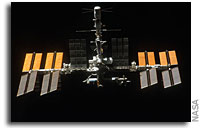
All ISS systems continue to function nominally, except those noted previously or below.
CDR Borisenko performed the routine checkup of the SM (Service Module) PSS Caution & Warning panel as part of the regular Daily Morning Inspection,
At wake-up, FE-5 Furukawa & FE-6 Fossum completed another post-sleep session of the Reaction Self Test (Psychomotor Vigilance Self Test on the ISS) protocol. [RST is done twice daily (after wakeup & before bedtime) for 3 days prior to the sleep shift, the day(s) of the sleep shift and 5 days following a sleep shift. The experiment consists of a 5-minute reaction time task that allows crewmembers to monitor the daily effects of fatigue on performance while on ISS. The experiment provides objective feedback on neurobehavioral changes in attention, psychomotor speed, state stability, and impulsivity while on ISS missions, particularly as they relate to changes in circadian rhythms, sleep restrictions, and extended work shifts.]
Also at wake-up, FE-4 Volkov terminated his 4th experiment session, started last night, for the long-term Russian sleep study MBI-12/Sonokard, taking the recording device from his Sonokard sports shirt pocket and later copying the measurements to the RSE-Med laptop for subsequent downlink to the ground. [Sonokard objectives are stated to (1) study the feasibility of obtaining the maximum of data through computer processing of records obtained overnight, (2) systematically record the crewmember’s physiological functions during sleep, (3) study the feasibility of obtaining real-time crew health data. Investigators believe that contactless acquisition of cardiorespiratory data over the night period could serve as a basis for developing efficient criteria for evaluating and predicting adaptive capability of human body in long-duration space flight.]
Next, Volkov performed the periodic maintenance of the active Russian BMP Harmful Impurities Removal System, starting the “bake-out” cycle to vacuum on absorbent bed #1 of the regenerable dual-channel filtration system. The process will be terminated later today (~5:15pm EDT), followed tomorrow by Bed #2 regeneration. [Regeneration of each of the two cartridges takes about 12 hours and is conducted only during crew awake periods. The BMP’s regeneration cycle is normally done every 20 days.]
In Node-3, Garan collected two 300mL samples of potable water from the WRS WPA (Water Recovery System / Water Processor Assembly) for return to Earth.
Also in Node-3, Furukawa performed the periodic changeout of the TOCA WWB (Total Organic Carbon Analyzer / Waste Water Bag), followed by the weekly (approx.) WRS sampling for TOCA analysis, after first initializing the software and priming (filling) the TOCA water sample hose. [After the approximately 2-hr TOCA analysis, results were transferred to the SSC-5 (Station Support Computer 5) laptop via USB drive for downlink, and the data were also logged.]
FE-1 activated the ASU toilet facility in the Soyuz TMA-21/26S spacecraft for the crew’s subsequent two undock preparation sessions.
With the protective shutters of the Kibo JPM (JEM Pressurized Module), Lab and Cupola windows closed, Andrey Borisenko & Sasha Samokutyayev prepared for the Soyuz 26S undocking from MRM2 “Poisk” and deorbit next Thursday evening by spending an hour in the TMA-21 Descent Module (SA), from 3:30am-4:30am EDT, supporting the 2nd ground-commanded checkout of the Soyuz MCS (Motion Control System SUD, Mode 2/”Docked”) which included pressurization of both KDU (Combined Propulsion System) sections, a test of the pilot’s rotational & translational hand controllers (RUD & RUO), and a one-minute hot firing of Soyuz thrusters at 4:08am. DPO lateral thrusters were not fired. [For the RST (rasstjkovkoy/undocking) test, station attitude was handed over to Russian thruster control at 4:00am. The one-minute firing started on Daily Orbit 2 during an RGS (Russian Groundsite) pass. Attitude control was returned to the USOS (U.S. Segment) at 5:00am.]
Afterwards, in preparation for their return to gravity, Borisenko & Samokutyayev undertook the first part of their 5th and final exercise/training session of the Russian MO-5 MedOps protocol of cardiovascular evaluation in the below-the-waist reduced-pressure device (ODNT, US: LBNP) on the TVIS treadmill, with Andrey assisting Sasha as CMO (Crew Medical Officer), and Andrey later being assisted by Sergei Volkov. Medical telemetry monitoring on the ground was at 7:14am for FE-1, 8:50am for the CDR. The activity was then closed out. Part 2 follows tomorrow. [The assessments, lasting one hour each, supported by ground specialist tagup (VHF) and telemetry monitoring from Russian ground sites, uses the Gamma-1 ECG equipment with biomed harness, skin electrodes and a blood pressure and rheoplethysmograph cuff wired to the cycle ergometer’s instrumentation panels. The Chibis ODNT provides gravity-simulating stress to the body’s cardiovascular/circulatory system for evaluation of the crewmembers’ orthostatic tolerance (e.g., the Gauer-Henry reflex) after several months in zero-G. The preparatory training generally consists of first imbibing 150-200 milliliters of water or juice, followed by two cycles of a sequence of progressive regimes of reduced (“negative”) pressure, set at -25, -35, -40, and -45 mmHg for five min. each, then -25, -35, and -45 mmHg (Torr) for 10 min. each plus 30mmHg for 5 min. while shifting from foot to foot at 10-12 steps per minute, while wearing a sphygmomanometer to measure blood pressure. The body’s circulatory system interprets the pressure differential between upper and lower body as a gravity-like force pulling the blood (and other liquids) down. Chibis data and biomed cardiovascular readings are recorded. The Chibis suit (not to be confused with the Russian “Pinguin” suit for spring-loaded body compression, or the “Kentavr” anti-g suit worn during reentry) is similar to the U.S. LBNP facility (not a suit) used for the first time on Skylab in 1973/74, although it appears to accomplish its purpose more quickly.]
Later, the returning Exp-28 crew, Borisenko, Samokutyayev & Garan, spent ~3 hrs in “their” 26S Descent Module (#231), docked at MRM2, conducting the Soyuz descent drill, a standard training exercise for every crew returning on this spacecraft, supported by ground tagups. Results of the exercise, which strictly forbids any command activation (except for switching the InPU display on the Neptun-ME console), were subsequently reported to ground control at TsUP/Moscow. [The session includes a review of the pertinent ODFs (operational data files), specifically the books on Soyuz Ascent & Descent Procedures, Emergency Descents, and Off-Nominal Situations, crew responsibilities when executing the flight program, visual crew recognition of SUS (Entry Control System) failures, spacesuit procedures, etc., with special emphasis on operations with the Neptune-ME cockpit console. The training uses a Descent Simulator application (Trenasher Spusk =”descent trainer”) on the RSK1 laptop. 26S will undock on 9/15 at ~8:37pm EDT and land in Kazakhstan on 9/16 at ~12:01am. ]
Also in preparation for Exp-28 crew departure, Mike Fossum, Sergei Volkov & Satoshi Furukawa joined up for a one-hour Crew Emergency Roles & Responsibilities Review (peredacha smeniy po bezopasnosti), to familiarize themselves with procedures and escape routes in case of an emergency, and to clarify emergency roles & responsibilities for the crew change ahead. [Fossum, Borisenko’s successor as CDR for the upcoming Increment 29, went through formally listed procedures in discussing the ISS prime to non-prime crew emergency roles & responsibility agreements established during ground training.]
FE-5 Furukawa opened the protective window shutters of the Lab WORF (Window Observational Research Facility) for the ISSAC (ISS Agriculture Camera) equipment, so ground images could be captured today by ground commanding. At sleeptime tonight, Satoshi will close the shutters again. [ISSAC takes frequent visible-light & infrared images of vegetated areas on the Earth. The camera focuses principally on rangelands, grasslands, forests, and wetlands in the northern Great Plains and Rocky Mountain regions of the United States. The images may be delivered directly upon request to farmers, ranchers, foresters, natural resource managers and tribal officials to help improve their environmental stewardship of the land. The images will also be shared with educators for classroom use.]
FE-6 Fossum uninstalled the 3 alignment guides from CIR (Combustion Integrated Rack) at Lab S3 to allow the PaRIS (Passive Rack Isolation System) to be activated before begin of ground-commanded CIR operations requiring a microgravity environment. Later in the day, FE-5 Furukawa re-installed the lock-down guides to protect the CIR rack from external loading (dynamic disturbances).
Fossum & Furukawa each conducted another session with the U.S. HMS VIS (Health Maintenance Systems / Visual Acuity) testing program which uses an eye chart for both far & near visual acuity and an eye questionnaire (DCT/Data Collection Tool), to be filled out with test data and downloaded on a laptop for ground access.
Working in the US A/L (Airlock) on EMU (Extravehicular Mobility Unit) #3010, Garan performed troubleshooting to determine if REBA (Rechargeable EVA Battery) #1009 or the suit’s WVS (Wireless Video System) #20, which failed during the Russian EVA-29, have faulty connectors. [Activities included opening the back of the EMU, opening the REBA pouch to check connectors and insert REBA #1008 as test battery, then installing the helmet lights and helmet TV to check their connectors.]
Also in the A/L, Ron initiated discharge cycle on REBA #1008 in the BSA (Battery Stowage Assembly).
Volkov took documentary photography of the two canisters (#13 & #14) of the Russian BIOEKOLOGIYA (Bioecology) experiment BTKh-44/CALCIUM for subsequent downlink to the ground, and Samokutyayev then transferred BTKh-44 to the Soyuz 26S Descent Module for return.
After Ron Garan had set up the G1 camcorder to provide live viewing of MSG (Microgravity Science Glovebox) activities and activated the MSG after a visual, inspection, Mike Fossum reviewed OBT (Onboard Training) material on CCF (Capillary Channel Flow) and then had ~3.5 hrs set aside for installing and setting up CCF experiment hardware in the MSG. [CCF is a versatile experiment for studying a critical variety of inertial-capillary dominated flows key to spacecraft systems that cannot be studied on the ground. CCF results will help innovate existing and inspire new applications in the portion of the aerospace community that is challenged by the containment, storage, and handling of large liquid inventories (fuels, cryogens, water) aboard spacecraft. The results will be immediately useful for the design, testing, and instrumentation for verification and validation of liquid management systems of current orbiting, design stage, and advanced spacecraft envisioned for future lunar and Mars missions. They will also be used to improve life support system design, phase separation, and enhance current system reliability.]
Sergei Volkov inspected the Russian BIO-5 Rasteniya-2 (“Plants-2”) payload with its LADA-01 greenhouse and verifying proper watering of the KM A32 & A24 root modules; in addition, taking the periodic documentary photography of setup & activities. [Rasteniya-2 researches growth and development of plants (currently wheat) under spaceflight conditions in the LADA greenhouse from IBMP (Institute of Bio-Medical Problems, Russian: IMBP).]
Continuing the current round of the monthly preventive maintenance of RS ventilation systems, FE-4 spent ~50 min in the DC1 Docking Compartment replacing its PF1 & PF2 dust filters and cleaning the V1 & V2 ventilator grills. The removed filters were discarded.
Afterwards, Sergei worked on the RSS2 laptop to check out the data files transferred from the newly ground-activated BZU Onboard Memory Device of the high-speed RSPI Radio Link Data Transmission System to the laptop’s storage folders.
With the G1 camcorder configured to provide live “over-the-shoulder” viewing of the FPEF (Fluid Physics Experiment Facility) in the JAXA Kibo JPM (JEM Pressurized Module), Satoshi Furukawa installed a new MS (Marangoni Surface) cassette into the MS Core, reduced internal pressure for a leak check, then installed the Core into the MS Body. Afterwards, Satoshi terminated the video downlink and deactivated G1 & MPC (Multi Protocol Converter).
Next, FE-5 performed the regular (~weekly) inspection & maintenance, as required, of the CGBA-4 (Commercial Generic Bioprocessing Apparatus 4) and CGBA-5 payloads in their ERs (EXPRESS Racks).
Satoshi also powered off and relocated the EHS / TEPC (Environmental Health Systems / Tissue Equivalent Proportional Counter) detector assembly from COL (Columbus Orbital Laboratory), loc. A3, to the SM, Panel 327, connecting it to the utility outlet at Panel 450. [TEPC is the primary radiation measurement tool in the ISS.]
Alex Samokutayev used the standard ECOSFERA equipment, set up yesterday for the MedOps SZM-MO-21 microbial experiment, to inspect and evaluate the samples collected overnight in Media 1 & Media 2 Petri dishes in Kit #A20 for cultivation. Afterwards, Sasha recharged the experiment’s battery and then set up the equipment for more sampling tomorrow. [The equipment, consisting of an air sampler set, a charger and power supply unit, provides samples to help determine microbial contamination of the ISS atmosphere, specifically the total bacterial and fungal microflora counts and microflora composition according to morphologic criteria of microorganism colonies. Because the Ecosphere battery can only support 10 air samples on one charge, the sample collection is being performed in two stages. After today’s sampling, the ECOSFERA battery pack is being recharged overnight for tomorrow’s Stage 2 for sampling to Kit #21 Petri dishes.]
In the Lab, Ron demated the LTL (Low Temperature Loop) return line disconnect of the CDRA (Carbon Dioxide Removal Assembly).
FE-4 Volkov conducted the routine daily servicing of the SOZh system (Environment Control & Life Support System, ECLSS) in the SM. [Regular daily SOZh maintenance consists, among else, of checking the ASU toilet facilities, replacement of the KTO & KBO solid waste containers, replacement of EDV-SV waste water and EDV-U urine containers and filling EDV-SV, KOV (for Elektron), EDV-ZV & EDV on RP flow regulator.]
Sergei also took on the daily IMS (Inventory Management System) maintenance, updating/editing its standard “delta file” including stowage locations, for the regular weekly automated export/import to its three databases on the ground (Houston, Moscow, Baikonur).
Andrey & Sasha again had about an hour each set aside for personal crew departure preparations; these are standard pre-return procedures for crewmembers.
CDR, FE-1 & FE-4 had their standard PMCs (Private Medical Conferences) via S- & Ku-band audio/video, Sasha at ~1:15pm, Sergei at ~1:50pm, Andrey at ~2:15pm EDT.
At ~8:45am, Satoshi & Mike supported two PAO TV events, downlinking messages for ground recording for (1) ABC TV’s “Good Morning America” segment “My Three Words”, and (2) an event conducted by the X-PRIZE Foundation.
The crew worked out with their regular 2-hr physical exercise protocol on the CEVIS cycle ergometer with vibration isolation (FE-5), TVIS treadmill with vibration isolation & stabilization (CDR, FE-1/2x, FE-4), ARED advanced resistive exercise device (FE-3, FE-4, FE-5, FE-6), and T2/COLBERT advanced treadmill (CDR, FE-3, FE-6).
A task listed for Andrey, Sergei & Sasha on the Russian discretionary “time permitting” job for today continues to be the preparation & downlinking of more reportages (written text, photos, videos) for the Roskosmos website to promote Russia’s manned space program (max. file size 500 Mb).
CEO (Crew Earth Observation) targets uplinked for today were Damascus, Syria (ISS had a descending pass over Damascus. The city lied right of track, located in a patch of greener agricultural land on the inland side of the Lebanese mountains), Riyadh, Saudi Arabia (a context view [180 mm lens] of the Saudi capital was requested. Looking slightly left of track for the rectangular pattern of the cityscape), and Mount St. Helens, WA (ISS had a nadir pass over this famous volcano located in the Cascade Range of southern Washington. Evidence of the explosive eruption of 1980 is still visible today. As ISS tracked northeastward toward the forest-covered slopes of the Cascades, the crew was to aim for this large, western-most peak and acquire detailed views of the summit area).
ISS Orbit (as of this morning, 8:36am EDT [= epoch])
Mean altitude – 384.6 km
Apogee height – 392.4 km
Perigee height – 376.9 km
Period — 92.25 min.
Inclination (to Equator) — 51.64 deg
Eccentricity — 0.0011462
Solar Beta Angle — -47.7 deg (magnitude peaking)
Orbits per 24-hr. day — 15.61
Mean altitude loss in the last 24 hours — 150 m
Revolutions since FGB/Zarya launch (Nov. 98) – 73,470
Significant Events Ahead (all dates Eastern Time and subject to change):
————–Six-crew operations————-
09/15/11 — Soyuz TMA-21/26S undock — 8:37pm EDT
09/16/11 — Soyuz TMA-21/26S landing — 12:01am EDT (End of Increment 28)
————–Three-crew operations————-
10/xx/11 — Progress M-10M/42P undocking — UNDER REVIEW
10/xx/11 — Progress M-13M/45P launch — UNDER REVIEW
10/xx/11 — Progress M-13M/45P docking — UNDER REVIEW
10/xx/11 — Soyuz TMA-03M/28S launch – D.Burbank (CDR-30)/A.Shkaplerov/A.Ivanishin — UNDER REVIEW
10/xx/11 — Soyuz TMA-03M/28S docking (MRM2)
————–Six-crew operations————-
11/17/11 — Soyuz TMA-02M/27S undock/landing (End of Increment 29)
————–Three-crew operations————-
11/30/11 — SpaceX Falcon 9/Dragon — Target date
12/xx/11 — Soyuz TMA-04M/29S launch – O.Kononenko (CDR-31)/A.Kuipers/D.Pettit — UNDER REVIEW
12/xx/11 — Soyuz TMA-04M/29S docking (MRM1)
————–Six-crew operations—————-
01/xx/12 — Progress M-13M/45P undock — UNDER REVIEW
01/xx/12 — Progress M-14M/46P launch — UNDER REVIEW
01/xx/12 — Progress M-14M/46P docking (DC-1) — UNDER REVIEW
02/29/12 — ATV3 launch readiness
03/16/12 — Soyuz TMA-03M/28S undock/landing (End of Increment 30)
————–Three-crew operations————-
03/30/12 — Soyuz TMA-05M/30S launch – G.Padalka (CDR-32)/J.Acaba/K.Volkov
04/01/12 — Soyuz TMA-05M/30S docking (MRM2)
————–Six-crew operations—————-
05/05/12 — 3R Multipurpose Laboratory Module (MLM) w/ERA – launch on Proton (under review)
05/06/12 — Progress M-14M/46P undock
05/07/12 — 3R Multipurpose Laboratory Module (MLM) – docking (under review)
05/16/12 — Soyuz TMA-04M/29S undock/landing (End of Increment 31)
————–Three-crew operations————-
05/29/12 – Soyuz TMA-06M/31S launch – S.Williams (CDR-33)/Y.Malenchenko/A.Hoshide
05/31/12 – Soyuz TMA-06M/31S docking
————–Six-crew operations—————-
09/18/12 — Soyuz TMA-05M/30S undock/landing (End of Increment 32)
————–Three-crew operations————-
10/02/12 — Soyuz TMA-07M/32S launch – K.Ford (CDR-34)/O.Novitskiy/E.Tarelkin
10/04/12 – Soyuz TMA-07M/32S docking
————–Six-crew operations————-
11/16/12 — Soyuz TMA-06M/31S undock/landing (End of Increment 33)
————–Three-crew operations————-
11/30/12 — Soyuz TMA-08M/33S launch – C.Hadfield (CDR-35)/T.Mashburn/R.Romanenko
12/02/12 – Soyuz TMA-08M/33S docking
————–Six-crew operations————-
03/xx/13 — Soyuz TMA-07M/32S undock/landing (End of Increment 34)
————–Three-crew operations————-
03/xx/13 – Soyuz TMA-09M/34S launch – P.Vinogradov (CDR-36)/C.Cassidy/A.Misurkin
03/xx/13 – Soyuz TMA-09M/34S docking
————–Six-crew operations————-
05/xx/13 – Soyuz TMA-08M/33S undock/landing (End of Increment 35)
————–Three-crew operations————-
05/xx/13 – Soyuz TMA-10M/35S launch – M.Suraev (CDR-37)/K.Nyberg/L.Parmitano
05/xx/13 – Soyuz TMA-10M/35S docking
————–Six-crew operations————-
09/xx/13 – Soyuz TMA-09M/34S undock/landing (End of Increment 36)
————–Three-crew operations————-
09/xx/13 – Soyuz TMA-11M/36S launch – M.Hopkins/TBD (CDR-38)/TBD
09/xx/13 – Soyuz TMA-11M/36S docking
————–Six-crew operations————-
11/xx/13 – Soyuz TMA-10M/35S undock/landing (End of Increment 37)
————–Three-crew operations————-
11/xx/13 – Soyuz TMA-12M/37S launch – K.Wakata (CDR-39)/R.Mastracchio/TBD
11/xx/13 – Soyuz TMA-12M/37S docking
————–Six-crew operations————-
03/xx/14 – Soyuz TMA-11M/36S undock/landing (End of Increment 38)
————–Three-crew operations————-



