NASA ISS On-Orbit Status 10 September 2011
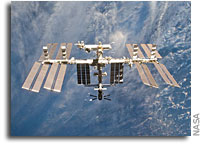
All ISS systems continue to function nominally, except those noted previously or below. Saturday – Crew off-duty day.
First thing in post-sleep prior to eating, drinking & brushing teeth, FE-3 Garan, FE-5 Furukawa & FE-6 Fossum performed another liquid saliva collection of their first INTEGRATED IMMUNE protocol (Day 2). The collections are made every other day for six days. [INTEGRATED IMMUNE (Validating Procedures for Monitoring Crew member Immune Function) samples & analyzes participant’s blood, urine, and saliva before, during and after flight for changes related to functions like bone metabolism, oxidative damage and immune function to develop and validate an immune monitoring strategy consistent with operational flight requirements and constraints. The strategy uses both long and short duration crewmembers as study subjects. The saliva is collected in two forms, dry and liquid. The dry samples are collected at intervals during the collection day using a specialized book that contains filter paper. The liquid saliva collections require that the crewmembers soak a piece of cotton inside their mouths and place it in a salivette bag; there are four of the liquid collections during docked operations. The on-orbit blood samples are collected right before undocking and returned to the ground so that analysis can occur with 48 hours of the sampling. This allows assays that quantify the function of different types of white blood cells and other active components of the immune system. Samples are secured in the MELFI (Minus-Eighty Laboratory Freezer for ISS). Also included are entries in a fluid/medications intact log, and a stress-test questionnaire to be filled out by the subject at begin and end. Urine is collected during a 24-hour period, conventionally divided into two twelve-hour phases: morning-evening and evening-morning.]
Also at wake-up, Garan, Furukawa & Fossum completed another post-sleep session of the Reaction Self Test (Psychomotor Vigilance Self Test on the ISS) protocol. [RST is done twice daily (after wakeup & before bedtime) for 3 days prior to the sleep shift, the day(s) of the sleep shift and 5 days following a sleep shift. The experiment consists of a 5-minute reaction time task that allows crewmembers to monitor the daily effects of fatigue on performance while on ISS. The experiment provides objective feedback on neurobehavioral changes in attention, psychomotor speed, state stability, and impulsivity while on ISS missions, particularly as they relate to changes in circadian rhythms, sleep restrictions, and extended work shifts.]
Afterwards, Mike Fossum, Ron Garan & Satoshi Furukawa joined in conducting the regular weekly three-hour task of thorough cleaning of their home, including COL (Columbus Orbital Laboratory) and Kibo JPM (JEM Pressurized Module). As part of today’s Uborka, Furukawa took documentary photographs of the RGSH AORG (Return Grid Sensor Housing add-on screens) at COL D0 before and after going over them with the vacuum cleaner (to be compared with pictures taken during previous cleaning to establish the quantity of debris captured during the week). [“Uborka”, usually done on Saturdays, includes removal of food waste products, cleaning of compartments with vacuum cleaner, damp cleaning of the SM (Service Module) dining table, other frequently touched surfaces and surfaces where trash is collected, as well as the sleep stations with a standard cleaning solution; also, fan screens and grilles are cleaned to avoid temperature rises. Special cleaning is also done every 90 days on the HEPA (high-efficiency particulate air) bacteria filters in the Lab.]
Andrey Borisenko & Alexandr Samokutyayev completed their 4th preliminary orthostatic hemodynamic endurance test run (of 5) with the Russian Chibis suit in preparation for their return to gravity on 9/16 with Soyuz 26S (along with Ron Garan). They conducted the ODNT exercise protocol in the below-the-waist reduced-pressure device (ODNT, US: LBNP/Lower Body Negative Pressure) on the TVIS treadmill. Each crewmember took turns as Subject and assisting CMO (Crew Medical Officer). Andrey was supported in his one-hour session by ground specialist tagup via VHF at 5:25am-5:44am, Sasha at 7:00am-7:16am EDT. [The Chibis provides gravity-simulating stress to the body’s cardiovascular/circulatory system for evaluation of the crewmember’s orthostatic tolerance (e.g., the Gauer-Henry reflex) after his long-term stay in zero-G. Data output includes blood pressure readings. The preparatory training generally consists of first imbibing 150-200 milliliters of water or juice, followed by one cycle of a sequence of progressive regimes of reduced (“negative”) pressure, set at -25, -35, -40 and -45 mmHg for five min. each, while shifting from foot to foot at 10-12 steps per minute, while wearing a sphygmomanometer to measure blood pressure and the REG SHKO Rheoencephalogram Biomed Cap. The body’s circulatory system interprets the pressure differential between upper and lower body as a gravity-like force pulling the blood (and other liquids) down. Chibis data and biomed cardiovascular readings are recorded. The Chibis suit (not to be confused with the Russian “Pinguin” suit for spring-loaded body compression, or the “Kentavr” anti-g suit worn during reentry) is similar to the U.S. LBNP facility (not a suit) used for the first time on Skylab in 1973/74, although it appears to accomplish its purpose more quickly.]
Furukawa opened the protective window shutters of the Lab WORF (Window Observational Research Facility) for the ISSAC (ISS Agriculture Camera) equipment, so ground images can be captured today by ground commanding. [ISSAC takes frequent visible-light & infrared images of vegetated areas on the Earth. The camera focuses principally on rangelands, grasslands, forests, and wetlands in the northern Great Plains and Rocky Mountain regions of the United States. The images may be delivered directly upon request to farmers, ranchers, foresters, natural resource managers and tribal officials to help improve their environmental stewardship of the land. The images will also be shared with educators for classroom use.]
Mike Fossum installed the three PaRIS (Passive Rack Isolation System) lock-down alignment guides on the CIR (Combustion Integrated Rack) in the Lab at S3 to protect its ARIS (Active Rack Isolation System) from external loading (dynamic disturbances) over the weekend.
FE-4 Volkov completed the daily inspection of the recently activated Russian BIO-5 Rasteniya-2 (“Plants-2”) payload with its LADA-01 greenhouse and ensured proper watering of the KM A32 & A24 root modules. [Rasteniya-2 researches growth and development of plants (currently wheat) under spaceflight conditions in the LADA greenhouse from IBMP (Institute of Bio-Medical Problems, Russian: IMBP).]
Sasha worked on the RSK1 & RSS2 laptops, copying accumulated science data files from the RSK1 return HDD (hard disk drive) to the RSS2 for downlink via the high-speed RSPI Radio Data Transmission System on the network.
Later, FE-1 was to initiate, on Go-ahead from TsUP-Moscow, another refresh of the ISS interior with an O2 repress from Progress M-10M/42P (#410) tankage, with the Russian Elektron oxygen generator currently off.
In the Lab (loc. O4), Mike serviced the unpowered GLACIER-2 (General Laboratory Active Cryogenic ISS Experiment Refrigerator 2) freezer in ER-6 (EXPRESS Rack 6) by placing desiccant packages in it.
Ron used the two hand-held CSA-O2 (Compound Specific Analyzer-Oxygen) units, #1043 & #1048, to take the periodic oxygen partial pressure readings in the SM & COL (Columbus Orbital Laboratory) at mid-module. [COL: 21.1% (#1043); 21.1% (#1048). SM: 21.1% (#1043); 21.2% (#1048).]
Sergei performed the routine daily servicing of the SOZh system (Environment Control & Life Support System, ECLSS) in the SM. [Regular daily SOZh maintenance consists, among else, of checking the ASU toilet facilities, replacement of the KTO & KBO solid waste containers, replacement of EDV-SV waste water and EDV-U urine containers and filling EDV-SV, KOV (for Elektron), EDV-ZV & EDV on RP flow regulator.]
Borisenko & Garan joined up for a manual control test of the SM PSS Caution & Warning (C&W) Panel, with Andrey depressing the Test button at a specific time and Ron listening for an audio signal in the USOS (US Orbital Segment), repeating the test three times. [The crew has reported numerous instances of a spurious C&W tone early in the morning, for which the daily PSS test is being suspected as the cause. A dedicated series of SM tests is now being performed with the crew listening for the tone in their CQs (Crew Quarters).]
Satoshi & Mike filled out their weekly FFQs (Food Frequency Questionnaires) on the MEC (Medical Equipment Computer). [On the FFQs, USOS astronauts keep a personalized log of their nutritional intake over time on special MEC software. Recorded are the amounts consumed during the past week of such food items as beverages, cereals, grains, eggs, breads, snacks, sweets, fruit, beans, soup, vegetables, dairy, fish, meat, chicken, sauces & spreads, and vitamins. The FFQ is performed once a week to estimate nutrient intake from the previous week and to give recommendations to ground specialists that help maintain optimal crew health. Weekly estimation has been verified to be reliable enough that nutrients do not need to be tracked daily.]
At ~7:45am EDT, the crew held the regular WPC (Weekly Planning Conference) with the ground, discussing next week’s “Look-Ahead Plan” (prepared jointly by MCC-H and TsUP-Moscow timeline planners), via S-band/audio, reviewing upcoming activities and any concerns about future on-orbit events.
At ~10:55am, Ron Garan had his standard weekly PMC (Private Medical Conference) via S- & Ku-band audio/video.
At ~2:00pm, Mike Fossum conducted his weekly PFC (Private Family Conference) via S-band/audio and Ku-band/MS-NetMeeting application (which displays the uplinked ground video on an SSC laptop).
The crew worked out with their regular 2-hr physical exercise protocol on the TVIS treadmill with vibration isolation & stabilization (CDR, FE-1, FE-4), ARED advanced resistive exercise device (CDR, FE-3, FE-5, FE-6), T2/COLBERT advanced treadmill (FE-1, FE-3, FE-5, FE-6), and VELO ergometer bike with load trainer (FE-4). [Mike Fossum is currently following a special experimental “SPRINT” protocol which diverts from the regular 2.5hrs per day regime and introduces special daily sessions. No exercise will be timelined for Friday. If any day is not completed, Mike picks up where he left off, i.e., he would be finishing out the week with his last day of exercise on his off day.]
Jobs listed for Andrey, Sergei & Sasha today on the Russian discretionary “time permitting” task list were –
. Another ~30-min. run of the GFI-8 “Uragan” (hurricane) earth-imaging program with the NIKON D3X digital camera with Sigma AF 300-800mm telelens, focusing on the Caspian Sea (polluting spills on the water surface), Aral Sea, the glaciers of the Pamir range, Bear Lake, Lake Sarez, Kerch Strait, Krasnaya Polyana, Kolka glacier, River Terek, and the Allalin glacier,
. A ~30-min. session for Russia’s EKON Environmental Safety Agency, making observations and taking KPT-3 aerial photography of environmental conditions on Earth using the NIKON D3X camera with the RSK-1 laptop,
. A ~15-min. photography session for the DZZ-13 “Seiner” ocean observation program, obtaining NIKON D3X photos with Nikkor 80-200 mm lens and the SONY HD video camcorder to record color bloom patterns in the waters of the Central-Eastern Atlantic, then copying the images to the RSK-1 laptop, and
. Preparing & downlinking more reportages (written text, photos, videos) for the Roskosmos website to promote Russia’s manned space program (max. file size 500 Mb).
Weekly Science Update (Expedition Twenty-Eight — Week 25)
2D NANO Template (JAXA): No report.
3D SPACE: Complete.
AgCam (Agricultural Camera): No report.
ALTCRISS (Alteino Long Term monitoring of Cosmic Rays on the ISS): Complete.
ALTEA SHIELD (NASA/ASI): “Thank you, Satoshi, for the power-cycle of ALTEA-SHIELD on 9/6. It brought all 6 Silicon Detector Units (SDU’s) back up to acquire science data. Currently at ~35 days of cumulative measurements on this location (minimum was 20-30 days).”
AMS-02 (Alpha Magnetic Spectrometer): All AMS payload and laptop ops are nominal. The component that has been near its temperature limit is doing better, and AMS worked with JSC and MSFC flight control teams to reposition the STRRJ to determine the thermal affect on this component. When the STRRJ was positioned at 40 degrees so that it presented more surface area to that particular side of the AMS payload (and less deep space – much colder), the component warmed up. This was seen previously as the STRRJ transitioned from -8 to 25 degrees, and was confirmed again in this 25 to 40 deg transition.
APEX (Advanced Plant Experiments on Orbit) -Cambium: No report.
APEX-TAGES (Transgenic Arabidopsis Gene Expression System): No report.
Asian Seed 2010 (JAXA): Returned on ULF6.
BCAT-4/5 (Binary Colloidal Alloy Test 4/5): The BCAT team would like to thank astronaut Mike Fossum for the pictures he took of BCAT-5, sample 9. These are well-centered and well-focused. With additional digital enhancement of these pictures, the PI team was able to surmise that significant crystallization has occurred; these pictures will have significant scientific value when retaken with the camera angle increased from its present 90 degree (perpendicular) position. It is the combination of the lighting and camera angles that make the scattering angle and when these particles form a crystal in microgravity (showing how order arises from disorder), then different colors of light are diffracted to different angles. This is much like X-ray crystallography with atoms, except scaled-up, since the particles that crystallize here (thanks to microgravity) are about the size of the wavelength of visible light.
BIOLAB (ESA): No report.
BIORHYTHMS (JAXA, Biological Rhythms): No report.
BISE (CSA, Bodies in the Space Environment): No report.
BISPHOSPHONATES: No report.
BXF-Facility (Boiling eXperiment Facility, NASA): No report.
BXF-MABE (Microheater Array Boiling Experiment, NASA): No report.
BXF-NPBX (Pool Boiling Experiment, NASA): No report.
CARD (Long Term Microgravity: Model for Investigating Mechanisms of Heart Disease, ESA): No report.
CARDIOCOG-2: Complete.
CB (JAXA Clean Bench): No report.
CBEF-2 (JAXA Cell Biology Experiment Facility)/SPACE SEED: No report.
CCISS (Cardiovascular & Cerebrovascular Control on Return from ISS): No report.
CERISE (JAXA): No report.
CCF (Capillary Channel Flow): No report.
CFS-A (Colored Fungi in Space-A, ESA): No report.
CSI-3/CGBA-5 (CGBA Science Insert #2/Commercial Generic Bioprocessing Apparatus 5): No report.
CGBA-2 (Commercial Generic Bioprocessing Apparatus 2): Complete.
CIR (Combustion Integrated Rack), MDCA/Flex: No report.
Commercial (Inc 23&24, JAXA): No report.
Commercial (Inc 25 & 26, JAXA): Sample returned by ULF6.
CSLM-2 (Coarsening in Solid-Liquid Mixtures 2): No report.
CsPins (JAXA): No report.
CubeLab: No report.
CW/CR (Cell Wall/Resist Wall) in EMCS (European Modular Cultivation System): Complete.
DECLIC-ALI (Device for the Study of Critical Liquids & Crystallization-ALICE-like, CNES/NASA): No report.
DomeGene (JAXA): Complete.
DOSIS (Dose Distribution Inside ISS, ESA): No report.
EarthKAM (Earth Knowledge Acquired by Middle School Students): No report.
EDR (European Drawer Rack, ESA): No report.
EKE (Endurance Capacity by Gas Exchange and Heart Rate Kinetics During Physical Training, ESA): No report.
ELITE-S2 (Elaboratore Immagini Televisive – Space 2): Planned.
EMCS (European Modular Cultivation System): No report.
ENose (Electronic Nose): No report.
EPM (European Physiology Module): No report.
EPO (Educational Payload Operations, NASA) (Sesame Street): No report.
EPO (Educational Payload Operations, NASA) (Kids in Micro-G): No report.
EPO LES-2 (ESA): No report.
EPO GREENHOUSE (ESA): No report.
EPO 3-min Video (JAXA): No report.
EPO J-Astro Report (JAXA): On 8/27, FE-5 Satoshi completed JAXA Report 7 and Report 8.
EPO Dewey’s Forest (JAXA): Closed out on 3/15.
EPO Space Clothes (JAXA): Complete.
EPO Hiten (Dance, JAXA): No report.
EPO Lego Bricks (NASA, JAXA): “Thank you for your wonderful participation in the Lego Bricks payload by assembling a Lego Space Shuttle. Our Lego partners are thrilled with the videos and are very excited to get students involved in this project.”
EPO-5 SpaceBottle (Message in a Bottle, JAXA): No report.
EPO Moon Score (JAXA): No report.
EPO Try Zero-G (JAXA): No report.
EPO Kibo Kids Tour (JAXA): Complete.
EPO Paper Craft (Origami, JAXA): No report.
EPO Poem (JAXA): On 9/3, during Voluntary Weekend Science, Satoshi completed photography of the DVD disk beside the JPM window.
EPO-6 Spiral Top 2 (JAXA): No report.
EPO-7 Doctor Demo (JAXA): On 8/20, FE-5 Satoshi completed EPO-7 as Voluntary Science. All of imagery and voice data was downloaded successfully. Thank you so much.
ERB-2 (Erasmus Recording Binocular, ESA): [ERB-2 aims are to develop narrated video material for various PR & educational products & events, including a 3D interior station view.] “Thanks Mike for the ERB-2 filming during your Voluntary Science activities on 9/3. The team really appreciated your participation. The images have all been downlinked.”
ETD (Eye Tracking Device): Completed.
FACET-2 (JAXA): No report.
FERULATE (JAXA): No report.
FIR/LMM/CVB (Fluids Integrated Rack / Light Microscopy Module / Constrained Vapor Bubble): No report.
Fish Scales (JAXA): Completed on FD7/ULF-4 and returned on STS-132.
FOAM STABILITY (ESA): No report.
FOCUS: No report.
FSL (Fluid Science Laboratory, ESA): “Satoshi, thank you for exchanging the hard disk of the FSL Video Management Unit (VMU) on 9/6. Activation of the FSL rack and the VMU afterwards went all fine, so great job! Tests have been run on the FSL VMU on 9/8, the results are being assessed.”
FWED (Flywheel Exercise Device, ESA): No report.
GENARA-A (Gravity Regulated Genes in Arabidopsis A/ESA): No report.
GEOFLOW-2 (ESA): GEOFLOW-2 runs will be resumed only when ESA will have a clear forward plan for FSL.
HAIR (JAXA): No report.
HDTV System (JAXA): No report.
Hicari (JAXA): No report.
Holter ECG (JAXA): No report.
HQPC (JAXA): Was delivered by 34P.
HREP (HICO/Hyperspectral Imager for the Coastal Ocean & RAIDS/Remote Atmospheric & Ionospheric Detection System/JAXA): HICO has taken 3987 images to-date. The most recent HICO images include parts of the Caspian Sea, the English Channel and the coast of China near Qingdao. RAIDS is collecting secondary science including nighttime atmospheric disk photometry, spectra and temperatures. Extreme Ultra Violet airglow spectroscopy and optical contamination studies are also being performed.
HydroTropi (Hydrotropism & Auxin-Inducible Gene Expression in Roots Grown under Microgravity Conditions/JAXA): No report.
ICE CRYSTAL (JAXA): Complete.
ICV (Integrated Cardiovascular): “Satoshi, the ICV PIs have indicated that the primary data for the experiment was only slightly affected by the 24 hour loss of the waist Actiwatch during your recent ICV Ambulatory Monitoring session. The Actiwatch data is used for interpretation of the data obtained from the Holter so, while the information is valuable, we should be able to interpolate and thus the impact of this loss on the science is expected to be small. We very much appreciate all of your efforts on behalf of ICV!”
IMMUNO (Neuroendocrine & Immune Responses in Humans During & After Long Term Stay at ISS): Complete.
INTEGRATED IMMUNE: “Ron, thanks for setting up the saliva kits for everyone this week. We were excited to see the greyed out saliva collections this week. We’re looking forward to supporting this series!”
InSPACE-2 (Investigating the Structure of Paramagnetic Aggregates from Colloidal Emulsions 2): No report.
IRIS (Image Reversal in Space, CSA): No report.
ISS Amateur/Ham Radio: No report.
ISSAC (ISS Agricultural Camera, NASA): Good sun angles in North America and great weather continued this past week. ISSAC was able to collect several images simultaneously with some ground spectroradiometer measurements, critical to our vicarious calibration activities. One other new project we began this week is imaging of the Missouri River bottom. All summer the Missouri has been at record flows, dropping under flood stage for the first time in several months just this week. We are going to attempt to quickly see how much the river course and surrounding riverine ecosystems have been affected.
IV Gen (Intravenous Fluids Generation): No report.
KID/KUBIK6: No report.
KUBIK 3 (ESA): No report.
LMM/PACE-2 (Light Microscopy Module / Preliminary Advanced Colloids Experiment): We have finished powered operations with the PACE Particle Samples. Next, we plan to observe and image the PACE Tissue Samples.”
LOCAD-PTS (Lab-on-a-Chip Application Development-Portable Test System): No report.
Marangoni Exp (JAXA): 24th run was completed on 12/22.
Marangoni DSD – Dynamic Surf (JAXA): Payload name was change from Marangoni DSD to Dynamic Surf.
Marangoni UVP (JAXA): No report.
MARES (Muscle Atrophy Research & Exercise System, ESA/NASA): No report.
Matryoshka-2 (RSA): No report.
MAXI (Monitor of All-sky X-ray Image, JAXA): Continuing telemetry monitoring.
MDCA/Flex: Late last week, CIR/MDCA successfully performed four test points in two different chamber atmospheres.
MEIS (Marangoni Experiment for ISS) in JAXA FPEF (Fluid Physics Experiment Facility): No report.
Microbe-2 (JAXA): Sample returned by ULF6.
Micro-G Clay (JAXA EPO): Complete.
MISSE-8 (Materials ISS Experiment 8): MISSE-8 is operating nominally. The SEUXSE II experiment did power cycle last week in order to reinitialize the experiment. This week PASCAL has continued nominal commanding that produced IV curves of the solar cells. IV curves are plots of the current versus voltage for solar cells and tell a lot about how these are performing. The SpaceCube experiment is running code for new radiation hardening by software.
MMA (JAXA/Microgravity Measurement Apparatus): No report.
MPAC/SEED (JAXA): Completed on 19A FD4.
MSG-SAME (Microgravity Science Glovebox-Smoke Aerosol Measurement Experiment): No report.
MSL (Materials Science Laboratory, ESA): No report.
MTR-2 (Russian radiation measurements): Passive dosimeters measurements in DC-1 “Pirs”.
MULTIGEN-1: Completed.
MYCO 3 (JAXA): No report.
MyoLab (JAXA): Completed on 4/20.
NANOSKELETON (Production of High Performance Nanomaterials in Microgravity, JAXA): Returned on ULF6.
NEURORAD (JAXA): No report.
NEUROSPAT (ESA/Study of Spatial Cognition, Novelty Processing and Sensorimotor Integration):
NOA-1/-2 (Nitric Oxide Analyzer, ESA): Complete.
NUTRITION w/REPOSITORY/ProK: No report.
ODK (Onboard Diagnostic Kit, JAXA): On 9/6 Satoshi completed Demo part 2 as a live video and introduced how remote-medical-diagnosis is going to be in the future Space Human Life.
PADIAC (Pathway Different Activators, ESA): No report.
PADLES (JAXA, Area PADLES 3/4; Passive Area Dosimeter for Lifescience Experiment in Space): On 6/14 completed installation of 17 Dosimeters in JPM and JLP.
PASSAGES (JAXA): No report.
PCDF-PU (Protein Crystallization Diagnostic Facility – Process Unit): No report.
PCG (JAXA, Protein Crystal Growth): Continuing telemetry monitoring. The removal of canister and its transfer to 26S for return is planned for 9/15.
PCRF (Protein Crystallization Research Facility) Reconfiguration (JAXA): See PCG.
PLSG (Plant Signaling, NASA/ESA): No report.
PMDIS (Perceptual Motor Deficits in Space): Complete.
POLCA/GRAVIGEN (ESA): Complete.
Portable PFS: No report.
Pro K: No report.
RadGene & LOH (JAXA): Complete.
RadSilk (JAXA): No report.
Reaction Self Test (RST/Psychomotor Vigilance Self Test on the ISS): “”Ron, the actual number of tests you will complete is 85. The number we have been carrying, 115, was a planning number. Thank you for your participation in Reaction Self Test throughout your increment! Mike and Satoshi, thank you for participating in Reaction Self Test! “
Robonaut (NASA): No report.
RYUTAI Rack (JAXA): No report.
SAIBO Rack (JAXA): On 9/3, during Voluntary Weekend Science, Satoshi completed the cleanup and discarded an old Velcro Tape on the micro-g insulation cover.
SAMS/MAMS (Space & Microgravity Acceleration Measurement Systems): No report.
SAMPLE: Complete.
SCOF (Solution Crystallization Observation Facility, JAXA): No report.
SEDA-AP (Space Environment Data Acquisition Equipment-Attached Payload, JAXA): Continuing telemetry monitoring.
SHERE II (Shear History Extensional Rheology Experiment II): No report.
SLAMMD (Space Linear Acceleration Mass Measurement Device): “Ron, Satoshi & Mike – thank you for getting the monthly SLAMMD body mass measurements this past week. These measurements support the Nutrition protocol. Mike, we acknowledge the words you left regarding scheduling of setups and stows, and appreciate the feedback. We’ll make every effort to work the operational products to be clear and efficient for execution!”
SLEEP (Sleep-Wake Actigraphy & Light Exposure during Spaceflight): No report.
SMILES (JAXA): Continuing telemetry monitoring.
SODI/IVIDIL (Selectable Optical Diagnostics Instrument/Influence of Vibration on Diffusion in Liquids, ESA): No report.
SODI/COLLOID (Selectable Optical Diagnostics Instrument/Colloid): No report.
SOLAR (Solar Monitoring Observatory): Science data acquisition for both SOLACES and SOLSPEC up to the end of Sun Visibility Window #44 on 9/3. Since then out of sun visibility. The next sun visibility window #45 is expected to start 9/21.
SOLO (Sodium Loading in Microgravity): No report.
Space-DRUMS (Space Dynamically Responding Ultrasonic Matrix System): No report.
Space Food (JAXA): No report.
SPHERES (Synchronized Position Hold, Engage, Reorient, Experimental Satellite): No report.
SPHINX (SPaceflight of Huvec: an Integrated eXperiment, ESA): No report.
SPICE (Smoke Point In Co-flow Experiment): No report.
SPINAL (Spinal Elongation): No report.
SPRINT: “Mike, congratulations on collecting the first ever leg muscle ultrasound images from space! Great job performing the scan yourself, hopefully it will be easier to get configured next time. The PI team is already reviewing the images and will pass along the results through your surgeon. Because of ultrasound troubles this was your first session, however nominally the FD90 scan is the 4th of 7 sessions, so we are hoping for 3 more sessions.”
SS-HDTV (Super Sensitivity High Definition Camera, JAXA): On 9/6, Satoshi completed the checkout #2 for the Live Video Event scheduled on 9/18. NHK will air it worldwide as a live broadcast on Dish & Cable channel “TV Japan”. Many people are expected to watch TV. Advanced information is available at http://www.tvjapan.net/en/.
STP-H3 (Space Test Program – Houston 3): All MHTEX evaporators were turned off and the system is being reprimed this week. Canary took data from the CIR vent usage event and continues to operate nominally. VADER has increased the voltage in the high emissivity state to the cycling VEDs in an effort to excite a greater change. VADER plans to continue in this state for the next few weeks. DISC has taken more images this week and is processing images that were taken in previous weeks.
SWAB (Characterization of Microorganisms & Allergens in Spacecraft): No report.
TASTE IN SPACE (ESA): No report.
THERMOLAB (ESA): No report.
TRAC (Test of Reaction & Adaptation Capabilities): Planned.
TREADMILL KINEMATICS: “Ron, thank you so much for making up the previous session and being the trooper you are!”
TRIPLELUX-B (ESA): No report.
ULTRASOUND: Planned.
UMS (Urine Monitoring System (NASA): No report.
VASCULAR (CSA): No report.
VCAM (Vehicle Cabin Atmosphere Module, NASA): “Satoshi, the video images that you set up during Friday’s VCAM corrective action clearly demonstrated that one connector was not seated but that all pins were intact. With your careful execution and patience you were able to engage screws on both sides of the floating connector and fully seat the connector. When VCAM powered up it pumped down to its standby vacuum level very quickly meaning that the instrument remained very clean in spite of the 9 hours it was unpowered. The ground commanded a background mass spectrometer measurement which showed all spectrometer functions were nominal. Turning on the MS Heater caused the pressure in the chamber to rise immediately. EXPRESS Rack data showed the input current to Locker 8 increased by the expected amount. Full functionality has been restored. VCAM will continue pumping down over the weekend. On Monday VCAM will run standard measurement sequences with the MS Heater off as well as upload new sequences to use the backup MS Heater. The latter are expected to lower the baseline counts and sharpen peaks in the ion chromatograms; we also expect to see chemical compounds that have been undetectable since July 2010 when the other MS Heater failed.”
VESSEL ID System (ESA): Acquiring science data with NorAIS receiver.
VESSEL IMAGING (ESA): No sessions possible due to Ultrasound anomaly.
VIABLE (eValuatIon And monitoring of microBiofiLms insidE the ISS Payload Touch, NASA): No activities this week. Viable continues to passively acquire data on the ISS microbial environment
VO2max (NASA): No report.
VLE (Video Lessons ESA): No report.
WAICO #1/#2 (Waving and Coiling of Arabidopsis Roots at Different g-levels; ESA): No report.
YEAST B (ESA): No report.
CEO (Crew Earth Observation): Through 9/7, 24,640 CEO frames were received on the ground for review and cataloging. “We are pleased to report your acquisition of imagery with times corresponding to those of our CEO Daily Target Lists for the following targets: Baku, Azerbaijan; Santa Barbara Coast, CA; Rio de Janeiro, Brazil; Niwot Ridge Tundra, Colorado; Mbabane, Swaziland; Serra da Cangalha Impact Crater, Brazil; Podgorica, Montevideo; Chisinau, Moldavia; Prague, Czech Republic; and Bagdad, Iraq – these are still under evaluation and cataloging for content requirements. Your recent views, both still sequences and videos, of the Texas wildfires from space have been of immense interest to PAO and the media – thanks for your unsolicited efforts in acquiring and promptly down linking this excellent imagery. The Atlantic Hurricane season remains very active and your imagery of these potentially destructive storms remains a prime dynamic event target whenever suitable views become available. One of your awesome views of the Texas Wildfire Smoke Plumes was published on the NASA/GSFC’s Earth Observatory website this week as an Image of the Day feature. Nice work!”
CEO (Crew Earth Observation) targets uplinked for today were Athens, Greece (the capital of Greece is an ancient city that dominates the south coast of region known as Attica in the southeastern part of the mainland. ISS had a nadir orbit over this city), Tropical Storm Nate, Bay of Campeche (Dynamic Event: On 9/9, Tropical Storm Nate had winds of 65 mph and was moving northwest at 2 mph. The National Hurricane Center forecasts that Nate will become a Category 1 Hurricane by the time of this orbital pass. The forecast tracks show Nate making landfall on the Mexican Gulf coast early Sunday evening local time. Looking left of track for this storm), Texas Wildfires (Dynamic Event: If there is any good news about the Texas wildfires it is that they are being reported as being mostly contained, as of 9/9. The forward progress of the Bastrop fire has been mostly stopped; however, the interior continues to burn. The total number of homes burned in the Bastrop fire is 1,636. In the Magnolia Fires [Grimes, Montgomery and Waller counties] the fires are 60% contained and 75% of the homes in this area have been burned. People in Houston and NASA area were able to see the smoke, and in some cases smell the smoke, from these fires. Looking right of ISS track, towards the bend in the Edward Plateau for the Bastrop fires, and towards the coast and Houston for the other major fires. With containment, many of the fires may no longer be visible), and West Hawk Impact Crater, Manitoba (this impact is marked by a ragged, circular lake about 40 miles north of the NW edge of Lake of The Woods. Looking slightly right of track for overlapping views of impact area).
ISS Orbit (as of this morning, 8:37am EDT [= epoch])
Mean altitude – 385.0 km
Apogee height – 393.1 km
Perigee height – 376.8 km
Period — 92.25 min.
Inclination (to Equator) — 51.64 deg
Eccentricity — 0.0012063
Solar Beta Angle — -44.4 deg (magnitude increasing)
Orbits per 24-hr. day — 15.61
Mean altitude loss in the last 24 hours — 46 m
Revolutions since FGB/Zarya launch (Nov. 98) – 73,423
Significant Events Ahead (all dates Eastern Time and subject to change):
————–Six-crew operations————-
09/13/11 — Soyuz TMA-21/26S thruster test — 4:05am-4:24am EDT
09/15/11 — Soyuz TMA-21/26S undock — 8:37pm EDT
09/16/11 — Soyuz TMA-21/26S landing — 12:01am EDT (End of Increment 28)
————–Three-crew operations————-
10/xx/11 — Progress M-10M/42P undocking — UNDER REVIEW
10/xx/11 — Progress M-13M/45P launch — UNDER REVIEW
10/xx/11 — Progress M-13M/45P docking — UNDER REVIEW
10/xx/11 — Soyuz TMA-03M/28S launch – D.Burbank (CDR-30)/A.Shkaplerov/A.Ivanishin — UNDER REVIEW
10/xx/11 — Soyuz TMA-03M/28S docking (MRM2)
————–Six-crew operations————-
11/17/11 — Soyuz TMA-02M/27S undock/landing (End of Increment 29)
————–Three-crew operations————-
11/30/11 — SpaceX Falcon 9/Dragon — Target date
12/xx/11 — Soyuz TMA-04M/29S launch – O.Kononenko (CDR-31)/A.Kuipers/D.Pettit — UNDER REVIEW
12/xx/11 — Soyuz TMA-04M/29S docking (MRM1)
————–Six-crew operations—————-
01/xx/12 — Progress M-13M/45P undock — UNDER REVIEW
01/xx/12 — Progress M-14M/46P launch — UNDER REVIEW
01/xx/12 — Progress M-14M/46P docking (DC-1) — UNDER REVIEW
02/29/12 — ATV3 launch readiness
03/16/12 — Soyuz TMA-03M/28S undock/landing (End of Increment 30)
————–Three-crew operations————-
03/30/12 — Soyuz TMA-05M/30S launch – G.Padalka (CDR-32)/J.Acaba/K.Volkov
04/01/12 — Soyuz TMA-05M/30S docking (MRM2)
————–Six-crew operations—————-
05/05/12 — 3R Multipurpose Laboratory Module (MLM) w/ERA – launch on Proton (under review)
05/06/12 — Progress M-14M/46P undock
05/07/12 — 3R Multipurpose Laboratory Module (MLM) – docking (under review)
05/16/12 — Soyuz TMA-04M/29S undock/landing (End of Increment 31)
————–Three-crew operations————-
05/29/12 – Soyuz TMA-06M/31S launch – S.Williams (CDR-33)/Y.Malenchenko/A.Hoshide
05/31/12 – Soyuz TMA-06M/31S docking
————–Six-crew operations—————-
09/18/12 — Soyuz TMA-05M/30S undock/landing (End of Increment 32)
————–Three-crew operations————-
10/02/12 — Soyuz TMA-07M/32S launch – K.Ford (CDR-34)/O.Novitskiy/E.Tarelkin
10/04/12 – Soyuz TMA-07M/32S docking
————–Six-crew operations————-
11/16/12 — Soyuz TMA-06M/31S undock/landing (End of Increment 33)
————–Three-crew operations————-
11/30/12 — Soyuz TMA-08M/33S launch – C.Hadfield (CDR-35)/T.Mashburn/R.Romanenko
12/02/12 – Soyuz TMA-08M/33S docking
————–Six-crew operations————-
03/xx/13 — Soyuz TMA-07M/32S undock/landing (End of Increment 34)
————–Three-crew operations————-
03/xx/13 – Soyuz TMA-09M/34S launch – P.Vinogradov (CDR-36)/C.Cassidy/A.Misurkin
03/xx/13 – Soyuz TMA-09M/34S docking
————–Six-crew operations————-
05/xx/13 – Soyuz TMA-08M/33S undock/landing (End of Increment 35)
————–Three-crew operations————-
05/xx/13 – Soyuz TMA-10M/35S launch – M.Suraev (CDR-37)/K.Nyberg/L.Parmitano
05/xx/13 – Soyuz TMA-10M/35S docking
————–Six-crew operations————-
09/xx/13 – Soyuz TMA-09M/34S undock/landing (End of Increment 36)
————–Three-crew operations————-
09/xx/13 – Soyuz TMA-11M/36S launch – M.Hopkins/TBD (CDR-38)/TBD
09/xx/13 – Soyuz TMA-11M/36S docking
————–Six-crew operations————-
11/xx/13 – Soyuz TMA-10M/35S undock/landing (End of Increment 37)
————–Three-crew operations————-
11/xx/13 – Soyuz TMA-12M/37S launch – K.Wakata (CDR-39)/R.Mastracchio/TBD
11/xx/13 – Soyuz TMA-12M/37S docking
————–Six-crew operations————-
03/xx/14 – Soyuz TMA-11M/36S undock/landing (End of Increment 38)
————–Three-crew operations————-