
NASA ISS On-Orbit Status 8 September 2011
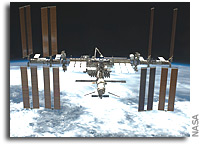
All ISS systems continue to function nominally, except those noted previously or below.
As part of the regular Daily Morning Inspection, Alex Samokutyayev performed the routine checkup of the SM (Service Module) PSS Caution & Warning panel. [The crew has reported numerous instances of a spurious C&W tone early in the morning, and the daily PSS test is being suspected as cause. A dedicated series of SM tests will be performed with the crew listening for the tone in their CQs (Crew Quarters).]
First thing in post-sleep, prior to eating, drinking & brushing teeth, FE-3 Garan, FE-5 Furukawa & FE-6 Fossum performed their first liquid saliva collection of the INTEGRATED IMMUNE protocol (Day 1). The collections are made every other day for six days. [INTEGRATED IMMUNE (Validating Procedures for Monitoring Crew member Immune Function) samples & analyzes participant’s blood, urine, and saliva before, during and after flight for changes related to functions like bone metabolism, oxidative damage and immune function to develop and validate an immune monitoring strategy consistent with operational flight requirements and constraints. The strategy uses both long and short duration crewmembers as study subjects. The saliva is collected in two forms, dry and liquid. The dry samples are collected at intervals during the collection day using a specialized book that contains filter paper. The liquid saliva collections require that the crewmembers soak a piece of cotton inside their mouths and place it in a salivette bag; there are four of the liquid collections during docked operations. The on-orbit blood samples are collected right before undocking and returned to the ground so that analysis can occur with 48 hours of the sampling. This allows assays that quantify the function of different types of white blood cells and other active components of the immune system. Samples are secured in the MELFI (Minus-Eighty Laboratory Freezer for ISS). Also included are entries in a fluid/medications intact log, and a stress-test questionnaire to be filled out by the subject at begin and end. Urine is collected during a 24-hour period, conventionally divided into two twelve-hour phases: morning-evening and evening-morning.]
Later, Garan uninstalled the 4 alignment guides from CIR (Combustion Integrated Rack) at Lab S3 to allow the PaRIS (Passive Rack Isolation System) to be activated before begin of ground-commanded CIR operations requiring a microgravity environment.
Ron also had ~90 min set aside to continue unpacking & stowing items brought up on Mission ULF7, using an uplinked updated unpack list.
FE-4 Volkov completed his 4th session with the Russian behavioral assessment TIPOLOGIA (MBI-20), setting up the workstation, connecting equipment, suiting up and launching the program on the RSK1 laptop. [Sasha Samokutyayev assisted Sergei in donning the electrode cap, preparing the head for the electrodes, applying electrode gel from the Neurolab-RM2 kit and taking documentary photography. Data were recorded on a PCMCIA memory card and downlinked via OCA comm. MBI-20 studies typological features of operator activity of the ISS crews in long-term space flight phases, with the subject using a cap with EEG (electroencephalogram) electrodes. The experiment, which records EEGs, consists of the Luescher test, “adaptive biological control” training, and the games Minesweeper and Tetris. The Luescher color diagnostic is a psychological test which measures a person’s psychophysical state, his/her ability to withstand stress, to perform and to communicate. It is believed to help uncover the cause of psychological stress, which can lead to physical symptoms. An EEG measures and records the electrical activity of the brain.]
Samokutyayev completed the daily inspection of the recently activated Russian BIO-5 Rasteniya-2 (“Plants-2”) payload with its LADA-01 greenhouse and ensured proper watering of the KM A32 & A24 root modules. [Rasteniya-2 researches growth and development of plants (currently wheat) under spaceflight conditions in the LADA greenhouse from IBMP (Institute of Bio-Medical Problems, Russian: IMBP).]
Later, Borisenko & Samokutyayev jointly continued the ongoing inventorying/auditing of stowage contents in the FGB for another hour, going by an uplinked roster listing 422 individual equipment (oborud) items.
In the US Lab, FE-5 Furukawa followed up on the recent installation of ER-8 (EXPRESS Rack 8) by deploying & installing the rack’s ELC laptop computer, a T61p, along with its power “brick” and cabling.
Afterwards, Satoshi powered on the Payload MPC (Multi Protocol Converter) and started the data flow to POIC (Payload Operations Integration Center/Huntsville), downlinking the video footage of yesterday’s building of a Lego Space Shuttle as part of the LEGO Brick EPO (Education Payload Operation) demo.
In the Kibo JPM (JEM Pressurized Module), FE-6 Fossum supported the BCAT-5 (Binary Colloidal Alloy Test-5) payload by installing the NIKON D2Xs camera & setting up a new sample for warming up and subsequent camera/flash photography of crystals formed during the cooldown back to room temperature. Afterwards, the imagery was transferred for downlinking. [The turbid temperature-sensitive Sample 10 was formulated to “melt” at about 23 degC (the mean temperature of the Kibo JPM at the time the sample was created in 2009). But when Sample 10 was run by Scott Kelly at the beginning of 2011, the mean temperature in the JPM was lower, about 22 degC, which resulted in the sample not “melting” as it had been designed to do at 23 degC. The objective today was to warm up Sample 10 above 23 degC using warm water in two drinking water containers and then letting it cool down for the crystal formation and photography.]
After turning off the rack power switch in Satoshi’s starboard CQ (Crew Quarters) for safing, Ron Garan spent ~90 min on cleaning the CQ, assisted for some time by Mike Fossum for “knowledge handover” (i.e., familiarization with a stuck fastener on the exhaust inlet panel & difficulties encountered during intake cleaning). [After Ron’s departure next week, Mike will be the one to clean the Deck & Port CQs.]
In the COL (Columbus Orbital Laboratory), Garan later removed & replaced a suspect PWS1 LAN (Portable Workstation 1 Local Area Network) cable. [The new LAN cable was retrieved from stowage and exchanged with the old cable between PWS1 and SUP2 (Standard Utility Panel 2), J05, which was discarded.]
Sasha did the daily IMS (Inventory Management System) maintenance, updating/editing its standard “delta file” including stowage locations, for the regular weekly automated export/import to its three databases on the ground (Houston, Moscow, Baikonur).
Andrey Borisenko performed the routine daily servicing of the SOZh system (Environment Control & Life Support System, ECLSS) in the SM. [Regular daily SOZh maintenance consists, among else, of checking the ASU toilet facilities, replacement of the KTO & KBO solid waste containers, replacement of EDV-SV waste water and EDV-U urine containers and filling EDV-SV, KOV (for Elektron), EDV-ZV & EDV on RP flow regulator.]
The CDR also checked out proper MKSD Control & Data Acquisition Module communications between the BSPN Payload Server and the RSS1 laptop, then copied science & service data, accumulated from the GFI-17 Molniya-GAMMA experiment mounted externally since the Russian EVA-28, over to RSS1 and prepared them for subsequent downlink to the ground. [GFI-17 “Molniya” FOTON-GAMMA investigates atmospheric gamma-ray bursts and optical radiation in conditions of thunderstorm activity.]
After setting up the Lab video camcorder for live “over-the-shoulder” viewing of the crew from the ground and configuring the laptop-based ROBoT trainer, Satoshi Furukawa worked his way through a Robotics Proficiency OBT (Onboard Training) course. Afterwards, FE-5 tore down the equipment and stored it and the video gear. [Today’s ROBoT session was a proficiency maintenance session in which Satoshi had to run through an uplinked procedure solo. Although this was a Shuttle-based sim (unberthing & handing off the OBSS/Orbiter Boom Sensor System), the focus is on SSRMS (Space Station Remote Manipulator System) operations, utilizing Manual, JOCAS (Joint Operator Commanded Auto Sequence)) and FOR (Frame of Reference) modes. Objectives of the OBT are to get reacquainted with operating the SSRMS, operate the arm in all modes, monitor clearances, and practice good operational habits.]
FE-4 Volkov performed periodic service of the RS (Russian Segment) radiation payload suite “Matryoshka-R” (RBO-3-2), collecting eight Bubble dosimeters (A22, A24, A27, A28, A33, A34, A35, A36) to read their recorded radiation traces in a special Reader. Afterwards, the dosimeters were initialized for new measurements and redeployed. [The complex Matryoshka payload suite is designed for sophisticated radiation studies. Note: Matryoshka is the name for the traditional Russian set of nested dolls],
Continuing his checkout work on the TORU teleoperator control system trainer (Trenasher), Volkov tested the cabling of the BSST signal matching unit for the -Z axis command path by taking resistance measurements with the MMTs-01 Multimeter.
Preparatory to installing the unpowered MERLIN (Microgravity Experiment Research Locker Incubator) unit in the ER-6 (loc. O4) in the Lab, Furukawa unpacked items from the GLACIER (General Laboratory Active Cryogenic ISS Experiment Refrigerator) freezer in ER-2 (bay O1) for use in the MERLIN installation (desiccant packs, auxiliary sensor harness, double water lines). FE-5 then connected the cabling and configured MERLIN switches.
Afterwards, Satoshi spent about an hour in the Kibo laboratory, setting up the camera and performing an inspection of two JPM windows, during two successive night passes, with cabin lights off. [The inspection had to be during night passes in order for the ground to clearly see any window irregularities in the photos: flaws are most visible when lit from the front only.]
In the US Lab, Garan worked on the CIR FCF (Fluids & Combustion Facility) to prepare the MWA WSA (Maintenance Work Area Work Surface Area) for upcoming FCF payload use. [Activities included setting up the containment system and performing post-launch inspection of the CIR HiBMS (High Bit Depth/Multispectral) imaging package, CIR LCTFM (Liquid Crystal Tunable Filter Module), CIR LLL-IR (Low Light Level Infrared) Filter Module, and LMM (Light Microscopy Module) Monochrome Camera 1 for shatterable materials. The MWA containment system was then restowed.]
Afterwards, Ron used the Velocicalc instrument for air flow velocity measurements between the US Airlock and Node-1 to determine if the THC IMV (Temperature & Humidity Control / Intravehicular Ventilation) needs cleaning.
After moving stowage out of the way, Satoshi installed the new experimental Amine Swingbed Locker in ER-8 (Lab P4). [The NASA Amine Swingbed investigation determines if a vacuum- regenerated amine system can effectively remove carbon dioxide (CO2) from the ISS atmosphere using a smaller more efficient vacuum regeneration system. This is the first test of the Amine Swingbed payload. A similar technology (amine based pressure swing adsorption) was used on the Shuttle extended duration orbiter, in the form of the RCRS (Regenerative Carbon Dioxide Removal System). The Amine Swingbed payload uses an amine with a significantly greater capacity for CO2 than the RCRS. ECLSS systems frequently function well in the lab, but suffer degraded performance or subsystem failure in a flight environment. These systems are sometimes attributed to microgravity, but more frequently are caused by the multifaceted nature of the flight environment that is impossible to re-create in the lab. The primary objective of this payload is to ascertain whether or not the flight environment will affect system performance. After the crew configured the hardware and connected the payload to the ISS vacuum system, the payload can operate from ground controls. Cabin air is drawn through the payload system: first the air is drawn through the desiccant wheel which removes humidity from the air, then the CO2 laden (but dry) cabin air is exposed to the amine swingbed. CO2 is adsorbed, and dry CO2 free air is drawn through the regeneration section of the desiccant wheel. The water is stripped from the desiccant wheel, and returned to the cabin (in the form of warm, humid air that is free from CO2). Requested are 1000 hrs of operation time, which can be segmented. An ideal segment would be two days of continuous operation. (Amines are organic compounds and functional groups that contain a basic nitrogen atom with a lone pair. They are derivatives of ammonia, in which one or more hydrogen atoms have been replaced by a substituent such as an alkyl or aryl group. Important amines are amino acids, biogenic amines, trimethylamine and aniline. Inorganic derivatives of ammonia are also called amines, such as chloramine (NClH2).]
FE-1 Samokutyayev performed the periodic task of downloading structural dynamics measurements of the IMU-Ts microaccelerometer of the running experiment TEKh-22 “Identifikatsiya” (Identification) in MRM1 (Mini Research Module 1) Rassvet to the RSE1 A31p laptop for subsequent downlink to the ground via OCA. [IMU-Ts is a part of the MRM1 SBI onboard measurement system, installed in PGO behind panel 104.]
Andrey & Sasha each had about an hour set aside for personal crew departure preparations; these are standard pre-return procedures for crewmembers.
Before “Presleep” period tonight, Furukawa turns off the MPC.
Shortly before sleeptime, Satoshi will close the protective window shutters of the Lab WORF (Window Observational Research Facility) for the ISSAC (ISS Agriculture Camera) equipment. [ISSAC takes frequent visible-light & infrared images of vegetated areas on the Earth. The camera focuses principally on rangelands, grasslands, forests, and wetlands in the northern Great Plains and Rocky Mountain regions of the United States. The images may be delivered directly upon request to farmers, ranchers, foresters, natural resource managers and tribal officials to help improve their environmental stewardship of the land. The images will also be shared with educators for classroom use.]
Also before sleeptime, Sergei will start battery charging for the Russian GFI-8 “Uragan” (hurricane) earth-imaging program with FSS science hardware for another run tomorrow. [The FSS (Fotospektralnaya sistema) system consists of an image recording module with lens and a spectroradiometer module with an electronics module. FSS includes the ME Electronics Module & MRI Image Recording Module.]
At ~6:00am EDT, the three Russian ISS residents joined for filming another 60-min video session for Roskosmos TV Studio with the high-resolution SONY HVR-Z7E camcorder, to be used in a joint project with Carousel TV Channel for children ages 8 to 12 years, the “It’s Time to go to space!” program, which has a segment where Russian cosmonauts are discussing their work &, answer viewers’ questions. The footage was then downlinked to TsUP-Moscow. [Andrey, Sasha & Sergei answered children’s questions resulting from a recent competition for “the best question”. Alisa Levina from Moscow: What is the area of the station? If compared to the regular size apartment. Margarita Mangubi from Korolyov: How often do you tidy up the station? Do you take duty turns or do it all together? Does everybody cleanup after himself after the meal? Alexandra Bozhko from Moscow: Do you watch any shows or movies together? Or does everyone watch what he likes? Polina Yezhova from Moscow” How do you check time? Do you have a wrist watch? Is it some kind of a special watch? Do you have a wall clock? Does the watch keep correct time in weightlessness? What time does your watch show? Do you distinguish between day and night on Earth? Is it possible to understand without looking in the window? Daniil Bogdanov from Sergiev Posad: Where does the station get the air? Andrey Sharov from Moscow: Does station follow the same path? Do you fly in parallel to equator or some other way? Vladimir Balayev from Dzerzhinsk: Did anything at all surprise on the station? Was anything different from what you expected before the flight? Anastasia Sanina from Korolyov: There are some things that are not needed in space, warm clothes, for example. What other regular things are not needed on the station? And what are the things that one cannot do without in space but can easily live without on the ground?]
At ~10:00am, Borisenko, Samokutyayev & Volkov filmed another video segment of onboard activities for the Russian information TV channel “Russia Today” which is preparing a feature on space food to be aired as a Special Report under the News section.
At ~11:40am the Russian crewmembers used the HVR-Z7E camcorder to record a PAO TV video file for the entertainment content of the World Exhibition MIPCOM 2011 to be held in Cannes, France, on October 3-6. [This year the joint show of Roskosmos & “Carousel” TV channel “It’s Time to Go to Space!” was invited to the exhibition.]
The crew worked out with their regular 2-hr physical exercise protocol on the TVIS treadmill with vibration isolation & stabilization (CDR, FE-1, FE-4), ARED advanced resistive exercise device (CDR, FE-3, FE-5), T2/COLBERT advanced treadmill (FE-1, FE-3, FE-5), and VELO ergometer bike with load trainer (FE-4). [Mike Fossum is currently following a special experimental “SPRINT” protocol which diverts from the regular 2.5hrs per day regime and introduces special daily sessions. No exercise will be timelined for Friday. If any day is not completed, Mike picks up where he left off, i.e., he would be finishing out the week with his last day of exercise on his off day.]
A task listed for Andrey, Sergei & Sasha on the Russian discretionary “time permitting” job for today continues to be the preparation & downlinking of more reportages (written text, photos, videos) for the Roskosmos website to promote Russia’s manned space program (max. file size 500 Mb).
WRM Update: A new WRM (Water Recovery Management) “cue card” was uplinked to the crew for their reference, updated with their latest CWC (Contingency Water Container) water audit. [The new card (28-0014M) lists 131 good CWCs (2,992.9 L total) for the five types of water identified on board: 1. technical water (31 CWCs with 1,285.2 L, for Elektron electrolysis, incl. 978.9 L in 24 bags containing Wautersia bacteria and 129 L in 3 clean bags for contingency use; 2. Silver potable water (no CWCs); 3. Iodinated water (88 CWCs with 1,591.4 L (also 19 expired bags with 345.4 L); 4. condensate water (79.3 L in 7 bags, plus 3 empty bags); and 5. waste/EMU dump and other (37.0 L in 2 CWCs, incl. 20.2 L from hose/pump flush). Wautersia bacteria are typical water-borne microorganisms that have been seen previously in ISS water sources. These isolates pose no threat to human health.]
SPDM Update: Controllers last night maneuvered the SPDM OTCM (Special Purpose Dexterous Manipulator / ORU Tool Changeout Mechanism) to inspect various locations on the RRM (Robotic Refueling Mission payload to test how lighting affected viewing of the objects. In particular, they inspected the Marmon Clamp, SMA (Sub Miniature Adapter) cap, TSA (Torque Set Adapter), HST (Hubble Space Telescope) J-Hook & HST door, FDV (Fluid Drain Valve) safety cap and Explosive Bolt Flange. After the RRM Vision Test the SPDM was maneuvered to the viewing position to support the photogrammetry of CTC-2 (Cargo Transporter Container 2) on the ELC-4 (EXPRESS Logistics Carrier 4), scheduled for Monday (9/12).
CEO (Crew Earth Observation) targets uplinked for today were Tehran, Iran (the Iranian capital, with a population nearing 9 million, is located in the northern part of the country about 70 miles south of the coast of the Caspian Sea. As the crew tracked over the desert towards the Alborz Range, they were to aim right of track for this sprawling urban area), Astana, Kazakhstan (this capital city of nearly three-quarters of a million is located on the Ishim River in a flat semi-desert steppe. Looking right of track), Bigach Impact Crater, Kazakhstan (ISS passed near this 8 km in diameter impact structure. It is a challenging target, but less challenging than the impact crater that the crew successfully captured in Brazil [Serra da Cangalha – the only crew from ISS or Shuttle to ever do so]. The roughly circular structure of the crater is somewhat subtle to recognize, and is located to the NW of Lake Zhaysang. Overlapping mapping frames, taken along track, were suggested in order to obtain imagery of the crater), Hurricane Katia, Atlantic (the injection of dry air into Katia will apparently keep it from becoming a major hurricane as originally forecasted. At the time of ISS closest approach, Hurricane Katia was projected to have winds of 85 mph, with a forward speed of 10 mph. It moves north before taking a north-northeastward turn towards the Atlantic and away from the U.S. Requested was a mapping pass of the hurricane, beginning as the crew saw the storm from Cuba, and continuing as it approached the storm from the SW. Continuous, overlapping frames as ISS passed over the storm and until the crew could no longer see Katia were requested), Texas Wildfires (a CEO video of the wildfires in Texas has been very popular in the national media – nice job of showing the scale of this event! Since the winds have died down a bit there is hope that there will be more containment of the fires and therefore less smoke by the time of the ISS passes for today. The crew was to look slightly left of track for the Bastrop fires, and right of track for the fires north of Houston), and Mount Hood, OR (Oregon’s highest peak [11,249 feet] is a glacially eroded volcano astride the crest of the Cascade Range, looking left of track. Visual cues are the nearby line of the Columbia River to the N, and Portland 50 miles to the W. Trying for detailed mapping views of the summit area of this target).
ISS Orbit (as of this morning, 7:22am EDT [= epoch])
Mean altitude – 385.1 km
Apogee height – 393.3 km
Perigee height – 376.8 km
Period — 92.25 min.
Inclination (to Equator) — 51.64 deg
Eccentricity — 0.0012243
Solar Beta Angle — -39.2 deg (magnitude increasing)
Orbits per 24-hr. day — 15.61
Mean altitude loss in the last 24 hours — 48 m
Revolutions since FGB/Zarya launch (Nov. 98) – 73,391
Significant Events Ahead (all dates Eastern Time and subject to change):
————–Six-crew operations————-
09/15/11 — Soyuz TMA-21/26S undock — 8:37pm EDT
09/16/11 — Soyuz TMA-21/26S landing — 12:01am EDT (End of Increment 28)
————–Three-crew operations————-
10/12/11 — Progress M-10M/42P undocking — (pre-decisional target date)
10/14/11 — Progress M-13M/45P launch — (pre-decisional target date)
10/16/11 — Progress M-13M/45P docking — (pre-decisional target date)
10/28/11 — Soyuz TMA-03M/28S launch — D.Burbank (CDR-30)/A.Shkaplerov/A.Ivanishin — (pre-decisional target date)
10/30/11 — Soyuz TMA-03M/28S docking (MRM2) — (pre-decisional target date)
————–Six-crew operations————-
11/17/11 — Soyuz TMA-02M/27S undock/landing (End of Increment 29)
————–Three-crew operations————-
11/30/11 — SpaceX Falcon 9/Dragon — Target date
12/xx/11 — Soyuz TMA-04M/29S launch – O.Kononenko (CDR-31)/A.Kuipers/D.Pettit — UNDER REVIEW
12/xx/11 — Soyuz TMA-04M/29S docking (MRM1)
————–Six-crew operations—————-
01/xx/12 — Progress M-13M/45P undock — UNDER REVIEW
01/xx/12 — Progress M-14M/46P launch — UNDER REVIEW
01/xx/12 — Progress M-14M/46P docking (DC-1) — UNDER REVIEW
02/29/12 — ATV3 launch readiness
03/16/12 — Soyuz TMA-03M/28S undock/landing (End of Increment 30)
————–Three-crew operations————-
03/30/12 — Soyuz TMA-05M/30S launch – G.Padalka (CDR-32)/J.Acaba/K.Volkov
04/01/12 — Soyuz TMA-05M/30S docking (MRM2)
————–Six-crew operations—————-
05/05/12 — 3R Multipurpose Laboratory Module (MLM) w/ERA – launch on Proton (under review)
05/06/12 — Progress M-14M/46P undock
05/07/12 — 3R Multipurpose Laboratory Module (MLM) – docking (under review)
05/16/12 — Soyuz TMA-04M/29S undock/landing (End of Increment 31)
————–Three-crew operations————-
05/29/12 – Soyuz TMA-06M/31S launch – S.Williams (CDR-33)/Y.Malenchenko/A.Hoshide
05/31/12 – Soyuz TMA-06M/31S docking
————–Six-crew operations—————-
09/18/12 — Soyuz TMA-05M/30S undock/landing (End of Increment 32)
————–Three-crew operations————-
10/02/12 — Soyuz TMA-07M/32S launch – K.Ford (CDR-34)/O.Novitskiy/E.Tarelkin
10/04/12 – Soyuz TMA-07M/32S docking
————–Six-crew operations————-
11/16/12 — Soyuz TMA-06M/31S undock/landing (End of Increment 33)
————–Three-crew operations————-
11/30/12 — Soyuz TMA-08M/33S launch – C.Hadfield (CDR-35)/T.Mashburn/R.Romanenko
12/02/12 – Soyuz TMA-08M/33S docking
————–Six-crew operations————-
03/xx/13 — Soyuz TMA-07M/32S undock/landing (End of Increment 34)
————–Three-crew operations————-
03/xx/13 – Soyuz TMA-09M/34S launch – P.Vinogradov (CDR-36)/C.Cassidy/A.Misurkin
03/xx/13 – Soyuz TMA-09M/34S docking
————–Six-crew operations————-
05/xx/13 – Soyuz TMA-08M/33S undock/landing (End of Increment 35)
————–Three-crew operations————-
05/xx/13 – Soyuz TMA-10M/35S launch – M.Suraev (CDR-37)/K.Nyberg/L.Parmitano
05/xx/13 – Soyuz TMA-10M/35S docking
————–Six-crew operations————-
09/xx/13 – Soyuz TMA-09M/34S undock/landing (End of Increment 36)
————–Three-crew operations————-
09/xx/13 – Soyuz TMA-11M/36S launch – M.Hopkins/TBD (CDR-38)/TBD
09/xx/13 – Soyuz TMA-11M/36S docking
————–Six-crew operations————-
11/xx/13 – Soyuz TMA-10M/35S undock/landing (End of Increment 37)
————–Three-crew operations————-
11/xx/13 – Soyuz TMA-12M/37S launch – K.Wakata (CDR-39)/R.Mastracchio/TBD
11/xx/13 – Soyuz TMA-12M/37S docking
————–Six-crew operations————-
03/xx/14 – Soyuz TMA-11M/36S undock/landing (End of Increment 38)
————–Three-crew operations————-



