
NASA ISS On-Orbit Status 15 August 2011
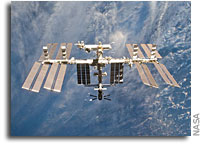
All ISS systems continue to function nominally, except those noted previously or below. Underway: Week 22 of Increment 28.
As part of the regular Daily Morning Inspection, CDR Borisenko performed the routine checkup of the SM (Service Module) PSS Caution & Warning panel as well as circuit breakers & fuses in MRM2 (Mini-Research Module 2) Poisk. [The monthly checkup in DC1, MRM1 & MRM2 looks at AZS circuit breakers on the BVP Amp Switch Panel (they should all be On) and the LEDs (light-emitting diodes) of 14 fuses in fuse panels BPP-30 & BPP-36. MRM2 & MRM1 were derived from the DC1 concept and are very similar to it.]
FE-1 Samokutyayev’s morning inspection today included the weekly checkup behind ASU/toilet panel 139 in the SM on a fluid connector (MNR-NS) of the SM-U urine collection system, looking for potential moisture, and the routine inspection of the BPP-4 & BPP-7 fuse panels in the MRM1 Rassvet.
Andrey & Aleksandr then undertook a 2-hr audit/inventory of stowage in the SM and FGB. [Earlier, the crew had completed the audit for 166 items on an uplinked stowage list comprising a total of 938 Russian equipment items.]
FE-5 Furukawa & FE-6 Fossum undertook their 10th weekly U.S. “Bisphosphonates” biomedical countermeasures session, ingesting an Alendronate pill before breakfast. The required ~10h fast period started for them last night. This is usually done on Mondays. [The Bisphosphonates study should determine whether antiresorptive agents (that help reduce bone loss) in conjunction with the routine in-flight exercise program will protect ISS crewmembers from the regional decreases in bone mineral density documented on previous ISS missions. Two dosing regimens are being tested: (1) an oral dose of 70 mg of Alendronate taken weekly starting 3 weeks prior to flight and then throughout the flight and (2) an intravenous (IV) dose of 4 mg Zoledronic Acid, administered just once approximately 45 days before flight. The rationale for including both Alendronate and Zoledronic Acid is that two dosing options will maximize crew participation, increase the countermeasure options available to flight surgeons, increase scientific opportunities, and minimize the effects of operational and logistical constraints. The primary measurement objective is to obtain preflight and postflight QCT (Quantitative Computed Tomography) scans of the hip. The QCT scans will provide volumetric bone density information of both cortical and trabecular (spongy) bone regions of the hip.]
FE-4 Volkov configured the hardware for the Russian MBI-21 PNEVMOKARD experiment, then conducted the 1h15m session, his 3rd, which forbids moving or talking during data recording. The experiment is controlled from the RSE-med A31p laptop and uses the TENZOPLUS sphygmomanometer to measure arterial blood pressure. The experiment was then closed out and the test data were downlinked via OCA. [PNEVMOKARD (Pneumocard) attempts to obtain new scientific information to refine the understanding about the mechanisms used by the cardiorespiratory system and the whole body organism to spaceflight conditions. By recording (on PCMCIA cards) the crewmember’s electrocardiogram, impedance cardiogram, low-frequency phonocardiogram (seismocardiogram), pneumotachogram (using nose temperature sensors), and finger photoplethismogram, the experiment supports integrated studies of (1) the cardiovascular system and its adaptation mechanisms in various phases of a long-duration mission, (2) the synchronization of heart activity and breathing factors, as well as the cardiorespiratory system control processes based on the variability rate of physiological parameters, and (3) the interconnection between the cardiorespiratory system during a long-duration mission and the tolerance of orthostatic & physical activities at the beginning of readaptation for predicting possible reactions of the crewmembers organism during the their return to ground.]
The CDR inspected the newly activated Russian BIO-5 Rasteniya-2 (“Plants-2”) payload with its LADA-01 greenhouse, checking for proper fan operation by hand-testing the air flow from the ventilators BO A04 & BO A05 for the KM A24 root module and verifying that both LEDs (Light Emitting Diodes) are lit. Later, Andrey also verified the periodic watering of the root module. [Rasteniya-2 researches growth and development of plants (currently wheat) under spaceflight conditions in the LADA greenhouse from IBMP (Institute of Bio-Medical Problems, Russian: IMBP).]
In the JAXA JPM (JEM Pressurized Module), FE-3 Garan set up the SPHERES (Synchronized Position Hold, Engage, Reorient, Experimental Satellite) equipment after reviewing the protocol and discussing it with the PD (Payload Developer), then relocated the SSC-15 (Station Support Computer 15) T61p laptop for the GUI (Graphic User Interface) to Kibo, configured cameras and executed a dry run, serving as a practice session for tomorrow’s Zero Robotics Student Competition. [Afterwards, Ron deactivated the floating satellites, checked and removed battery packs, powered off the beacons, disconnected LPTX antenna power & data cables, and stowed the satellites. SSC-15 was then returned to its original location. SPHERES was operated the last time by Scott Kelly in December 2010 with students at the 2010 Zero Robotics competition. The SPHERES experiment is a test bed for the development and testing of formation flying and other multi-spacecraft control algorithms. Sessions use several satellites and beacons on mounts, with CO2 (Carbon Dioxide) tanks and battery packs, to experiment with docking, formation flight, and reconfigurations. In addition, the sessions add a wide range of control algorithms for maneuvers previously demonstrated using basic control laws. Modern robust control techniques are combined with path planning and formation flight algorithms to improve the performance of the system. The sessions also obtain data for control reconfiguration after satellites dock (and their mass properties change). Per applicable Flight Rule, SPHERES operations have no CO2 output constraints if the CDRA (CO2 Removal Assembly) is operating in dual-bed or single-bed mode.]
Before and after the SPHERES session, Garan checked the CO2 level of the JPM and SM cabin atmospheres with the CDM (Carbon Dioxide Monitor).
Samokutyayev used a Russian AK-1M absorber in the SM (Service Module) & FGB to sample the cabin atmosphere for air, and IPD-CO Draeger tubes, on a cartridge belt with a pump, to check the SM cabin air for CO (Carbon Monoxide). The samplers were stowed in kits for subsequent return to Earth.
FE-6 Fossum meanwhile deployed two new BCR/RFID (Bar Code Reader Radio Frequency ID) scanner systems (#1004, #1005), installed their software on an SSC laptop and set them up for battery charging.
Afterwards, Mike had 2h20m reserved for more unpacking & stowing of US cargo delivered on Progress M-10M/42P, docked at DC-1.
Satoshi gathered & prepared US trash and discarded equipment for disposal on Progress M-11M/43P, currently docked at SM aft end (to be jettisoned on 8/23).
Time again for recharging the Motorola Iridium-9505A satellite phones in the Soyuz Descent Modules, – completed by Sasha Samokutyayev for Soyuz TMA-21/26S (#231, docked at MRM2) and by Sergei Volkov for TMA-02M/27S (#702, docked at MRM1), a monthly routine job and the 2nd time for Andrey & Sergei. (Done last time: 7/3). [After retrieving the phones from their location in the spacecraft Descent Modules (SA, spuskayemyy apparat), the crewmembers initiated the recharge of the lithium-ion batteries, monitoring the process every 10-15 minutes as it took place. Upon completion, the phones were returned inside their SSSP Iridium kits and stowed back in the SA’s ODF (operational data files) container. The satphone accompanies returning ISS crews on Soyuz reentry & landing for contingency communications with SAR (Search-and-Rescue) personnel after touchdown (e.g., after an “undershoot” ballistic reentry, as happened during the 15S return). The Russian-developed procedure for the monthly recharging has been approved jointly by safety officials. During the procedure, the phone is left in its fire-protective fluoroplastic bag with open flap. The Iridium 9505A satphone uses the Iridium constellation of low-Earth orbit satellites to relay the landed Soyuz capsule’s GPS (Global Positioning System) coordinates to helicopter-borne recovery crews. The older Iridium-9505 phones were first put on board Soyuz in August 2003. The newer 9505A phone, currently in use, delivers 30 hours of standby time and three hours of talk, up from 20 and two hours, respectively, on the older units.]
Borisenko performed periodic service of the RS (Russian Segment) radiation payload suite “Matryoshka-R” (RBO-3-2), reading the recorded radiation traces of 8 Bubble dosimeters, then initializing & re-deploying the detectors and verifying proper function of the setup with the LULIN-5 electronics box. [The complex Matryoshka payload suite is designed for sophisticated radiation studies. Note: Matryoshka is the name for the traditional Russian set of nested dolls.]
After his dry run on 8/10 for familiarization, FE-5 Furukawa conducted his first science run with the SHERE (Shear History Extensional Rheology Experiment) payload. [Satoshi activated the MSG (Microgravity Science Glovebox) from its laptop and was then to conduct two consecutive experiment runs, each with an FM (Fluid Module), unstowed & retrieved from the CGBA (Commercial Generic Bioprocessing Apparatus) and restowed after its run. At the conclusion later today, FE-5 will transfer the experiment data and turn off the equipment, including the MSG. During his session on 8/11, Mike Fossum was able to complete five runs instead of the planned three. Background: Rheology is the study of the deformation and flow of matter under the influence of an applied stress (“preshearing” = rotation) which might be, for example, a shear stress or extensional stress. In practice, rheology is principally concerned with extending the “classical” disciplines of elasticity and (Newtonian) fluid mechanics to materials whose mechanical behavior cannot be described with the classical theories. SHERE is designed to study the effect of preshear (rotation) on the transient evolution of the microstructure and viscoelastic tensile stresses for solutions with long chains of monodisperse dilute polymer molecules in the MSG. Collectively referred to as “Boger fluids,” these polymer solutions have become a popular choice for rheological studies of non-Newtonian fluids and are the non-Newtonian fluid used in this experiment. The SHERE hardware consists of the Rheometer, Camera Arm, Interface Box, Cabling, Keyboard, Tool Box, Fluid Modules, and Stowage Tray.]
Afterwards, FE-5 powered off and relocated the TEPC (Tissue Equivalent Proportional Counter) detector assembly from Node-2 to COL (Columbus Orbital Laboratory), TEPC location change being a periodic activity. [TEPC is the primary radiation measurement tool in the ISS.]
Sergei Volkov worked on the RSK-1 T61p laptop, installing new software for the TORU Flight Simulator for docking & re-docking and verifying its proper function, supported by ground specialist tagup via S-band.
Satoshi Furukawa was to look for at least one of two hatch thermal covers, with 4 corner struts, in Node-1 (P4_A2). [One hatch thermal cover will be used to prevent stowage in PMA-2 (Pressurized Mating Adapter 2) from impacting the Node-2 Fwd hatch. With no Shuttle dockings scheduled anymore for the ISS, PMA-2 will be used for stowage.]
FE-1 purged & inerted the SrPK (air supply tankage) Section 2 of Progress 43P (M-11M) by charging it with N2 (nitrogen). [43P is scheduled for undocking on 8/23.]
Sasha also conducted the periodic (~monthly) maintenance on the temporarily deactivated Russian IK0501 GA (Gas Analyzer) of the SOGS Pressure Control & Atmospheric Monitoring System behind SM panel 449 by replacing its CO2 filter assembly (BF) with a new spare (done last: 7/1). The old unit was discarded on Progress 43P and the IMS (Inventory Management System)) updated. [IK0501 is an automated system for measuring CO2, O2, and H2O in the air, as well as the flow rate of the gas being analyzed.]
FE-1 conducted the daily IMS maintenance, updating/editing its standard “delta file” including stowage locations, for the regular weekly automated export/import to its three databases on the ground (Houston, Moscow, Baikonur).
Sasha also took care of the routine daily servicing of the SOZh system (Environment Control & Life Support System, ECLSS) in the SM. [Regular daily SOZh maintenance consists, among else, of checking the ASU toilet facilities, replacement of the KTO & KBO solid waste containers, replacement of EDV-SV waste water and EDV-U urine containers and filling EDV-SV, KOV (for Elektron), EDV-ZV & EDV on RP flow regulator.]
Garan completed a session with the U.S. HMS VIS (Health Maintenance Systems / Visual Acuity) testing program, using an eye chart for both far & near visual acuity and filling out an eye questionnaire for downloading on a laptop for ground access.
Later, Ron is the subject for his first onboard session with the 24S-delivered HMS (Health Maintenance System) Tonometry payload. Mike Fossum acts as CMO (Crew Medical Officer) to measure the subject’s intraocular pressure, supervised via live S-band video by medical ground personnel. [Data take is preceded by a skill refresher for Mike on an eye simulator, observed from the ground. Seven to 10 measurements are required for the Tonometer to calculate an eye pressure reading and the statistical confidence level. For the actual Tonometry, anesthetic eye drops (Proparacaine) are used that are effective in approx. 30 seconds and last for 20 minutes or longer. Tonometer measurements in micro-G will be used to assess the health of the crew’s eyes.]
Before sleep time, Garan will also undergo his first PanOptic eye test, which requires application of eye drops (Tropicamide [Mydriacyl]) causing eye dilation for subsequent ophthalmic examination, performed by Fossum as operator with an ophthalmoscope. [The procedure, guided by special software on the T61p RoBOT laptop (#1026), captures still & video images of the eye, including the posterior poles, macula & optic disc with the optic nerve, for downlink and expert analysis. Prior to the test, Ron sets up the equipment including video camera, and afterwards downloads the data, then disassembles & stows the gear.]
Before sleeptime, Samokutyayev will initiate overnight charging (10-hr) of the KPT-2 Piren battery for the Piren-V Pyro-endoscope, part of the Russian BAR science instruments suite, for another session.
Also before turning in, Satoshi will deactivate the MPC (Multi-Protocol Converter) which transmitted the live video during the day to the ground.
After charging its battery, Volkov used the Russian GFI-8 “Uragan” (hurricane) earth-imaging program with FSS science hardware at SM window #9 during a one-hour segment, taking pictures of targets along the flight track, including water and coastal area of the Pacific Ocean, typical natural areas of South America (lakes, glaciers, etc.), water and coastal area of the Atlantic Ocean. [The FSS (Fotospektralnaya sistema) consists of an image recording module with lens and a spectroradiometer module with an electronics module. FSS includes the ME Electronics Module & MRI Image Recording Module.]
Sergei also broke out and set up the equipment for another session with the Russian crew health monitoring program’s medical assessment MO-9/Biochemical Urinalysis, scheduled tomorrow for the three Russian crewmembers. [MO-9 is conducted every 30 days (and also before and after EVAs) and is one of five nominal Russian medical tests adopted by NASA for U.S. crewmembers for IMG PHS (Integrated Medical Group/Periodic Health Status) evaluation as part of the “PHS/Without Blood Labs” exam, also conducted today. The analysis uses the sophisticated in-vitro diagnostic apparatus Urolux developed originally by Boehringer (Mannheim/Germany) for the Mir program. Afterwards, the data are entered in the MEC (Medical Equipment Computer)’s /special IFEP software (In-Flight Examination Program).]
Borisenko, Volkov & Samokutyayev had ~80 min reserved for a commemorative (“symbolic”) activity, viz., stamping and signing ~120 envelopes for Roskosmos and GRO/Russian Postal Service. Garan, Fossum & Furukawa participated in the signing for ~20 min (with additional time, if required, to be carried in the voluntary “job jar” task list). The envelopes were packed into a kit for return on Soyuz TMA-21/26S next month (9/8).
The crew worked out with their regular 2-hr physical exercise protocol on the CEVIS cycle ergometer with vibration isolation (FE-5), TVIS treadmill with vibration isolation & stabilization (CDR, FE-1, FE-4), ARED advanced resistive exercise device (CDR, FE-3, FE-5, FE-6), T2/COLBERT advanced treadmill (FE-1, FE-3, FE-6) and VELO ergometer bike with load trainer (FE-4).
MRM1 Computer Issue: As reported by Energia/Moscow this morning, the TVU-2 Terminal Computing Device in MRM1 had an issue last week which interrupted Rassvet telemetry. TsUP switched MRM1 to TVU-1 and is currently assessing the TVU-2 computer.
No CEO (Crew Earth Observation) targets uplinked for today.
Listed on the voluntary USOS “job jar” task list for Ron, Satoshi & Mike for today were –
. Symbolic activity, if required (see above),
. More unpacking of Progress 43P-delivered US cargo,
. Photography of the PFS GDS (Pulmonary Function System Gas Delivery System), and
. Replacing KTO solid waste container as required.
Jobs listed for Andrey, Sergei & Sasha today on the Russian discretionary “time permitting” task list were –
* Preparation & downlinking of more reportages (written text, photos, videos) for the Roskosmos website to promote Russia’s manned space program (max. file size 500 Mb).
ISS Orbit (as of this morning, 7:22am EDT [= epoch])
Mean altitude – 386.5 km
Apogee height – 395.3 km
Perigee height – 377.7 km
Period — 92.28 min.
Inclination (to Equator) — 51.64 deg
Eccentricity — 0.001304
Solar Beta Angle — 64.2 deg (magnitude decreasing)
Orbits per 24-hr. day — 15.60
Mean altitude loss in the last 24 hours — 28 m
Revolutions since FGB/Zarya launch (Nov. 98) – 73,016
Significant Events Ahead (all dates Eastern Time and subject to change):
————–Six-crew operations————-
08/23/11 — Progress M-11M/43P undocking (5:34am EDT)
08/24/11 — Progress M-12M/44P launch (~9:00am)
08/26/11 — Progress M-12M/44P docking (SM aft) (~10:40am)
09/08/11 — Soyuz TMA-21/26S undock/landing (End of Increment 28)
————–Three-crew operations————-
09/22/11 — Soyuz TMA-03M/28S launch – D.Burbank (CDR-30)/A.Shkaplerov/A.Ivanishin
09/24/11 — Soyuz TMA-03M/28S docking (MRM2)
————–Six-crew operations————-
10/25/11 — Progress M-10M/42P undocking
10/26/11 — Progress M-13M/45P launch
10/28/11 — Progress M-13M/45P docking (DC-1)
11/16/11 — Soyuz TMA-02M/27S undock/landing (End of Increment 29)
————–Three-crew operations————-
11/30/11 — Soyuz TMA-04M/29S launch – O.Kononenko (CDR-31)/A.Kuipers/D.Pettit
12/02/11 — Soyuz TMA-04M/29S docking (MRM1)
————–Six-crew operations—————-
12/26/11 — Progress M-13M/45P undock
12/27/11 — Progress M-14M/46P launch
12/29/11 — Progress M-14M/46P docking (DC-1)
02/29/12 — ATV3 launch readiness
03/05/12 — Progress M-12M/44P undock
03/16/12 — Soyuz TMA-03M/28S undock/landing (End of Increment 30)
————–Three-crew operations————-
03/30/12 — Soyuz TMA-05M/30S launch – G.Padalka (CDR-32)/J.Acaba/K.Volkov
04/01/12 — Soyuz TMA-05M/30S docking (MRM2)
————–Six-crew operations—————-
05/05/12 — 3R Multipurpose Laboratory Module (MLM) w/ERA – launch on Proton (under review)
05/06/12 — Progress M-14M/46P undock
05/07/12 — 3R Multipurpose Laboratory Module (MLM) – docking (under review)
05/16/12 — Soyuz TMA-04M/29S undock/landing (End of Increment 31)
————–Three-crew operations————-
05/29/12 – Soyuz TMA-06M/31S launch – S.Williams (CDR-33)/Y.Malenchenko/A.Hoshide
05/31/12 – Soyuz TMA-06M/31S docking
————–Six-crew operations—————-
09/18/12 — Soyuz TMA-05M/30S undock/landing (End of Increment 32)
————–Three-crew operations————-
10/02/12 — Soyuz TMA-07M/32S launch – K.Ford (CDR-34)/O.Novitskiy/E.Tarelkin
10/04/12 – Soyuz TMA-07M/32S docking
————–Six-crew operations————-
11/16/12 — Soyuz TMA-06M/31S undock/landing (End of Increment 33)
————–Three-crew operations————-
11/30/12 — Soyuz TMA-08M/33S launch – C.Hadfield (CDR-35)/T.Mashburn/R.Romanenko
12/02/12 – Soyuz TMA-08M/33S docking
————–Six-crew operations————-
03/xx/13 — Soyuz TMA-07M/32S undock/landing (End of Increment 34)
————–Three-crew operations————-
03/xx/13 – Soyuz TMA-09M/34S launch – P.Vinogradov (CDR-36)/C.Cassidy/A.Misurkin
03/xx/13 – Soyuz TMA-09M/34S docking
————–Six-crew operations————-
05/xx/13 – Soyuz TMA-08M/33S undock/landing (End of Increment 35)
————–Three-crew operations————-
05/xx/13 – Soyuz TMA-10M/35S launch – M.Suraev (CDR-37)/K.Nyberg/L.Parmitano
05/xx/13 – Soyuz TMA-10M/35S docking
————–Six-crew operations————-
09/xx/13 – Soyuz TMA-09M/34S undock/landing (End of Increment 36)
————–Three-crew operations————-
09/xx/13 – Soyuz TMA-11M/36S launch – M.Hopkins/TBD (CDR-38)/TBD
09/xx/13 – Soyuz TMA-11M/36S docking
————–Six-crew operations————-
11/xx/13 – Soyuz TMA-10M/35S undock/landing (End of Increment 37)
————–Three-crew operations————-
11/xx/13 – Soyuz TMA-12M/37S launch – K.Wakata (CDR-39)/R.Mastracchio/TBD
11/xx/13 – Soyuz TMA-12M/37S docking
————–Six-crew operations————-
03/xx/14 – Soyuz TMA-11M/36S undock/landing (End of Increment 38)
————–Three-crew operations————-



