
NASA ISS On-Orbit Status 3 June 2011
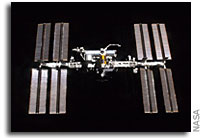
All ISS systems continue to function nominally, except those noted previously or below.
At wake-up, Garan conducted another session with the Reaction Self Test (Psychomotor Vigilance Self Test on the ISS) protocol, his 19th. [The RST is performed twice daily (after wakeup & before bedtime) for 3 days prior to the sleep shift, the day(s) of the sleep shift and 5 days following a sleep shift. The experiment consists of a 5-minute reaction time task that allows crewmembers to monitor the daily effects of fatigue on performance while on ISS. The experiment provides objective feedback on neurobehavioral changes in attention, psychomotor speed, state stability, and impulsivity while on ISS missions, particularly as they relate to changes in circadian rhythms, sleep restrictions, and extended work shifts.]
CDR Borisenko conducted the periodic maintenance of the active Russian BMP Harmful Impurities Removal System, starting the “bake-out” cycle to vacuum on absorbent bed #2 of the regenerable dual-channel filtration system. Andrey will terminate the process at ~5:15pm EDT before sleep time. Bed #1 regeneration was performed yesterday. [Regeneration of each of the two cartridges takes about 12 hours and is conducted only during crew awake periods. The BMP’s regeneration cycle is normally done every 20 days. (Last time done: 5/9-5/10).]
Borisenko also terminated the 10-hr charging of the Piren-B Piroendoscope battery for the Russian KPT-12 payload started last night.
FE-1 Samokutyayev took his 2nd MBI-24 “SPRUT-2” (“Squid-2”) onboard test, part of Russian medical research on the distribution and behavior of human body fluids in zero gravity, along with PZEh-MO-8 body mass measurement using the IM device. [Supported by the RSE-Med A31p laptop with new software (Vers. 1.6) in the SM (Service Module), the test uses the Profilaktika kit, with data recorded on PCMCIA memory cards, along with the crewmember’s body mass values and earlier recorded MO-10 Hematocrit value, but skipping “fat fold” measurements. Experiment requisites are the Sprut securing harness, skin electrodes (cuffs), and RSS-Med for control and data storage. The “Pinguin” suit or Braslet-M cuffs, if worn, have to be taken off first. Electrode measurements are recorded at complete rest and relaxed body position. The actual recording takes 3-5 minutes, during which the patient has to remain at complete rest.]
After yesterday’s preparations, Samokutyayev also completed Part 2 (of two) of the periodic window inspection & photography in the SM, using a tool kit with ruler, adhesive tape, 90-deg equilateral triangle & measuring tape, the NIKON D2 X digital camera with 28-70 mm lens, a flash attachment, and sketches of the windows under scrutiny with previous detected flaws marked and flaw tables. Borisenko assisted as required. [Today’s inspections (w/repeats) were on windows 1, 6, 7, 8, 12, 26 in the SM, VL1 & VL2 (EV hatch 1,2) in the MRM2 Poisk module, and VL2 in the DC1 Docking Compartment. Observed defects were recorded in image and text files on the RSK1 laptop for subsequent downlink via U.S. OCA assets. Objective of the inspection, which uses a digital still camera (Nikon D1X w/SB-28DX flash) and voice recorder, is to assess the window pane surfaces for any changes (new cavities, scratches, new or expanded old stains or discolorations affecting transparency properties) since the last inspection. The new assessment will be compared to earlier observations. Defects are measured with the parallax method which uses eyeball-sighting with a ruler and a right isosceles triangle to determine the defects’ size and position with respect to the window’s internal surface (parallax being the apparent change in an object’s position resulting from changing the observer’s position).]
FE-3 Garan performed the periodic changeout of the TOCA WWB (Total Organic Carbon Analyzer / Waste Water Bag) in Node-3, followed by the (approx.) weekly WRS (Water Recovery System) sampling using the TOCA, after first initializing the software and priming (filling) the TOCA water sample hose. [After the approximately 2-hr TOCA analysis, results were transferred to the SSC-5 (Station Support Computer 5) laptop via USB drive for downlink, and the data were also logged.]
Later, Ron set up the PPFS (Portable Pulmonary Function System) hardware including MBS (Mixing Bag System) in COL (Columbus Orbital Laboratory), and then conducted his 2nd session with the VO2max assessment, integrated with Thermolab. Afterwards, Ron powered down, cleaned up and fully stowed all equipment, then downloaded the data to a PCS laptop. [The experiment VO2max uses the PPFS, CEVIS ergometer cycle, PFS (Pulmonary Function System) gas cylinders and mixing bag system, plus multiple other pieces of hardware to measure oxygen uptake, cardiac output, and more. The exercise protocol consists of a 2-min rest period, then three 5-min stages at workloads eliciting 25%, 50% & 75% of aerobic capacity as measured pre-flight, followed by a 25-watt increase in workload every minute until the crewmember reaches maximum exercise capacity. At that point, CEVIS workload increase is stopped, and a 5-min cool down period follows at the 25% load. Rebreathing measurements are initiated by the subject during the last minute of each stage. Constraints are: no food 2 hrs prior to exercise start, no caffeine 8 hrs prior to exercise, and must be well hydrated.]
Samokutyayev conducted the periodic calibration & adjustment test of the O2 sensor of the SM SOGS (Pressure Control & Atmospheric Monitoring System) IK0501 gas analyzer (GA), using the BKGA/Gas Analyzer Calibration Assembly and IGZ/Analyzer Status Indicator (constituent meter), supported by ground specialist tagup. [IK0501 is an automated system for measuring CO2, O2, and H2O in the air as well as the flow rate of the gas being analyzed. Result for O2 channel output should be 3 volts.]
FE-1 also performed the periodic inspection of the SRV-K2M Condensate Water Processor’s sediment trap insert (VU) in the SM. [The VU insert was replaced with a spare on 3/30. The Russian SRVK-2M converts collected condensate into drinking water and dispenses the reclaimed potable water.]
Andrey Borisenko performed a final checkout of the new Russian BIO-5 Rasteniya-2 (“Plants-2”) payload with its LADA-01 greenhouse, took pictures of the hardware configuration, cleaned up and filled the water containers, supported by ground specialist tagup via S-band. [Rasteniya-2 researches growth and development of plants under spaceflight conditions in the LADA greenhouse from IBMP (Institute of Bio-Medical Problems, Russian: IMBP).]
Later, the CDR conducted the daily monitoring of the running Russian TEKh-15/DAKON-M IZGIB (“Bend”) experiment in the SM which took structural dynamics data during last night’s ATV2 reboost of the ISS. The data were copied from the BUSD Control & Data Gathering Unit to a USB-D-M-3 stick for downlink to the ground. The BUSD archive was then deleted and the DAKON-M restarted. [IZGIB has the objective to help update mathematical models of the ISS gravitation environment, using accelerometers of the Russian SBI Onboard Measurement System, the GIVUS high-accuracy angular rate vector gyrometer of the SUDN Motion Control & Navigation System and other accelerometers for unattended measurement of micro-accelerations at science hardware accommodation locations – (1) in operation of onboard equipment having rotating parts (gyrodynes, fans), (2) when establishing and keeping various ISS attitude modes, and (3) when performing crew egresses into space and physical exercises.]
Borisenko also downloaded the structural dynamic data collected by the IMU-Ts microaccelerometer of the running experiment TEKh-22 “Identifikatsiya” (Identification) in MRM1 (Mini Research Module 1) Rassvet to the RSE1 A31p laptop for subsequent downlink to the ground via OCA. [IMU-Ts is a part of the MRM1 SBI onboard measurement system, installed in PGO behind panel 104.]
This was the first day for Ron Garan to support SSCV4, i.e. the SSC (Station Support Computer) laptop reloading with software v.4 by the ground that will span the next three days. [Ron’s involvement today had him printing out & reviewing the SSCV4 procedures, timeline and NINJA (Network Information for JSL Administration) password document, then teleconferencing (at ~11:30am EDT) with ground specialists to discuss the transition. There are a total of 21 SSC laptops distributed in the ISS, three of them (SSC1, SSC2, SSC3) in the SM. Nineteen machines are Lenovo T61p laptops; the remaining two IBM A31p’s will also be replaced with T61p’s.]
Other activities performed by FE-3 Ron Garan included –
* The weekly health check of the O2 sensor in CSA-O2 (Compound Specific Analyzer-Oxygen) #1045, which has exceeded its shelf life,
* The regular 30-day inspection of the AED (Automated External Defibrillator) in the CHeCS (Crew Health Care Systems) rack; [AED is a portable electronic device that automatically diagnoses the potentially life threatening cardiac arrhythmias of ventricular fibrillation and ventricular tachycardia in a patient. It then can treat them through defibrillation, i.e., the application of electrical therapy which stops the arrhythmia, allowing the heart to re-establish an effective rhythm],
* Servicing the WRS (Water Recovery System) by accessing the RFTA (Recycle Filter Tank Assembly) of the WRS-2 rack and reconfiguring the setup for the periodic RFTA backfill with a QD (Quick Disconnect) hose, which was then stowed and the RFTA activity closed out,
* Preparing MELFI-1 (Minus Eighty Laboratory Freezer for ISS 1) for Stage ULF6 preservative storage needs by retrieving 8 ice bricks (-32 degC) and inserting them in Dewar 3, Tray B/Sections 1,2 & Tray D/Sections 1,2,
* Similarly preparing MELFI-3 by retrieving 22 +4 degC ice bricks for insertion in Dewar 4, Tray A/Sections 1,2 & 3,4, Tray B/Sections 1,2 & 3,4, Tray C/Sections 1,2, and Tray D/Sections 1,2, and
* Opening the portable handheld HRD (High Rate Dosimeter) and removing its four used batteries.
Aleksandr Samokutyayev performed the periodic data dump from the BRI (SSR/Smart Switch Router) control log to the RSS1 laptop for downlink to the ground via OCA,
Afterwards, FE-1 retrieved & stowed the four passive FMK (Formaldehyde Monitoring Kit) sampling assemblies, deployed by him on 6/1 in the Lab (at P3, below CEVIS) and SM (at the most forward handrail, on panel 307), to catch any atmospheric formaldehyde on a collector substrate for subsequent analysis on the ground. [Two monitors each are usually attached side by side, preferably in an orientation with their faces perpendicular to the direction of air flow.]
Sasha also conducted the routine daily servicing of the SOZh system (Environment Control & Life Support System, ECLSS) in the SM. [Regular daily SOZh maintenance consists, among else, of checking the ASU toilet facilities, replacement of the KTO & KBO solid waste containers, replacement of EDV-SV waste water and EDV-U urine containers and filling EDV-SV, KOV (for Elektron), EDV-ZV & EDV on RP flow regulator.]
Borisenko meanwhile did the daily IMS (Inventory Management System) maintenance, updating/editing its standard “delta file” including stowage locations, for the regular weekly automated export/import to its three databases on the ground (Houston, Moscow, Baikonur).
The CDR also completed the periodic checkout & performance verification of IP-1 airflow sensors in the various RS (Russian Segment) hatchways. [Inspected IP-1s are in the passageways PrK (SM Transfer Tunnel)-RO (SM Working Compartment), PkhO (SM Transfer Compartment)-RO, PkhO-DC1, PkhO-FGB PGO, PkhO-MRM2, FGB PGO-FGB GA, and FGB GA-Node-1.]
Later, Andrey conducted a photography session for the DZZ-13 “Seiner” ocean observation program, obtaining photo & video data on oceanic color bloom patterns in the South-East Pacific waters, then copied the images to the RSK-1 laptop.
Before “Presleep” period, Ron will power on the MPC (Multi-Protocol Converter) and start the data flow of video recorded during the day to the ground, with POIC (Payload Operations & Integration Center) routing the onboard HRDL (High-Rate Data Link). After about an hour, MPC will be turned off again. [This is a routine operation which regularly transmits HD onboard video (live or tape playback) to the ground on a daily basis before sleeptime.]
At ~4:15am EDT, Andrey, Alex & Ron held the regular (nominally weekly) tagup with the Russian Flight Control Team (GOGU/Glavnaya operativnaya gruppa upravleniya), including Shift Flight Director (SRP), at TsUP-Moscow via S-band/audio, phone-patched from Houston and Moscow.
At ~4:30am, Sasha & Andrey linked up with TsUP-Moscow stowage specialists via S-band to conduct the weekly IMS tagup, discussing inventory & stowage issues, equipment locations and cargo transfers.
At ~2:10pm, the three crewmembers are scheduled for their regular weekly tagup with the Lead Flight Director at JSC/MCC-Houston.
The crew worked out with their regular 2-hr physical exercise protocol on the CEVIS cycle ergometer with vibration isolation (FE-3), ARED advanced resistive exercise device (CDR, FE-3), T2/COLBERT advanced treadmill (CDR, FE-1), and VELO ergometer bike with load trainer (FE-1).
SPDM Relocation: Tonight at ~5:30pm-8:00pm, the SSRMS (Space Station Remote Manipulator System) will complete the relocation of the SPDM (Special Purpose Dexterous Manipulator) Dextre to MBS PDGF-2 (Mobile Base System / Power & Data Grapple Fixture 2) in preparation for STS-135/ULF-7 support.
ATV2 Reboost Update: The one-burn reboost of ISS was completed nominally last night at 6:30pm EDT using the ATV-2 OCS (Orbit Correction System) thrusters. Burn duration was 16 min 51 sec, resulting in a delta-V of 2.52 m/s (8.27 ft/s) vs. planned 2.50/8.20. Mean altitude gain: 4.36 km (2.35 nmi) vs. planned 4.3/2.3. The reboost used up 331 kg of ATV propellant, and 35 kg were used for attitude control. Purpose of the reboost was to set up phasing for the Progress 43P launch & docking on 6/22 & 6/24. For the maneuver, Russian thrusters were disabled at 5:30pm (CMG control) and re-enabled at 8:00pm. No CMG desats were required.
WRM Update: A new WRM (Water Recovery Management) “cue card” was uplinked to the crew for their reference, updated with their latest CWC (Contingency Water Container) water audit. [The new card (28-0041) lists 106 CWCs (2,418.2 L total) for the five types of water identified on board: 1. technical water (21 CWCs with 846.4 L, for Elektron electrolysis, incl. 562.2 L in 14 bags containing Wautersia bacteria and 134.2 L in 3 clean bags for contingency use; 2. Silver potable water (no CWCs); 3. iodinated water (73 CWCs with 1,334.3 L for reserve (also 32 expired or leaking bags with 585.5 L); 4. condensate water (201.8 L in 9 bags, plus 1 empty bag); and 5. waste/EMU dump and other (35.6 L in 2 CWCs, incl. 20.2 L from hose/pump flush). Wautersia bacteria are typical water-borne microorganisms that have been seen previously in ISS water sources. These isolates pose no threat to human health.]
CEO (Crew Earth Observation) targets uplinked for today were B.P. Structure, Impact Crater, Libya (B.P. crater was at nadir with respect to ISS orbit track. A local visual cue is an S-bend ridge), St. John’s, Antigua and Barbuda (Antigua and Barbuda is a small Caribbean nation with an estimated population of 85,700 people. Looking slightly right of track for the capital city of St. John’s. Trying to get a context view of the city in one frame if possible),and Sian Kaan Bay Mangroves, Yucatan, MX (ISS had a late morning pass in fair weather for this target area located on the east coast of the Yucatan Peninsula. The crew was able to capture this area on 6/2; however, there were more clouds present than had been anticipated. ISS pass for this day was a little earlier in the morning and it was hoped that there were less clouds. This large World Heritage Site of ~1.3 million acres was established as a biosphere area in 1986, and preserves fauna, flora and archeological sites. Looking to the right of track for this area with its visual cues of two major bays on the Caribbean Sea. Context views are requested for this new target).
ISS Orbit (as of this morning, 8:24am EDT [= epoch])
Mean altitude – 346.8 km
Apogee height – 347.8 km
Perigee height – 345.9 km
Period — 91.47 min.
Inclination (to Equator) — 51.65 deg
Eccentricity — 0.0001376
Solar Beta Angle — 26.8 deg (magnitude increasing)
Orbits per 24-hr. day — 15.74
Mean altitude gain in the last 24 hours – 4.3 km
Revolutions since FGB/Zarya launch (Nov. 98) – 71,875
Significant Events Ahead (all dates Eastern Time and subject to change):
————–Three-crew operations————-
06/07/11 — Soyuz TMA-02M/27S launch – 4:12:45pm – M. Fossum (CDR-29)/S. Furukawa/S. Volkov
06/09/11 — Soyuz TMA-02M/27S docking (MRM1) – ~5:22pm EDT
————–Six-crew operations————-
06/20/11 — ATV-2 “Johannes Kepler” undock (SM aft)
06/21/11 – ATV-2 “Johannes Kepler” reentry
06/21/11 — Progress M-11M/43P launch – 11:00am EDT
06/23/11 — Progress M-11M/43P docking (SM aft) ~ 12:05pm EDT
07/08/11 — STS-135/Atlantis launch ULF7 (MPLM) ~3:30pm EDT
07/10/11 — STS-135/Atlantis docking ULF7 (MPLM)
07/27/11 — Russian EVA #29
08/29/11 — Progress M-11M/43P undocking
08/30/11 — Progress M-12M/44P launch
09/01/11 — Progress M-12M/44P docking (SM aft)
09/16/11 – Soyuz TMA-21/26S undock/landing (End of Increment 28)
————–Three-crew operations————-
09/30/11 — Soyuz TMA-03M/28S launch – D.Burbank (CDR-30)/A.Shkaplerov/A.Ivanishin
10/02/11 – Soyuz TMA-03M/28S docking (MRM2)
————–Six-crew operations————-
10/25/11 — Progress M-10M/42P undocking
10/26/11 — Progress M-13M/45P launch
10/28/11 — Progress M-13M/45P docking (DC-1)
11/16/11 — Soyuz TMA-02M/27S undock/landing (End of Increment 29)
————–Three-crew operations————-
11/30/11 — Soyuz TMA-04M/29S launch – O.Kononenko (CDR-31)/A.Kuipers/D.Pettit
12/02/11 — Soyuz TMA-04M/29S docking (MRM1)
————–Six-crew operations—————-
12/26/11 — Progress M-13M/45P undock
12/27/11 — Progress M-14M/46P launch
12/29/11 — Progress M-14M/46P docking (DC-1)
02/29/12 — ATV3 launch readiness
03/05/12 — Progress M-12M/44P undock
03/16/12 — Soyuz TMA-03M/28S undock/landing (End of Increment 30)
————–Three-crew operations————-
03/30/12 — Soyuz TMA-05M/30S launch – G.Padalka (CDR-32)/J.Acaba/K.Volkov
04/01/12 — Soyuz TMA-05M/30S docking (MRM2)
————–Six-crew operations—————-
05/05/12 — 3R Multipurpose Laboratory Module (MLM) w/ERA – launch on Proton (under review)
05/06/12 — Progress M-14M/46P undock
05/07/12 — 3R Multipurpose Laboratory Module (MLM) – docking (under review)
05/16/12 — Soyuz TMA-04M/29S undock/landing (End of Increment 31)
————–Three-crew operations————-
05/29/12 – Soyuz TMA-06M/31S launch – S.Williams (CDR-33)/Y.Malenchenko/A.Hoshide
05/31/12 – Soyuz TMA-06M/31S docking
————–Six-crew operations—————-
09/18/12 — Soyuz TMA-05M/30S undock/landing (End of Increment 32)
————–Three-crew operations————-
10/02/12 — Soyuz TMA-07M/32S launch – K.Ford (CDR-34)/O.Novitskiy/E.Tarelkin
10/04/12 – Soyuz TMA-07M/32S docking
————–Six-crew operations————-
11/16/12 — Soyuz TMA-06M/31S undock/landing (End of Increment 33)
————–Three-crew operations————-
11/30/12 — Soyuz TMA-08M/33S launch – C.Hadfield (CDR-35)/T.Mashburn/R.Romanenko
12/02/12 – Soyuz TMA-08M/33S docking
————–Six-crew operations————-
03/xx/13 — Soyuz TMA-07M/32S undock/landing (End of Increment 34)
————–Three-crew operations————-
03/xx/13 – Soyuz TMA-09M/34S launch – P.Vinogradov (CDR-36)/C.Cassidy/A.Misurkin
03/xx/13 – Soyuz TMA-09M/34S docking
————–Six-crew operations————-
05/xx/13 – Soyuz TMA-08M/33S undock/landing (End of Increment 35)
————–Three-crew operations————-
05/xx/13 – Soyuz TMA-10M/35S launch – M.Suraev (CDR-37)/K.Nyberg/L.Parmitano
05/xx/13 – Soyuz TMA-10M/35S docking
————–Six-crew operations————-
09/xx/13 – Soyuz TMA-09M/34S undock/landing (End of Increment 36)
————–Three-crew operations————-
09/xx/13 – Soyuz TMA-11M/36S launch – M.Hopkins/TBD (CDR-38)/TBD
09/xx/13 – Soyuz TMA-11M/36S docking
————–Six-crew operations————-
11/xx/13 – Soyuz TMA-10M/35S undock/landing (End of Increment 37)
————–Three-crew operations————-
11/xx/13 – Soyuz TMA-12M/37S launch – K.Wakata (CDR-39)/R.Mastracchio/TBD
11/xx/13 – Soyuz TMA-12M/37S docking
————–Six-crew operations————-
03/xx/14 – Soyuz TMA-11M/36S undock/landing (End of Increment 38)
————–Three-crew operations————-



