
NASA ISS On-Orbit Status 28 May 2011
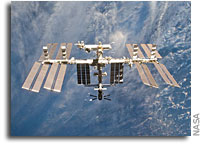
All ISS systems continue to function nominally, except those noted previously or below. Saturday – FD13 (Flight Day 13) of STS-134/Endeavour/ULF-6. Onboard crew complement: 9.
. ISS crew sleep schedule: Wake – 7:56pm last night; Sleep – 11:26am (till 7:56pm) today.
. Shuttle sleep schedule: Wake – 7:56pm last night; Sleep – 11:56am (till 7:56pm) today.
First thing in post-sleep, prior to eating, drinking & brushing teeth, FE-3 Ron Garan began his 4th saliva collection of the INTEGRATED IMMUNE protocol (Day 4), today collecting dry saliva samples five times in the course of the day. [INTEGRATED IMMUNE (Validating Procedures for Monitoring Crew member Immune Function) samples & analyzes participant’s blood, urine, and saliva before, during and after flight for changes related to functions like bone metabolism, oxidative damage and immune function to develop and validate an immune monitoring strategy consistent with operational flight requirements and constraints. The strategy uses both long and short duration crewmembers as study subjects. The saliva is collected in two forms, dry and liquid. The dry samples are collected at intervals during the collection day using a specialized book that contains filter paper. The liquid saliva collections require that the crewmembers soak a piece of cotton inside their mouths and place it in a salivette bag; there are four of the liquid collections during docked operations. The on-orbit blood samples are collected right before undocking and returned to the ground so that analysis can occur with 48 hours of the sampling. This allows assays that quantify the function of different types of white blood cells and other active components of the immune system. Samples are secured in the MELFI (Minus-Eighty Laboratory Freezer for ISS). Also included are entries in a fluid/medications intact log, and a stress-test questionnaire to be filled out by the subject at begin and end. Urine is collected during a 24-hour period, conventionally divided into two twelve-hour phases: morning-evening and evening-morning.]
Also at wake-up, Garan undertook another session with the Reaction Self Test (Psychomotor Vigilance Self Test on the ISS) protocol, his 13th. [The RST is performed twice daily (after wakeup & before bedtime) for 3 days prior to the sleep shift, the day(s) of the sleep shift and 5 days following a sleep shift. The experiment consists of a 5-minute reaction time task that allows crewmembers to monitor the daily effects of fatigue on performance while on ISS. The experiment provides objective feedback on neurobehavioral changes in attention, psychomotor speed, state stability, and impulsivity while on ISS missions, particularly as they relate to changes in circadian rhythms, sleep restrictions, and extended work shifts.]
In support of the JAXA experiment MYCO (Mycological Evaluation of Crew Exposure to ISS Ambient Air), body samples were collected in the morning by Ron Garan from PLT Gregory Johnson and himself, then inserted into the GLACIER (General Laboratory Active Cryogenic ISS Experiment Refrigerator) freezer for preservation. [MYCO evaluates the risk of microorganisms via inhalation and adhesion to the skin to determine which fungi act as allergens on the ISS. MYCO samples are collected from the nasal cavity, the pharynx and the skin of crew during preflight, in flight and postflight focusing particularly on fungi which act as strong allergens in our living environment. Before sample collection, crewmembers are not to eat or drink anything except water, nor wash their face, brush their teeth, or gargle after you wake up to avoid science loss.]
CDR Borisenko & FE-1 Samokutyayev joined in conducting the regular weekly three-hour task of thorough cleaning of their home, including COL (Columbus Orbital Laboratory) and Kibo JPM (JEM Pressurized Module). [“Uborka”, usually done on Saturdays, includes removal of food waste products, cleaning of compartments with vacuum cleaner, damp cleaning of the SM (Service Module) dining table, other frequently touched surfaces and surfaces where trash is collected, as well as the sleep stations with a standard cleaning solution; also, fan screens and grilles are cleaned to avoid temperature rises. Special cleaning is also done every 90 days on the HEPA (high-efficiency particulate air) bacteria filters in the Lab.]
As part of the uborka house cleaning, Andrey & Aleksandr completed regular maintenance inspection & cleaning of fan screens in the FGB (TsV2) plus Group E fan grilles (VPkhO, FS5, FS6, VP) and the BMP Harmful Contaminants Removal System grille in the SM (Service Module).
Later, the CDR conducted the daily monitoring of the running Russian TEKh-15/DAKON-M IZGIB (“Bend”) experiment in the SM which is taking structural dynamics data during the Shuttle docked phase. The data were later copied from the BUSD Control & Data Gathering Unit to a USB-D-M-3 stick for downlink to the ground. The BUSD archive was then deleted and the DAKON-M restarted. [IZGIB has the objective to help update mathematical models of the ISS gravitation environment, using accelerometers of the Russian SBI Onboard Measurement System, the GIVUS high-accuracy angular rate vector gyrometer of the SUDN Motion Control & Navigation System and other accelerometers for unattended measurement of micro-accelerations at science hardware accommodation locations – (1) in operation of onboard equipment having rotating parts (gyrodynes, fans), (2) when establishing and keeping various ISS attitude modes, and (3) when performing crew egresses into space and physical exercises.]
Borisenko also conducted the periodic checkout & performance verification of IP-1 airflow sensors in the various RS (Russian Segment) hatchways to see how the ventilation/circulation system is coping with the 9-person crew. [Inspected IP-1s are in the passageways PrK (SM Transfer Tunnel)-RO (SM Working Compartment), PkhO (SM Transfer Compartment)-RO, PkhO-DC1, PkhO-FGB PGO, PkhO-MRM2, FGB PGO-FGB GA, and FGB GA-Node-1.]
In a somewhat unusual twist of timelines, Shuttle crewmembers MS4 Chamitoff & MS1 Fincke performed major IFM (Inflight Maintenance) in the ISS by working in Node-3 on restoring the CDRA (Carbon Dioxide Removal Assembly) to full service. [After Ron Garan had removed the failed Desiccant/Sorbent Bed 2 from the rear of the CDRA rack at Bay A4 on 5/24, Spanky & Taz had a hard time today completing the installation of the new Bed 201 frame delivered on ULF6 due to fit check problems. The installation took longer than anticipated but was completed. Work continues and is expected to be finished to allow the Shuttle reboost and undocking remain on schedule as planned. Interesting: a Shuttle crew doing an ISS installation of a Russian component.]
FE-3 Garan meanwhile worked with CDR Mark Kelly & MS3 Andrew Feustel on post-EVA EMU (Extravehicular Mobility Unit) reconfiguration and tools & hardware transfers. [EMUs 3005 & 3011 stay on ISS (3011 was moved from the PMM/Permanent Multipurpose Module to the U.S. Airlock). EMUs 3004 & 3018 were reconfigured for return to Earth.]
Afterwards, Ron swapped the GLACIER (General Laboratory Active Cryogenic ISS Experiment Refrigerator) freezers, disconnecting the sample-loaded Descent GLACIER on the ISS and exchanging it for the Ascent GLACIER with Roberto Vittori, photographed by Box Johnson. [Power interrupts had to be limited to 30 min for the -35 degC unit and limited to 120 min for the 95 degC unit during transfer.]
Roberto & Drew also worked several hours on Middeck Transfers between Shuttle & ISS.
Other activities completed by Ron Garan included –
Activation of the SAMS ICU (Space Acceleration Measurement System / Interim Control Unit) in the Lab’s ER1 (EXPRESS Rack 1), Drawer 2,
Building three KTO solid waste containers for the WHC (Waste & Hygiene Compartment) from Russian bottom & body components,
Conducting, after a calibration check, the periodic (approx. weekly) WRS (Water Recovery System) sampling in Node-3 using the TOCA (Total Organic Carbon Analyzer), after first initializing the software and priming (filling) the TOCA water sample hose; [after the approximately 2-hr TOCA analysis, results were transferred to the SSC-5 (Station Support Computer 5) laptop via USB drive for downlink, and the data were also logged],
Performing the weekly 10-min. CWC (Contingency Water Container) inventory as part of the on-going WRM (Water Recovery & Management) assessment of onboard water supplies. Updated “cue cards” based on the crew’s water calldowns are sent up every other week for recording changes, [the current card (27-0014H) lists 113 CWCs (2,169.7 L total) for the five types of water identified on board: 1. technical water (10 CWCs with 392.0 L, for Elektron electrolysis, incl. 87.0 L in 3 bags containing Wautersia bacteria and 134.2 L in 3 clean bags for contingency use; 2. Silver potable water (no CWCs); 3. iodinated water (91 CWCs with 1,668.3 L for reserve (also 14 expired bags with 251.5 L); 4. condensate water (76.6 L in 5 bags, plus 5 empty bags); and 5. waste/EMU dump and other (32.8 L in 2 CWCs from hose/pump flush). Wautersia bacteria are typical water-borne microorganisms that have been seen previously in ISS water sources. These isolates pose no threat to human health], and
Completing periodic maintenance on the ARED (Advanced Resistive Exercise Device), inspecting the exercise rope knot for fraying or damage in rope or rope strands as well as the periodic evacuation of its cylinder flywheels to maintain proper vacuum condition & sensor calibration. [Knot can be loosened as needed to aid in the inspection. Areas of concern are those with the tightest diameters (i.e. sections of rope contacting the French Clip). If damage is found, Ron was to photo document it and notify MCC-Houston.]
Sasha conducted the routine daily servicing of the SOZh system (Environment Control & Life Support System, ECLSS) in the SM. [Regular daily SOZh maintenance consists, among else, of checking the ASU toilet facilities, replacement of the KTO & KBO solid waste containers, replacement of EDV-SV waste water and EDV-U urine containers and filling EDV-SV, KOV (for Elektron), EDV-ZV & EDV on RP flow regulator.]
Andrey powered up the amateur/ham radio equipment in the SM.
At ~1:00am EDT, after Borisenko had powered up the amateur/ham equipment in the SM Kenwood VHF transceiver with manual frequency selection, headset, & power supply), he & Samokutyayev used it for a ham radio session with students at the International Children’s Creative Film & Video Festival “St. Petersburg Movie Screen” in St. Petersburg, Russia.
At ~10:16am, Garan, Kelly & Johnson supported an educational PAO/TV downlink, fielding questions from students at a Tucson Civic Event at the University of Arizona, Tucson, AZ. [In attendance on the ground were Michael J. Drake, Head, Department of Planetary Sciences and Director, Lunar and Planetary Laboratory; middle school students; Science Technology Engineering and Math (STEM) teachers and graduates of the University of Arizona. Additional Guests: (From the Tucson NW Fire District): Paul Mischel and daughter Emma; Kyle Canty and daughter Molly; Kirk Travis Sr. and son Kirk Jr.]
FE-1 & FE-3 had their weekly PFCs (Private Family Conferences) via S-band/audio and Ku-band/MS-NetMeeting application (which displays the uplinked ground video on an SSC laptop), Ron at ~8:41pm, Sasha at ~7:31am EDT.
At ~8:03am, Ron also had his weekly PMC (Private Medical Conference), via S- & Ku-band audio/video.
Oxygen Transfer Update: The planned O2 transfer was completed using the backup hose with no issues, with about 10 lbs of O2 transferred from the Shuttle to the A/L (Airlock) tanks. Teardown of the transfer equipment will be completed tomorrow by Garan & Kelly.
Reboost Update: The ISS reboost by Shuttle pilot Greg Johnson using the VCRS (Vernier Reaction Control System, Config. 3/Auto Reboost) is scheduled for early tomorrow morning at ~1:01am.
The crew worked out with their regular 2-hr physical exercise protocol on the ARED advanced resistive exercise device (FE-1), T2/COLBERT advanced treadmill (CDR), and VELO ergometer bike with load trainer (CDR, FE-1). Ron Garan’s exercise was not reported.
Weekly Science Update (Expedition Twenty-Seven/Twenty-Eight — Week 10)
2D NANO Template (JAXA): Postponed 5/20 MELFI retrieval, planned no earlier than 6/10.
3D SPACE: No report.
AgCam (Agricultural Camera): No report.
ALTCRISS (Alteino Long Term monitoring of Cosmic Rays on the ISS): Complete.
ALTEA SHIELD (NASA/ASI): Measurements were continuing with all six SDU’s until 5/26, where 2 SDU’s in different directions lost communication, leading to limited loss of science. We are working on a plan to restore the 2 SDUs.
AMS-02 (Alpha Magnetic Spectrometer): Each day, AMS continues to collect about 100 Gbytes of data from 40 million cosmic rays. All nominal except for 5/23, when we needed to reboot via the AMS Laptop. Many thanks to the STS-134 crew for the early HCOR RPCM R&R as we were completely blind during the outage.
APEX (Advanced Plant Experiments on Orbit) -Cambium: No report.
APEX-TAGES (Transgenic Arabidopsis Gene Expression System): No report.
Asian Seed 2010 (JAXA): Photo session is on the task list.
BCAT-4/5 (Binary Colloidal Alloy Test 4/5): No report.
BIOLAB (ESA): No report.
BIORHYTHMS (JAXA, Biological Rhythms): | No report.
BISE (CSA, Bodies in the Space Environment): No report.
BISPHOSPHONATES: No report.
BXF-Facility (Boiling eXperiment Facility, NASA): No report.
BXF-MABE (Microheater Array Boiling Experiment, NASA): No report.
BXF-NPBX (Pool Boiling Experiment, NASA): No report.
CARD (Long Term Microgravity: Model for Investigating Mechanisms of Heart Disease, ESA): No report.
CARDIOCOG-2: Complete.
CB (JAXA Clean Bench): No report.
CBEF-2 (JAXA Cell Biology Experiment Facility)/SPACE SEED: No report.
CCISS (Cardiovascular & Cerebrovascular Control on Return from ISS): No report.
CERISE (JAXA): No report.
CCF (Capillary Channel Flow): No report.
CFS-A (Colored Fungi in Space-A, ESA): No report.
CSI-3/CGBA-5 (CGBA Science Insert #2/Commercial Generic Bioprocessing Apparatus 5): No report.
CGBA-2 (Commercial Generic Bioprocessing Apparatus 2): Complete.
CIR (Combustion Integrated Rack), MDCA/Flex: No report.
Commercial (Inc 23&24, JAXA): No report.
Commercial (Inc 25 & 26, JAXA): Sample launch & return by ULF6.
CSLM-2 (Coarsening in Solid-Liquid Mixtures 2): No report.
CsPins (JAXA): No report.
CubeLab: No report.
CW/CR (Cell Wall/Resist Wall) in EMCS (European Modular Cultivation System): Complete.
DECLIC-ALI (Device for the Study of Critical Liquids & Crystallization-ALICE-like, CNES/NASA): No report.
DomeGene (JAXA): Complete.
DOSIS (Dose Distribution Inside ISS, ESA): Acquiring science data with DOSTEL-2 detector.
EarthKAM (Earth Knowledge Acquired by Middle School Students): No report.
EDR (European Drawer Rack, ESA): No report.
EKE (Endurance Capacity by Gas Exchange and Heart Rate Kinetics During Physical Training, ESA): No report.
ELITE-S2 (Elaboratore Immagini Televisive – Space 2): Planned.
EMCS (European Modular Cultivation System): No report.
ENose (Electronic Nose): No report.
EPM (European Physiology Module): No report.
EPO (Educational Payload Operations, NASA) (Sesame Street): “Thank you for completing the EPO Sesame Street 2 demo along with the STS-134 crew. The video will be provided to Sesame Street for use in Season 42 episodes. This demo was developed in collaboration with Sesame Street in an effort to engage children in STEM related activities. We look forward to working with you on more education activities.”
EPO (Educational Payload Operations, NASA) (Kids in Micro-G): No report.
EPO LES-2 (ESA): No report.
EPO GREENHOUSE (ESA): No report.
EPO 3-min Video (JAXA): No report.
EPO J-Astro Report (JAXA): No report.
EPO Dewey’s Forest (JAXA): Closed out on 3/15.
EPO Space Clothes (JAXA): Complete.
EPO Hiten (Dance, JAXA): No report.
EPO-5 SpaceBottle (Message in a Bottle, JAXA): No report.
EPO Moon Score (JAXA): No report.
EPO Try Zero-G (JAXA): No report.
EPO Kibo Kids Tour (JAXA): Complete.
EPO Paper Craft (Origami, JAXA): No report.
EPO Poem (JAXA): No report.
EPO Spiral Top 2 (JAXA, EPO-6): No report.
ERB-2 (Erasmus Recording Binocular, ESA): [ERB-2 aims are to develop narrated video material for various PR & educational products & events, including a 3D interior station view.] The hard disk exchanged by Paolo on 5/21 was stowed for return with ULF6.
ETD (Eye Tracking Device): Completed.
FACET-2 (JAXA): No report.
FERULATE (JAXA): No report.
FIR/LMM/CVB (Fluids Integrated Rack / Light Microscopy Module / Constrained Vapor Bubble): “Ron: Thank you for the successful sample changeout. We are currently looking at the cells in Sample 3 with the Microscope. Data collection from Samples 1, 2 and 3 has been going well.”
Fish Scales (JAXA): Completed on FD7/ULF-4 and returned on STS-132.
FOAM STABILITY (ESA): No report.
FOCUS: No report.
FSL (Fluid Science Laboratory, ESA): Active for GEOFLOW-II experiment. Refer to GEOFLOW-II.
FWED (Flywheel Exercise Device, ESA): No report.
GENARA-A (Gravity Regulated Genes in Arabidopsis A/ESA): No report.
GEOFLOW (ESA): All runs for the coldest thermal environment (Tcold=20degC) have been completed on 5/20, including repetition of previously missed setpoints. On 5/20 unexpected Optical Diagnostics Module (ODM) parameter changes were observed during the GEOFLOW-2 data downlink session, after which the downlink was aborted and FSL transitioned to Standby mode. A first level troubleshooting was performed the same day, without success. Analysis of the data by the payload developer leads to a suspicion that the ODM Application SoftWare (ASW) is corrupted, a hardware problem was ruled out, but the root cause of the problem is not known. The ODM ASW will be reloaded and tested on-board soon. Since the ODM failure on 5/20 GEOFLOW-2 operations are on-hold.
HAIR (JAXA): No report.
HDTV System (JAXA): Was delivered by HTV1.
Hicari (JAXA): Continued trouble shooting, completed N2 injection then deactivated GHF on 5/13.
Holter ECG (JAXA): No report.
HQPC (JAXA): Was delivered by 34P.
HREP (HICO/Hyperspectral Imager for the Coastal Ocean & RAIDS/Remote Atmospheric & Ionospheric Detection System/JAXA): HICO has taken 3215 images to date and the best images of March 2011 are attached to this status. The most recent HICO images include images the coast of North Carolina, Lake Pontchartrain and the coast of California. RAIDS is collecting secondary science including nighttime atmospheric disk photometry, spectra and temperatures. Extreme Ultraviolet airglow spectroscopy and optical contamination studies are also being performed.
HydroTropi (Hydrotropism & Auxin-Inducible Gene Expression in Roots Grown under Microgravity Conditions/JAXA): No report.
ICE CRYSTAL (JAXA): Complete.
ICV (Integrated Cardiovascular): No report.
IMMUNO (Neuroendocrine & Immune Responses in Humans During & After Long Term Stay at ISS): Complete.
INTEGRATED IMMUNE: No report.
InSPACE-2 (Investigating the Structure of Paramagnetic Aggregates from Colloidal Emulsions 2): No report.
IRIS (Image Reversal in Space, CSA): No report.
ISS Amateur/Ham Radio: No report.
ISSAC (ISS Agricultural Camera, NASA): No report.
IV Gen (Intravenous Fluids Generation): No report.
KID/KUBIK6: No report.
KUBIK 3 (ESA): No report.
LOCAD-PTS (Lab-on-a-Chip Application Development-Portable Test System): No report.
Marangoni Exp (JAXA): 24th run was completed on 12/22.
Marangoni DSD – Dynamic Surf (JAXA): Payload name was change from Marangoni DSD to Dynamic Surf.
Marangoni UVP (JAXA): No report.
Matryoshka-2 (RSA): No report.
MAXI (Monitor of All-sky X-ray Image, JAXA): No report.
MDCA/Flex: No report.
MEIS (Marangoni Experiment for ISS) in JAXA FPEF (Fluid Physics Experiment Facility): No report.
Microbe-2 (JAXA): Sample return by ULF6.
Micro-G Clay (JAXA EPO): Complete.
MISSE-7 (Materials ISS Experiment 7): The 7th Materials on International Space Station Experiment (MISSE-7) reached a successful mission completion on 5/10. During EVA-1, PEC 7A and PEC 7B were retrieved and transferred to the STS-134 Shuttle payload bay for return to Earth. MISSE-7 was launched to the ISS aboard the STS-129 Shuttle mission in November 2009, and operated continuously since that time. During its 1.5 year on-orbit mission, MISSE-7 tested a variety of next-generation solar cells and electronic devices and provided real-time downlink of science data. MISSE-7 also continuously exposed cutting-edge material samples that will be analyzed in ground laboratories to determine how well they survived the space exposure effects of atomic oxygen, ultraviolet exposure, particle irradiation, and extreme temperature cycles.
MISSE-8 (Materials ISS Experiment 8): After MISSE-7 was retrieved from the ISS, the 8th Materials on International Space Station Experiment (MISSE-8) was deployed to ISS and successfully began its mission. A few minutes after the MISSE-8 PEC was installed on the ISS, ground operators at both the DoD Space Test Program Houston Office and the Naval Research Laboratory were able to downlink health and status data, as well as science data from the active experiments on MISSE-8. This was followed by successful commanding of the MISSE-8 Forward Technology Solar Cell Experiment. All MISSE-8 systems are performing as expected. MISSE-8 supports a dozen active experiments with real-time data downlink, as well as hundreds of passive material experiments that will be returned to Earth for post-flight characterization. MISSE-8 will operate on the ISS for approximately two years, with a return to Earth scheduled inside the Dragon Capsule of the SpaceX-5 flight in early 2013.
MMA (JAXA/Microgravity Measurement Apparatus): No report.
MPAC/SEED (JAXA): Completed on 19A FD4.
MSG-SAME (Microgravity Science Glovebox-Smoke Aerosol Measurement Experiment): No report.
MSL (Materials Science Laboratory, ESA): Last Sample Cartridge Assembly (SCA) returned with STS-133 (ULF5).
MTR-2 (Russian radiation measurements): Passive dosimeters measurements in DC-1 “Pirs”.
MULTIGEN-1: Completed.
MYCO 3 (JAXA): Planned for Garan and Shuttle Pilot Box on 5/28 (FD13).
MyoLab (JAXA): Completed on 4/20.
NANOSKELETON (Production of High Performance Nanomaterials in Microgravity, JAXA): No report.
NEURORAD (JAXA): No report.
NEUROSPAT (ESA/Study of Spatial Cognition, Novelty Processing and Sensorimotor Integration):
NOA-1/-2 (Nitric Oxide Analyzer, ESA): Complete.
NUTRITION w/REPOSITORY/ProK: No report.
PADIAC (Pathway Different Activators, ESA): No report.
PADLES (JAXA, Area PADLES 3/4; Passive Area Dosimeter for Lifescience Experiment in Space): Completed stow into 25S on 5/22.
PASSAGES (JAXA): No report.
PCDF-PU (Protein Crystallization Diagnostic Facility – Process Unit): No report.
PCG (JAXA, Protein Crystal Growth): No report.
PCRF (Protein Crystallization Research Facility) Reconfiguration (JAXA): See PCG.
PMDIS (Perceptual Motor Deficits in Space): Complete.
POLCA/GRAVIGEN (ESA): Complete.
Pro K: No report.
RadGene & LOH (JAXA): Complete.
RadSilk (JAXA): No report.
RST/Reaction Self Test (Psychomotor Vigilance Self Test on the ISS): “Ron, on 5/28 you will begin the Reaction Self Test sleep shift session. For a sleep shift session, Reaction Self Test is performed twice daily for 3 days prior to the sleep shift, the day(s) of the sleep shift and 5 days following the sleep shift. Therefore you will have Reaction Self Test scheduled from 5/28 to 6/5.”
RYUTAI Rack (JAXA): No report.
SAIBO Rack (JAXA): No report.
SAMS/MAMS (Space & Microgravity Acceleration Measurement Systems): No report.
SAMPLE: Complete.
SCOF (Solution Crystallization Observation Facility, JAXA): No report.
SEDA-AP (Space Environment Data Acquisition Equipment-Attached Payload, JAXA): Continuous operation from Inc 19&20.
SHERE (Shear History Extensional Rheology Experiment): Complete.
SLAMMD (Space Linear Acceleration Mass Measurement Device): No report.
SLEEP (Sleep-Wake Actigraphy & Light Exposure during Spaceflight): No report.
SMILES (JAXA): Recooling mode #13 continues.
SODI/IVIDIL (Selectable Optical Diagnostics Instrument/Influence of Vibration on Diffusion in Liquids, ESA): No report.
SODI/COLLOID (Selectable Optical Diagnostics Instrument/Colloid): COLLOID flash-disks returned with STS-133 (ULF5).
SOLAR (Solar Monitoring Observatory): The Sun Visibility Window#41 started on 5/18. The measurements were impacted by an AIB failure on 5/21. After the recovery science runs were restarted, resulting in no science loss. SolACES data were lost during the HCOR outages on 5/23 and 24, resulting in minimal science impact. Regarding the SolACES spectrophotometer degradation, the science team reported that the results of the last heating period and the last but one are comparable with each other, more than one order increased count rates in spectrometers SP1 and in SP2, and less in the good one SP3. The count rates are sound (< 1 % statistical error) again for science measurements. The analysis of degradation processes is still going on.
SOLO (Sodium Loading in Microgravity): No report.
Space-DRUMS (Space Dynamically Responding Ultrasonic Matrix System): No report.
SPHERES (Synchronized Position Hold, Engage, Reorient, Experimental Satellite): No report.
SPHINX (SPaceflight of Huvec: an Integrated eXperiment, ESA): No report.
SPICE (Smoke Point In Co-flow Experiment): No report.
SPINAL (Spinal Elongation): No report.
STP-H3 (Space Test Program – Houston 3): MHTEX was successfully activated and the priming successfully completed. The Capillary Pumped Loops startup was successfully performed as well as demonstration of the Advanced Evaporator. The system is being put into steady state mode for heat load performance characterization that will continue for approximately 2 months before continuing on to the next test objective. The DISC experiment is a star field imager and was successfully activated. It has demonstrated its basic capability to acquire time tagged images and the PIs are currently working to process the raw data into a useable star tracking image. Canary, an ion spectrometer, is alive and operating nominally. Data has been taken and downlinked during several special command windows. The VADER activation and aliveness test went well. The VADER sample performance is degraded as expected due to the prolonged humidity exposure pre-flight. During EVA-3, Drew used an IR camera to take an 8 minute video of the VADER while the variable emissivity devices were in transition. This video has been received and currently being analyzed. This has the potential to return up to 70% of the Science by characterizing the degradation, effectively saving the VADER mission. The STP-H3 team would like to send a huge thanks to the crew for performing this task on such short notice.
SWAB (Characterization of Microorganisms & Allergens in Spacecraft): No report.
TASTE IN SPACE (ESA): No report.
THERMOLAB (ESA): No report.
TRAC (Test of Reaction & Adaptation Capabilities): Planned.
TREADMILL KINEMATICS: “Ron, thanks for your great work on Treadmill Kinematics. And thanks to Cady for carefully navigating around the camcorder so as not to bump it!”
TRIPLELUX-B (ESA): No report.
ULTRASOUND: Planned.
VASCULAR (CSA): No report.
VCAM (Vehicle Cabin Atmosphere Module, NASA): No report.
VESSEL ID System (ESA): Acquiring science data with NorAIS receiver.
VESSEL IMAGING (ESA): No sessions possible due to Ultrasound anomaly.
VO2max (NASA): No report.
VLE (Video Lessons ESA): No report.
WAICO #1/#2 (Waving and Coiling of Arabidopsis Roots at Different g-levels; ESA): No report.
YEAST B (ESA): No report.
CEO (Crew Earth Observation): No report.
No CEO targets uplinked for today.
ISS Orbit (as of this morning, 7:05am EDT [= epoch])
Mean altitude – 342.8 km
Apogee height – 345.4 km
Perigee height – 340.2 km
Period — 91.39 min.
Inclination (to Equator) — 51.65 deg
Eccentricity — 0.0003865
Solar Beta Angle — -0.8 deg (magnitude bottoming out)
Orbits per 24-hr. day — 15.76
Mean altitude loss in the last 24 hours — 133 m
Revolutions since FGB/Zarya launch (Nov. 98) – 71,780
Significant Events Ahead (all dates Eastern Time and subject to change):
————–Three-crew operations————-
05/29/11 — STS-134/Endeavour undock – 11:55:28pm
06/01/11 — STS-134/Endeavour landing – ~2:32am
06/07/11 — Soyuz TMA-02M/27S launch – M. Fossum (CDR-29)/S. Furukawa/S. Volkov
06/09/11 — Soyuz TMA-02M/27S docking (MRM1)
————–Six-crew operations————-
06/xx/11 — ATV-2 “Johannes Kepler” undock (SM aft)
06/21/11 — Progress M-11M/43P launch
06/23/11 — Progress M-11M/43P docking (SM aft)
07/08/11 — STS-135/Endeavour launch ULF7 (MPLM) ~3:30pm EDT
07/10/11 — STS-135/Endeavour docking ULF7 (MPLM)
07/27/11 – Russian EVA #29
08/29/11 — Progress M-11M/43P undocking
08/30/11 — Progress M-12M/44P launch
09/01/11 — Progress M-12M/44P docking (SM aft)
09/16/11 – Soyuz TMA-21/26S undock/landing (End of Increment 28)
————–Three-crew operations————-
09/30/11 — Soyuz TMA-03M/28S launch – D.Burbank (CDR-30)/A.Shkaplerov/A.Ivanishin
10/02/11 – Soyuz TMA-03M/28S docking (MRM2)
————–Six-crew operations————-
10/25/11 — Progress M-10M/42P undocking
10/26/11 — Progress M-13M/45P launch
10/28/11 — Progress M-13M/45P docking (DC-1)
11/16/11 — Soyuz TMA-02M/27S undock/landing (End of Increment 29)
————–Three-crew operations————-
11/30/11 — Soyuz TMA-04M/29S launch – O.Kononenko (CDR-31)/A.Kuipers/D.Pettit
12/02/11 — Soyuz TMA-04M/29S docking (MRM1)
————–Six-crew operations—————-
12/26/11 — Progress M-13M/45P undock
12/27/11 — Progress M-14M/46P launch
12/29/11 — Progress M-14M/46P docking (DC-1)
02/29/12 — ATV3 launch readiness
03/05/12 — Progress M-12M/44P undock
03/16/12 — Soyuz TMA-03M/28S undock/landing (End of Increment 30)
————–Three-crew operations————-
03/30/12 — Soyuz TMA-05M/30S launch – G.Padalka (CDR-32)/J.Acaba/K.Volkov
04/01/12 — Soyuz TMA-05M/30S docking (MRM2)
————–Six-crew operations—————-
05/05/12 — 3R Multipurpose Laboratory Module (MLM) w/ERA – launch on Proton (under review)
05/06/12 — Progress M-14M/46P undock
05/07/12 — 3R Multipurpose Laboratory Module (MLM) – docking (under review)
05/16/12 — Soyuz TMA-04M/29S undock/landing (End of Increment 31)
————–Three-crew operations————-
05/29/12 – Soyuz TMA-06M/31S launch – S.Williams (CDR-33)/Y.Malenchenko/A.Hoshide
05/31/12 – Soyuz TMA-06M/31S docking
————–Six-crew operations—————-
09/18/12 — Soyuz TMA-05M/30S undock/landing (End of Increment 32)
————–Three-crew operations————-
10/02/12 — Soyuz TMA-07M/32S launch – K.Ford (CDR-34)/O.Novitskiy/E.Tarelkin
10/04/12 – Soyuz TMA-07M/32S docking
————–Six-crew operations————-
11/16/12 — Soyuz TMA-06M/31S undock/landing (End of Increment 33)
————–Three-crew operations————-
11/30/12 — Soyuz TMA-08M/33S launch – C.Hadfield (CDR-35)/T.Mashburn/R.Romanenko
12/02/12 – Soyuz TMA-08M/33S docking
————–Six-crew operations————-
03/xx/13 — Soyuz TMA-07M/32S undock/landing (End of Increment 34)
————–Three-crew operations————-
03/xx/13 – Soyuz TMA-09M/34S launch – P.Vinogradov (CDR-36)/C.Cassidy/A.Misurkin
03/xx/13 – Soyuz TMA-09M/34S docking
————–Six-crew operations————-
05/xx/13 – Soyuz TMA-08M/33S undock/landing (End of Increment 35)
————–Three-crew operations————-
05/xx/13 – Soyuz TMA-10M/35S launch – M.Suraev (CDR-37)/K.Nyberg/L.Parmitano
05/xx/13 – Soyuz TMA-10M/35S docking
————–Six-crew operations————-
09/xx/13 – Soyuz TMA-09M/34S undock/landing (End of Increment 36)
————–Three-crew operations————-
09/xx/13 – Soyuz TMA-11M/36S launch – M.Hopkins/TBD (CDR-38)/TBD
09/xx/13 – Soyuz TMA-11M/36S docking
————–Six-crew operations————-
11/xx/13 – Soyuz TMA-10M/35S undock/landing (End of Increment 37)
————–Three-crew operations————-
11/xx/13 – Soyuz TMA-12M/37S launch – K.Wakata (CDR-39)/R.Mastracchio/TBD
11/xx/13 – Soyuz TMA-12M/37S docking
————–Six-crew operations————-
03/xx/14 – Soyuz TMA-11M/36S undock/landing (End of Increment 38)
————–Three-crew operations————-



