
NASA ISS On-Orbit Status 13 March 2011
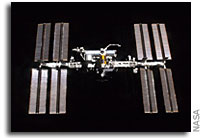
All ISS systems continue to function nominally, except those noted previously or below. Sunday – Ahead: Week 17 of Increment 26/Week 1 of Increment 27.
CDR Scott Kelly continued his current week-long activity with the post-wakeup experiment SLEEP (Sleep-Wake Actigraphy & Light Exposure during Spaceflight), Scott’s 9th session, transferring data from his Actiwatch to the HRF-1 (Human Research Facility 1) laptop. [To monitor their sleep/wake patterns and light exposure during a SLEEP session, US crewmembers wear a special Actiwatch device which measures the light levels encountered by him/her as well as their patterns of sleep and activity throughout the Expedition, using the payload software for data logging and filling in questionnaire entries in the experiment’s laptop session file on the HRF-1 laptop. The log entries are done within 15 minutes of final awakening for seven consecutive days.]
Early this morning, FE-4 Kondratyev undertook the regular daily check of the aerosol filters at the Russian Elektron O2 generator which Maxim Suraev had installed on 10/19/09 in gaps between the BZh Liquid Unit and the oxygen outlet pipe (filter FA-K) plus hydrogen outlet pipe (filter FA-V). [Dmitri will inspect the filters again before bedtime tonight, currently a daily requirement per plan, with photographs to be taken if the filter packing is discolored.]
At wake-up, FE-2 Skripochka terminated his 14th experiment session, started last night, for the long-term Russian sleep study MBI-12/Sonokard, taking the recording device from his Sonokard sports shirt pocket and later copying the measurements to the RSE-Med laptop for subsequent downlink to the ground. [Sonokard objectives are stated to (1) study the feasibility of obtaining the maximum of data through computer processing of records obtained overnight, (2) systematically record the crewmember’s physiological functions during sleep, (3) study the feasibility of obtaining real-time crew health data. Investigators believe that contactless acquisition of cardiorespiratory data over the night period could serve as a basis for developing efficient criteria for evaluating and predicting adaptive capability of human body in long-duration space flight.]
With the protective shutters of the Kibo JPM (JEM Pressurized Module), Lab and Cupola windows closed, Alex Kaleri & Oleg Skripochka prepared for Soyuz 24S undocking and deorbit next Wednesday morning by spending an hour in the TMA-01M Descent Module (SA) supporting a ground-commanded checkout of the Soyuz MCS (Motion Control System SUD, Mode 2/”Docked”) which included pressurization of the KDU (Combined Propulsion System) Section 2 and Tank 2, a test of the pilot’s rotational & translational hand controllers (RUD & RUO), and a hot firing of the DPO braking thrusters (3:53am EDT). DPO lateral thrusters were not fired. [For the RST (rasstjkovkoy/undocking) test, station attitude was handed over to Russian thruster control at 3:38am. The one-minute firing started on Daily Orbit 2 during an RGS (Russian Groundsite) pass. Attitude control was returned to the USOS (U.S. Segment) at 4:25am.]
Afterwards, Alex, Scott & Oleg spent three hours in “their” 24S Descent Module (#701) to conduct the Soyuz descent drill, a standard training exercise for every crew returning on this spacecraft. Results of the exercise, which strictly forbids any command activation (except for switching the InPU display on the Neptun-ME console), were subsequently reported to ground control at TsUP/Moscow. [The session includes a review of the pertinent ODFs (operational data files), specifically the books on Soyuz Ascent & Descent Procedures, Emergency Descents, and Off-Nominal Situations, crew responsibilities when executing the flight program, visual crew recognition of SUS (Entry Control System) failures, spacesuit procedures, etc., with special emphasis on operations with the Neptune-ME cockpit console. The training uses a Descent Simulator application (Trenasher Spusk =”descent trainer”) on the RSK1 laptop.]
FE-4 Kondratyev serviced the running experiment TEKh-22 “Identifikatsiya” (Identification) in MRM1 (Mini Research Module 1) Rassvet, downloading structural dynamic data collected by the IMU-Ts microaccelerometer during and after Shuttle departure to the RSE1 A31p laptop for subsequent downlink to the ground via OCA. [IMU-Ts is a part of the MRM1 SBI onboard measurement system, installed in PGO behind panel 104.]
Dmitri also continued the current round of monthly preventive maintenance of RS (Russian Segment) ventilation systems, today replacing the PS1 & PS2 dust collector filters in the FGB with new spares, discarding the used units and updating the IMS (Inventory Management System) with the BCR (Bar Code Reader).
Afterwards, Dmitri had ~3 hrs set aside for unloading & transferring more cargo from Progress 41P, docked at DC1 Nadir, to the ISS, with IMS updating.
In preparation for their return to gravity tomorrow night, Sasha & Oleg undertook the first part of their 5th and final exercise/training session of the Russian MO-5 MedOps protocol of cardiovascular evaluation in the below-the-waist reduced-pressure device (ODNT, US: LBNP) on the VELO bike ergometer, assisting each other as CMO (Crew Medical Officer). Medical telemetry monitoring on the ground was at 6:53am for Alex, 8:28am for Oleg. The activity was then closed out. Part 2 follows tomorrow. [The assessments, lasting one hour each, supported by ground specialist tagup (VHF) and telemetry monitoring from Russian ground sites (at 5:54am & 7:29am EDT), uses the Gamma-1 ECG equipment with biomed harness, skin electrodes and a blood pressure and rheoplethysmograph cuff wired to the cycle ergometer’s instrumentation panels. The Chibis ODNT provides gravity-simulating stress to the body’s cardiovascular/circulatory system for evaluation of the crewmembers’ orthostatic tolerance (e.g., the Gauer-Henry reflex) after several months in zero-G. The preparatory training generally consists of first imbibing 150-200 milliliters of water or juice, followed by two cycles of a sequence of progressive regimes of reduced (“negative”) pressure, set at -20, -25, -30, and -35 mmHg for five min. each, then -25, -30, and -35 mmHg (Torr) for 10 min. each plus 30mmHg for 5 min. while shifting from foot to foot at 10-12 steps per minute, while wearing a sphygmomanometer to measure blood pressure. The body’s circulatory system interprets the pressure differential between upper and lower body as a gravity-like force pulling the blood (and other liquids) down. Chibis data and biomed cardiovascular readings are recorded. The Chibis suit (not to be confused with the Russian “Pinguin” suit for spring-loaded body compression, or the “Kentavr” anti-g suit worn during reentry) is similar to the U.S. LBNP facility (not a suit) used for the first time on Skylab in 1973/74, although it appears to accomplish its purpose more quickly.]
Afterwards, Sasha completed another data collection session for the psychological MBI-16 Vzaimodejstvie (“Interactions”) program, accessing and completing the computerized study questionnaire on the RSE-Med laptop and saving the data in an encrypted file. It was his 11th run. [The software has a “mood” questionnaire, a “group & work environment” questionnaire, and a “critical incidents” log. Results from the study, which is also mirrored by ground control subjects, could help to improve the ability of future crewmembers to interact safely and effectively with each other and with Mission Control, to have a more positive experience in space during multi-cultural, long-duration missions, and to successfully accomplish mission activities.]
FE-4 conducted another ~15-min. photography session for the DZZ-13 “Seiner” ocean observation program, obtaining NIKON D3 photos with Nikkor 80-200 mm lens and the SONY HD video camcorder on oceanic color bloom patterns in the waters of the Central-Eastern Atlantic then copying the images to the RSK-1 laptop.
Later, Kondratyev used the standard ECOSFERA equipment, set up yesterday by Oleg, to inspect and evaluate the samples collected earlier for the MedOps SZM-MO-21 microbial experiment in Media 2 Petri dishes for cultivation. Afterwards, Dmitri recharged the experiment’s battery and then set up the equipment for more sampling overnight. [The equipment, consisting of an air sampler set, a charger and power supply unit, provides samples to help determine microbial contamination of the ISS atmosphere, specifically the total bacterial and fungal microflora counts and microflora composition according to morphologic criteria of microorganism colonies.]
Skripochka completed the routine daily servicing of the SOZh system (Environment Control & Life Support System, ECLSS) in the SM, including the weekly collection of the toilet flush (SP) counter and water supply (SVO) readings for calldown to TsUP-Moscow. [This includes checking the ASU toilet facilities, replacement of the KTO & KBO solid waste containers and replacement of EDV-SV waste water and EDV-U urine containers].
Oleg also downlinked, via Ku-band, the video footage recorded in the recent past of “Life on ISS” for the Roskosmos TV Channel.
Before sleep time, Alex Kaleri will prepare the Russian MBI-12 Sonokard payload and start his 13th experiment session, using a sports shirt from the Sonokard kit with a special device in the pocket for testing a new method for acquiring physiological data without using direct contact on the skin. Measurements are recorded on a data card for return to Earth. [Sonokard objectives are stated to (1) study the feasibility of obtaining the maximum of data through computer processing of records obtained overnight, (2) systematically record the crewmember’s physiological functions during sleep, (3) study the feasibility of obtaining real-time crew health data. Investigators believe that contactless acquisition of cardiorespiratory data over the night period could serve as a basis for developing efficient criteria for evaluating and predicting adaptive capability of human body in long-duration space flight.]
CDR, FE-2, FE-5 & FE-6 had their weekly PFCs (Private Family Conferences) via S-band/audio and Ku-band/MS-NetMeeting application (which displays the uplinked ground video on an SSC laptop), Oleg at ~5:30am, Paolo at ~12:20pm, Scott at ~1:50pm, Cady at ~3:25pm EDT.
The crew worked out on today’s 2-hr physical exercise protocol on the CEVIS cycle ergometer with vibration isolation (FE-6), ARED advanced resistive exercise device (CDR, FE-4, FE-5, FE-6), T2/COLBERT advanced treadmill (CDR, FE-1, FE-4, FE-6), and VELO bike ergometer with load trainer (FE-2).
CEO (Crew Earth Observation) photo targets uplinked for today was Earthquake Damage, Japan/Sendai (a magnitude 8.9 earthquake occurred on 3/11 near the east coast of the island of Honshu. The earthquake spawned a tsunami that caused additional damage and flooding)
ISS Orbit (as of this morning, 6:56am EDT [= epoch])
Mean altitude – 350.9 km
Apogee height – 355.0 km
Perigee height – 347.0 km
Period — 91.56 min.
Inclination (to Equator) — 51.65 deg
Eccentricity — 0.0006068
Solar Beta Angle — -45.1 deg (magnitude increasing)
Orbits per 24-hr. day — 15.73
Mean altitude loss in the last 24 hours — 147 m
Revolutions since FGB/Zarya launch (Nov. 98) – 70,583
Significant Events Ahead (all dates Eastern Time and subject to change):
————–Six-crew operations————-
03/16/11 — Soyuz TMA-01M/24S undock (00:27am EDT)/post-undock tests/landing (3:53am) (End of Increment 26)
03/18/11 — ATV2 Reboost (~00:05am EDT)
————–Three-crew operations————-
03/28/11 — HTV2 unberth (~12:00pm EDT)
03/29/11 — HTV2 deorbit (~12:00am EDT)
03/30/11 — Soyuz TMA-21/26S launch – A. Borisenko (CDR-28)/R.Garan/A.Samokutayev
04/01/11 — Soyuz TMA-21/26S docking
————–Six-crew operations————-
04/19/11 — STS-134/Endeavour launch ULF6 (ELC-3, AMS) ~7:48pm EDT NET
04/21/11 — STS-134/Endeavour docking (NET)
04/26/11 — Progress M-09M/41P undock
04/27/11 — Progress M-10M/42P launch
04/29/11 — Progress M-10M/42P docking (DC-1 nadir)
05/01/11 — STS-134/Endeavour undock
05/03/11 — STS-134/Endeavour landing
05/16/11 – Soyuz TMA-20/25S undock/landing (End of Increment 27)
————–Three-crew operations————-
05/30/11 — Soyuz TMA-02M/27S launch – M. Fossum (CDR-29)/S. Furukawa/S. Volkov
06/01/11 — Soyuz TMA-02M/27S docking (MRM1)
————–Six-crew operations————-
06/04/11 — ATV-2 “Johannes Kepler” undock (SM aft) – under review
06/21/11 — Progress M-11M/43P launch
06/23/11 — Progress M-11M/43P docking (SM aft)
06/28/11 — STS-135/Atlantis launch ULF7 (MPLM) — ~3:30pm EDT NET
08/29/11 — Progress M-11M/43P undocking
08/30/11 — Progress M-12M/44P launch
09/01/11 — Progress M-12M/44P docking (SM aft)
09/16/11 – Soyuz TMA-21/26S undock/landing (End of Increment 28)
————–Three-crew operations————-
09/30/11 — Soyuz TMA-03M/28S launch – D.Burbank (CDR-30)/A.Shkaplerov/A.Ivanishin
10/02/11 – Soyuz TMA-03M/28S docking (MRM2)
————–Six-crew operations————-
10/25/11 — Progress M-10M/42P undocking
10/26/11 — Progress M-13M/45P launch
10/28/11 — Progress M-13M/45P docking (DC-1)
11/16/11 — Soyuz TMA-02M/27S undock/landing (End of Increment 29)
————–Three-crew operations————-
11/30/11 — Soyuz TMA-04M/29S launch – O.Kononenko (CDR-31)/A.Kuipers/D.Pettit
12/02/11 — Soyuz TMA-04M/29S docking (MRM1)
————–Six-crew operations—————-
12/??/11 — 3R Multipurpose Laboratory Module (MLM) w/ERA – on Proton.
12/26/11 — Progress M-13M/45P undock
12/27/11 — Progress M-14M/46P launch
12/29/11 — Progress M-14M/46P docking (DC-1)
03/05/12 — Progress M-12M/44P undock
03/16/12 — Soyuz TMA-03M/28S undock/landing (End of Increment 30)
————–Three-crew operations————-
03/30/12 — Soyuz TMA-05M/30S launch – G.Padalka (CDR-32)/J.Acaba/K.Volkov
04/01/12 — Soyuz TMA-05M/30S docking (MRM2)
————–Six-crew operations—————-
05/xx/12 – 3R Russian Proton — Multipurpose Laboratory Module (MLM) w/ERA
05/16/12 — Soyuz TMA-04M/29S undock/landing (End of Increment 31)
————–Three-crew operations————-
05/29/12 – Soyuz TMA-06M/31S launch – S.Williams (CDR-33)/Y.Malenchenko/A.Hoshide
05/31/12 – Soyuz TMA-06M/31S docking
————–Six-crew operations—————-
09/18/12 — Soyuz TMA-05M/30S undock/landing (End of Increment 32)
————–Three-crew operations————-
10/02/12 — Soyuz TMA-07M/32S launch – K.Ford (CDR-34)/O.Novitskiy/E.Tarelkin
10/04/12 – Soyuz TMA-07M/32S docking
————–Six-crew operations————-
11/16/12 — Soyuz TMA-06M/31S undock/landing (End of Increment 33)
————–Three-crew operations————-
11/30/12 — Soyuz TMA-08M/33S launch – C.Hadfield (CDR-35)/T.Mashburn/R.Romanenko
12/02/12 – Soyuz TMA-08M/33S docking
————–Six-crew operations————-
03/xx/13 — Soyuz TMA-07M/32S undock/landing (End of Increment 34)
————–Three-crew operations————-
03/xx/13 – Soyuz TMA-09M/34S launch – P.Vinogradov (CDR-36)/C.Cassidy/A.Misurkin
03/xx/13 – Soyuz TMA-09M/34S docking
————–Six-crew operations————-
05/xx/13 – Soyuz TMA-08M/33S undock/landing (End of Increment 35)
————–Three-crew operations————-
05/xx/13 – Soyuz TMA-10M/35S launch – M.Suraev (CDR-37)/K.Nyberg/L.Parmitano
05/xx/13 – Soyuz TMA-10M/35S docking
————–Six-crew operations————-
09/xx/13 – Soyuz TMA-09M/34S undock/landing (End of Increment 36)
————–Three-crew operations————-
09/xx/13 – Soyuz TMA-11M/36S launch – M.Hopkins/TBD (CDR-38)/TBD
09/xx/13 – Soyuz TMA-11M/36S docking
————–Six-crew operations————-
11/xx/13 – Soyuz TMA-10M/35S undock/landing (End of Increment 37)
————–Three-crew operations————-
11/xx/13 – Soyuz TMA-12M/37S launch – K.Wakata (CDR-39)/R.Mastracchio/TBD
11/xx/13 – Soyuz TMA-12M/37S docking
————–Six-crew operations————-
03/xx/14 – Soyuz TMA-11M/36S undock/landing (End of Increment 38)
————–Three-crew operations————



