NASA ISS On-Orbit Status 6 January 2011
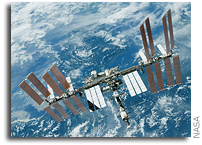
All ISS systems continue to function nominally, except those noted previously or below.
FE-2 Skripochka conducted the regular daily early-morning check of the aerosol filters at the Russian Elektron O2 (oxygen) generator, installed (by Maxim Suraev on 10/19/09) in gaps between the BZh Liquid Unit and the oxygen outlet pipe (filter FA-K) plus hydrogen outlet pipe (filter FA-V). [Oleg will inspect the filters again before bedtime tonight, currently a daily requirement per plan, with photographs to be taken if the filter packing is discolored.]
At wake-up, CDR Scott Kelly, FE-5 Paolo Nespoli & FE-6 Cady Coleman completed their 5th post-sleep shift session of the Reaction Self Test (Psychomotor Vigilance Self Test on the ISS) protocol. [RST is done twice daily (after wakeup & before bedtime) for 3 days prior to the sleep shift, the day(s) of the sleep shift and 5 days following a sleep shift. The experiment consists of a 5-minute reaction time task that allows crewmembers to monitor the daily effects of fatigue on performance while on ISS. The experiment provides objective feedback on neurobehavioral changes in attention, psychomotor speed, state stability, and impulsivity while on ISS missions, particularly as they relate to changes in circadian rhythms, sleep restrictions, and extended work shifts.]
Kelly also continued his current week-long regimen with the post-wakeup experiment SLEEP (Sleep-Wake Actigraphy & Light Exposure during Spaceflight), Scott’s 5th session, transferring data from his Actiwatch to the HRF-1 (Human Research Facility 1) laptop. [To monitor their sleep/wake patterns and light exposure during a SLEEP session, US crewmembers wear a special Actiwatch device which measures the light levels encountered by him/her as well as their patterns of sleep and activity throughout the Expedition, using the payload software for data logging and filling in questionnaire entries in the experiment’s laptop session file on the HRF-1 laptop. The log entries are done within 15 minutes of final awakening for seven consecutive days.]
FE-5 Nespoli had Day 4 of his 2nd suite of sessions with the medical protocol Pro K (Dietary Intake Can Predict & Protect against Changes in Bone Metabolism during Spaceflight & Recovery), with diet logging after the urine pH spot test, for a 5-day period. No special diet intact required. [For Pro K, there will be five in-flight sessions (FD15, FD30, FD60, FD120, FD180) of samplings, to be shared with the NUTRITION w/Repository protocol, each one with five days of diet & urine pH logging and photography on the last day. The crewmember prepares a diet log and then annotates quantities of food packets consumed and supplements taken. Urine collections are spread over 24 hrs; samples go into the MELFI (Minus Eighty Laboratory Freezer for ISS) within 30 min after collection. Blood samples, on the last day, are centrifuged in the RC (Refrigerated Centrifuge) and placed in MELFI at -80 degC. There is an 8-hr fasting requirement prior to the blood draw (i.e., no food or drink, but water ingestion is encouraged). MELFI constraints: Maximum MELFI dewar open time: 60 sec; at least 45 min between MELFI dewar door openings.]
Beginning this morning and continuing for the next 24 hrs, Nespoli is also collecting his 2nd NUTRITION/Repository/Pro K urine samples for deposit in MELFI. Later in the day, Paolo set up the blood draw equipment, to be used tomorrow for his first phlebotomy. [The operational products for blood & urine collections for the HRP (Human Research Program) payloads were revised some time ago, based on crew feedback, new cold stowage hardware, and IPV capabilities. Generic blood & urine procedures have been created to allow an individual crewmember to select their payload complement and see specific requirements populated. Individual crewmembers will select their specific parameter in the procedures to reflect their science complement. Different crewmembers will have different required tubes and hardware configurations, so they must verify their choice selection before continuing with operations to ensure their specific instruction.]
At wake-up, FE-2 Skripochka terminated his 8th experiment session, started last night, for the long-term Russian sleep study MBI-12/Sonokard, taking the recording device from his Sonokard sports shirt pocket and later copying the measurements to the RSE-Med laptop for subsequent downlink to the ground. [Sonokard objectives are stated to (1) study the feasibility of obtaining the maximum of data through computer processing of records obtained overnight, (2) systematically record the crewmember’s physiological functions during sleep, (3) study the feasibility of obtaining real-time crew health data. Investigators believe that contactless acquisition of cardiorespiratory data over the night period could serve as a basis for developing efficient criteria for evaluating and predicting adaptive capability of human body in long-duration space flight.]
FE-6 Coleman undertook her first Ambulatory Monitoring session of the ESA ICV (Integrated Cardiovascular) experiment with exercise (on CEVIS), assisted by Paolo as CMO (Crew Medical Officer) in preparing the Actiwatches, electrode sites, attaching the harness, donning the Cardiopres, and taking documentary pictures. [ICV activities consist of two separate but related parts over a one-week time period: an ultrasound echo scan & an ambulatory monitoring session. Today, wearing electrodes, the HM2 (Holter Monitor 2) for recording ECG (Electrocardiogram) for 48 hours, the ESA Cardiopres to continuously monitor blood pressure for 24 hours, and two Actiwatches (hip/waist & ankle) for monitoring activity levels over 48 hours, Cady started the ambulatory monitoring part of the ICV assessment. During the first 24 hrs (while all devices are worn), ten minutes of quiet, resting breathing are timelined to collect data for a specific analysis. The nominal exercise, preferably on the CEVIS cycle ergometer, includes at least 10 minutes at a heart rate >=120 bpm (beats per minute). After 24 hrs, the Cardiopres is doffed and the HM2 HiFi CF Card and AA Battery are changed out to allow continuation of the session for another 24 hours. After data collection is complete, the Actiwatches and both HM2 HiFi CF Cards are downloaded to the HRF PC1, while Cardiopres data are downloaded to the EPM (European Physiology Module) Rack and transferred to the HRF PC1 via a USB key for downlink. The sessions are scheduled at or around FD14, FD30, FD75, FD135 and R-15 (there will be fewer sessions if mission duration is less than six months). The FD75 echo scan includes an exercise component with a second scan (subset of the first) completed within 5 minutes after the end of exercise.]
After configuring the STTS communications system for working in the MRM2 “Poisk” module, Alex Kaleri conducted a tagup with ground specialists and then began installation and preparation for operating the new KPT-21 PK-3+ Plasma Crystal-3+ (Plazmennyi-Kristall-3 plus) Telescience payload, the first time for Expedition 26. Afterwards, the CDR conducted a leak check on the EB vacuum chamber and later returned the STTS comm system to nominal. [The PK-3+ hardware comprises the EB (Eksperimental’nyj Blok) Experiment Module with a turbopump for evacuation, Ts laptop, video monitor, vacuum hoses, electrical circuitry, four hard storage disks for video, and one USB stick with the control application. After setting up the hardware in MRM2 (it used to be run in the SM/Service Module), Alexander today configured vacuum and electrical connections, installed external hard drives and conducted a leak check on the electronics box. The experiment is performed on plasma, i.e., fine particles charged and excited by HF (high frequency) radio power inside the evacuated work chamber. Main objective is to obtain a homogeneous plasma dust cloud at various pressures and particle quantities with or without superimposition of an LF (low frequency) harmonic electrical field. The experiment is conducted in automated mode. PK-3+ has more advanced hardware and software than the previously used Russian PKE-Nefedov payload.]
Activities completed by Scott Kelly included C
* The periodic (monthly) battery check and reboot of all active US PCS (Portable Computer System) laptops in Lab, A/L (Airlock), CUP (Node-3 Cupola), SM and of the COL PWS (Columbus Orbital Laboratory Portable Workstation) laptops, recording the battery state of charge of each of them,
* Filling out his weekly FFQ (Food Frequency Questionnaire) on the MEC (Medical Equipment Computer); [on the FFQs, NASA astronauts keep a personalized log of their nutritional intake over time on special MEC software. Recorded are the amounts consumed during the past week of such food items as beverages, cereals, grains, eggs, breads, snacks, sweets, fruit, beans, soup, vegetables, dairy, fish, meat, chicken, sauces & spreads, and vitamins. The FFQ is performed once a week to estimate nutrient intake from the previous week and to give recommendations to ground specialists that help maintain optimal crew health. Weekly estimation has been verified to be reliable enough that nutrients do not need to be tracked daily],
* Reconnecting the WHC (Waste & Hygiene Compartment) from backflow back to feeding the UPA (Urine Processor Assembly), then reporting the flush counter value, a periodic activity, and
* Supporting the BCAT-5 (Binary Colloidal Alloy Test-5) payload in the Kibo JPM (JEM Pressurized Module) by performing the periodic camera setup status check on the running BCAT-5 with Sample 10, without SSC (Station Support Computer); [the checkup includes image transfer, camera battery and camera/flash position. It is currently scheduled every other day after Initiation+1 day during automated photography. Pictures are being taken automatically of Sample 10 for 14 days (started on 12/30)].
CDR Kelly also conducted another weekly 10-min. CWC (Contingency Water Container) inventory as part of the on-going WRM (Water Recovery & Management) assessment of onboard water supplies. Updated “cue cards” based on the crew’s water calldowns are sent up every other week for recording changes. [The current card (26-0045B) lists 123 CWCs (2,589.2 L total) for the five types of water identified on board: 1. technical water (27 CWCs with 1061.5 L, for Elektron electrolysis, incl. 604.2 L in 16 bags containing Wautersia bacteria, 134.2 L in 3 clean bags for contingency use, 300.1 L in 7 bags for flushing only with microbial filter, and 23.0 L in 1 bag for flushing only; 2. potable water (no CWCs); 3. iodinated water (85 CWCs with 1,501.2 L for reserve; 4. condensate water (6.3 L in 1 bag to be used only for OGA, plus 7 empty bags); and 5. waste/EMU dump and other (20.2 L in 1 CWC from hose/pump flush & 1 empty bag). Wautersia bacteria are typical water-borne microorganisms that have been seen previously in ISS water sources. These isolates pose no threat to human health.]
Kaleri & Kondratyev continued the current round of the monthly preventive maintenance of RS (Russian Segment) ventilation systems. [In the MRM1 Rassvet module, Alex replaced the SKPF1 & SKPF2 dust filter cartridges, then cleaned Group B filters & the GZhT heat exchanger grille. Dmitri worked in the SM, cleaning the SOTR Thermal Control System’s VV1RO & VV2RO fan screens and Group C ventilators, then moved to the FGB to clean ventilation screens on interior panels and the TsV1 fan grille.]
Nespoli & Coleman had ~30 min for the standard Shuttle RPM (R-bar Pitch Maneuver) onboard familiarization training, their first, using a NIKON D2Xs digital still camera with 400mm & 800mm lenses and taking practice shots of CEO (Crew Earth Observation) ground features from SM windows #6 or #8, with images having 40-50% overlap and about 20 images in each sequence. [The RPM drill prepares crewmembers for the bottom-side mapping of the Orbiter at the arrival of the next Shuttle (STS-133/Discovery/ULF5), to be launched NET 2/3/11. During the RPM at ~600 ft from the station, the “shooters” have only ~90 seconds for taking high-resolution digital photographs of all tile areas and door seals on Discovery, to be downlinked for launch debris assessment. Thus, time available for the shooting will be very limited, requiring great coordination between the two headset-equipped photographers and the Shuttle pilot.]
Paolo set up the CANON G1 video camcorder at the earth-facing Cupola window #5 to support ESA in recording more footage of the overflown Earth surface.
FE-5 also downloaded and saved the ECG (Electrocardiograph) data recorded for the last 24 hrs from his first session (of 3 total) with the JAXA biomedical experiment BIORHYTHMS and its body-worn digital Walk Holter ECG (Electrocardiograph), started yesterday.
Dmitri had ~40 min set aside to familiarize himself with RS computers, both the Ethernet/LAN-connected laptops and the auxiliary system laptops (VKS), using RODF (Russian Operations Data Files) as reference.
Oleg completed his 4th session with the Russian behavioral assessment TIPOLOGIA (MBI-20), setting up the workstation, connecting equipment, suiting up and launching the program on the RSK1 laptop. [Dmitri assisted in donning the electrode cap, preparing the head for the electrodes, applying electrode gel from the Neurolab-RM2 kit and taking documentary photography. Data were recorded on a PCMCIA memory card and downlinked via OCA comm. MBI-20 studies typological features of operator activity of the ISS crews in long-term space flight phases, with the subject using a cap with EEG (electroencephalogram) electrodes. The experiment, which records EEGs, consists of the Luescher test, “adaptive biological control” training, and the games Minesweeper and Tetris. The Luescher color diagnostic is a psychological test which measures a person’s psychophysical state, his/her ability to withstand stress, to perform and to communicate. It is believed to help uncover the cause of psychological stress, which can lead to physical symptoms. An EEG measures and records the electrical activity of the brain.]
Kaleri performed the periodic data dump from the BRI (SSR/Smart Switch Router) control log to the RSS1 laptop for downlink to the ground via OCA.
Later, Sasha completed the regular inspection of the replaceable half-coupling of the 4GB4 hydraulic unit of the KOB-2 (Loop 2) of the Russian SOTR Thermal Control System, checking for coolant fluid hermeticity (leak-tightness).
After enabling the Cupola RWS UOP (Robotic Workstation / Utility Outlet Panel) for power-up in Node-3, Scott Kelly installed the CCR (Cupola Crew Restraint) and checked out both Lab & Cupola RWSs as part of the subsequent regular SSRMS (Space Station Remote Manipulator System) prelaunch checkout.
Scott, Cady & Paolo then reviewed the new POC DOUG (Portable Onboard Computer / Dynamic Onboard Ubiquitous Graphics) software for upcoming SSRMS ops and the necessary setup of DOUG to receive telemetry from the robotarm during the ops.
Afterwards, the three crewmembers had another 30-min session with the SSRMS to hone their proficiency, taking the SSRMS through a practice maneuver (misaligned grapple approach) in preparation for HTV2 approach & berthing. Coleman then disabled the CUP UOP, and Scott removed the CCR.
Kondratyev & Kaleri completed another data collection session for the psychological MBI-16 Vzaimodejstvie (“Interactions”) program, accessing and completing the computerized study questionnaire on the RSE-Med laptop and saving the data in an encrypted file. It was Dima’s 2nd, Sasha’s 6th run. [The software has a “mood” questionnaire, a “group & work environment” questionnaire, and a “critical incidents” log. Results from the study, which is also mirrored by ground control subjects, could help to improve the ability of future crewmembers to interact safely and effectively with each other and with Mission Control, to have a more positive experience in space during multi-cultural, long-duration missions, and to successfully accomplish mission activities.]
Skripochka had ~1h reserved for conducting the periodic electrical plug-in audit in the RS, i.e. SM, FGB, DC1 (Docking Compartment), MRM1, MRM2, plus PPS-31 & PPS-26 panels in SM, logging the specific hardware/equipment currently plugged in each power outlet. [Using an uplinked tracking list, FE-2 compared the onboard situation (panel locations, power outlet designations, users, operating mode, nominal current load) against listed plug-in data, updated the listing where necessary and prepared the file for downlink via OCA.]
Oleg also did the daily IMS (Inventory Management System) maintenance, updating/editing its standard “delta file” including stowage locations, for the regular weekly automated export/import to its three databases on the ground (Houston, Moscow, Baikonur).
FE-4 meanwhile completed the routine daily servicing of the SOZh system (Environment Control & Life Support System, ECLSS) in the SM. [Regular daily SOZh maintenance consists, among else, of checking the ASU toilet facilities, replacement of the KTO & KBO solid waste containers and replacement of EDV-SV waste water and EDV-U urine containers.]
The CDR performed two troubleshooting activities on the ARED exercise device. [First, collecting some data points to help determine the root cause why the ARED detents are not engaging. Second, rotating the detent plate 180 deg so that the detent balls stop gouging out the same spot on the plate.]
At ~3:15am EST, Sasha & Oleg linked up with TsUP/Moscow stowage specialists via S-band to conduct the weekly IMS tagup, discussing inventory & stowage issues, equipment locations and cargo transfers.
At ~7:05am, Nespoli conducted a tagup with the ESA staff at Col-CC at Oberpfaffenhofen/Germany. [This conference is scheduled once every week, between ISS crewmembers and Col-CC via S/G2 (Space-to-Ground 2) audio.]
At ~11:00am, Scott, Cady & Paolo supported a PAO TV event, responding to questions in an interview with KSAZ-TV, Phoenix, AZ (John Hook).
At ~11:50am, Kelly, Nespoli & Coleman held the periodic Payload/Crew Conference, to discuss the onboard science program ahead. [Represented on the ground were IPM (Increment Payload Manager) Anita Weaver, LIS (Lead Increment Scientist) Jorge Sotomayor, PE (Payload Engineer Matt Metzinger, POM (Payload Operations Manager) Lamar Stacy, APOM (Assistant Payload Operations Manager) Emily Willis, LIS (Lead Increment Scientist) Rep Chris Loyd, Gina Calderon and Cindy Romero, Lead PPM (Payload Planning Manager) Jim Watson.]
At ~1:25pm, Scott had his regular IMS stowage conference with Houston stowage specialists.
The crewmembers worked out with their regular 2-hr physical exercise on the CEVIS cycle ergometer with vibration isolation (FE-5, FE-6), TVIS treadmill (FE-1, FE-2, FE-4), ARED advanced resistive exerciser (CDR, FE-4, FE-5, FE-6), T2/COLBERT advanced treadmill (CDR), and VELO ergometer bike with bungee cord load trainer (FE-1, FE-2). [T2 snubber arm inspection is no longer needed after every T2 session but must be done after the last T2 session of the day.]
CEO (Crew Earth Observation) targets uploaded today were Bosumtwi Impact Crater, Ghana (requested was this target because this is the rare time of year where clouds are minimal. CEO staff has few images of this impact crater and anything ISS can add would greatly enhance the CEO database. The crater is a little hard to locate because of its proximity to a much larger and more visually attractive target, Lake Volta. This impact crater is located about 150 km west of the south end of Lake Volta in south central Ghana. It is a very young impact [just over a million years old], about 10.5 km in diameter, and almost completely filled by a lake. Looking slightly right of track for a circular lake just southeast of the urban area of Kumasi. Overlapping frames were requested), Russia, Mongolia, China, Korea (highlighting this night orbit pass, looking to the right for the cities of Pyongyang, North Korea and Seoul, South Korea), Kazakhstan, Mongolia, Myanmar (city at night highlights for this orbit track include Tashkent, Uzbekistan, Bishkek, Kyrgyzstan [before ISS passed over the Himalayas], Thimphu, Bhutan, and Naypidaw, Myanmar), and Australia (clouds made this a short night pass through the interior of Australia. To the right of track the crew may have been able to see Adelaide along the southern coast, along with Melbourne, also along the southern coast).
ISS Orbit (as of this noon, 8:09am EST [= epoch])
Mean altitude C 351.6 km
Apogee height C 355.2 km
Perigee height C 348.0 km
Period — 91.57 min.
Inclination (to Equator) — 51.65 deg
Eccentricity — 0.0005322
Solar Beta Angle — -27.0 deg (magnitude increasing)
Orbits per 24-hr. day — 15.72
Mean altitude loss in the last 24 hours C 64 m
Revolutions since FGB/Zarya launch (Nov. 98) C 69,546.
Significant Events Ahead (all dates Eastern Time and subject to change):
————–Six-crew operations————-
01/13/11 — ISS Reboost Pt. 2
01/20/11 — HTV2 launch
01/21/11 — Russian EVA-27
01/24/11 — Progress M-08M/40P undock
01/27/11 — HTV2 berthing (Node-2 zenith)
01/28/11 — Progress M-09M/41P launch
01/31/11 — Progress M-09M/41P docking (DC1)
02/03/11 — STS-133/Discovery launch C 1:37:36 am EST
02/04/11 — STS-133/Discovery docking C ~9:43pm
02/11/11 — STS-133/Discovery undock C 4:42pm
02/13/11 — STS-133/Discovery land (KSC) C ~8:41pm
02/21/11 — Russian EVA-28
02/15/11 — ATV-2 “Johannes Kepler” launch
02/19/11 — Progress M-07M/39P undock
02/24/11 — HTV2 unberthing (Node-2 nadir)
02/26/11 — ATV-2 “Johannes Kepler” docking (SM aft)
03/16/11 — Soyuz TMA-01M/24S undock/landing (End of Increment 26)
————–Three-crew operations————-
03/20/11 — Soyuz TMA-21/26S launch C A. Borisienko (CDR-28)/R.Garan/A.Samokutayev
03/22/11 — Soyuz TMA-21/26S docking (MRM2)
————–Six-crew operations————-
04/01/11 — STS-134/Endeavour (ULF6 C ELC3, AMS-02) launch C ~3:15am — NET
04/26/11 — Progress M-09M/41P undock
04/27/11 — Progress M-10M/42P launch
04/29/11 — Progress M-10M/42P docking (DC1)
05/xx/11 — Russian EVA-29
05/16/11 — Soyuz TMA-20/25S undock/landing (End of Increment 27)
————–Three-crew operations————-
05/30/11 — Soyuz TMA-22/27S launch C M. Fossum (CDR-29)/S. Furukawa/S. Volkov
06/01/11 — Soyuz TMA-22/27S docking (MRM1)
————–Six-crew operations————-
06/04/11 — ATV-2 “Johannes Kepler” undock (SM aft)
06/21/11 — Progress M-11M/43P launch
06/23/11 — Progress M-11M/43P docking (SM aft)
08/29/11 — Progress M-11M/43P undocking
08/30/11 — Progress M-12M/44P launch
09/01/11 — Progress M-12M/44P docking (SM aft)
09/16/11 C Soyuz TMA-21/26S undock/landing (End of Increment 28)
————–Three-crew operations————-
09/30/11 — Soyuz TMA-23/28S launch C D.Burbank (CDR-30)/A.Shkaplerov/A.Ivanishin
10/02/11 C Soyuz TMA-23/28S docking (MRM2)
————–Six-crew operations————-
10/25/11 — Progress M-10M/42P undocking
10/26/11 — Progress M-13M/45P launch
10/28/11 — Progress M-13M/45P docking (DC-1)
11/16/11 — Soyuz TMA-22/27S undock/landing (End of Increment 29)
————–Three-crew operations————-
11/30/11 — Soyuz TMA-24/29S launch C O.Kononenko (CDR-31)/A.Kuipers/D.Pettit
12/02/11 — Soyuz TMA-24/29S docking (MRM1)
————–Six-crew operations—————-
12/??/11 — 3R Multipurpose Laboratory Module (MLM) w/ERA C on Proton.
12/26/11 — Progress M-13M/45P undock
12/27/11 — Progress M-14M/46P launch
12/29/11 — Progress M-14M/46P docking (DC-1)
03/05/12 — Progress M-12M/44P undock
03/16/12 — Soyuz TMA-23/28S undock/landing (End of Increment 30)
————–Three-crew operations————-
03/30/12 — Soyuz TMA-25/30S launch C G.Padalka (CDR-32)/J.Acaba/K.Valkov
04/01/12 — Soyuz TMA-25/30S docking (MRM2)
————–Six-crew operations—————-
05/15/12 — Soyuz TMA-24/29S undock/landing (End of Increment 31)
————–Three-crew operations————-
05/29/12 C Soyuz TMA-26/31S launch C S.Williams (CDR-33)/Y.Malenchenko/A.Hoshide
05/31/12 C Soyuz TMA-26/31S docking
————–Six-crew operations—————-
09/09/12 — Soyuz TMA-25/30S undock/landing (End of Increment 32)
————–Three-crew operations————-
09/23/12 — Soyuz TMA-27/32S launch C K.Ford (CDR-34)/O. Novitskiy/E.Tarelkin
09/25/12 C Soyuz TMA-27/32S docking
————–Six-crew operations————-
10/07/12 — Soyuz TMA-26/31S undock/landing (End of Increment 33)
————–Three-crew operations————-
11/xx/12 — Soyuz TMA-28/33S launch C C.Hadfield (CDR-35)/T.Mashburn/R.Romanenko
11/xx/12 C Soyuz TMA-28/33S docking
————–Six-crew operations————-
03/xx/12 — Soyuz TMA-27/32S undock/landing (End of Increment 34)
————–Three-crew operations————-
03/xx/12 C Soyuz TMA-29/34S launch.
03/xx/12 C Soyuz TMA-29/34S docking
————–Six-crew operations————-