
NASA Mars Exploration Rover Update: Opportunity Finds More Evidence of Ancient Water – sol 1463-1470, March 5-13, 2008
OPPORTUNITY UPDATE: Opportunity Finds More Evidence of Ancient Water – sol 1463-1470, March 5-13, 2008:
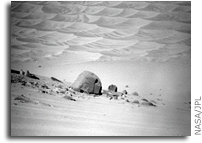
Opportunity has completed scientific studies of the undisturbed surface of a rock target informally named “Dorsal” in the “Gilbert” rock layer inside “Victoria Crater.” Dorsal is a protruding fin of rock created by minerals deposited in cracks that remained in place long after the original rock eroded away because they were more resistant to weathering.
Data collected with the Moessbauer and alpha-particle X-ray spectrometers show that the fins in Gilbert contain large quantities of the mineral hematite. This iron-bearing mineral is also abundant in the frequently occurring, round concretions known as “blueberries” that are believed to have formed in water. Scientists have been looking for such pristine fins ever since Opportunity first noticed them back in “Eagle Crater,” where the rover landed more than four years ago.
Next, Opportunity will grind into the rock surface at a point informally named “Gilbert_A” to measure the chemical composition of the rock’s interior using the alpha-particle X-ray spectrometer. Along the way, the rover has been getting close-up views of the fin with the microscopic imager.
Sol-by-sol summary:
In addition to receiving instructions directly from Earth via the rover’s high-gain antenna, relaying data to Earth via the UHF antenna on the Mars Odyssey orbiter, and measuring atmospheric dust with the panoramic camera, Opportunity completed the following activities:
Sol 1463 (March 5, 2008): Opportunity ran diagnostic tests of the robotic arm and acquired a 1-by-1-by-5 stack of microscopic images, with some extras thrown in for good measure, of Dorsal. The rover placed the Moessbauer spectrometer on a specific target informally named “Dorsal Tail” and spent about 10 hours collecting data with the instrument. Opportunity began work on a super-resolution mosaic of images of the rim of Victoria Crater known as the “rimshot panorama,” acquiring part 1 of the mosaic using the panoramic camera. The rover acquired full-color images, using all 13 filters of the panoramic camera, of a cobble nicknamed “Jin” on the slope above the rover.
Sol 1464: Opportunity restarted the Moessbauer spectrometer and continued its investigation of Dorsal Tail. The rover acquired images with the navigation camera as well as part 2 of the super-resolution rimshot panorama, which will encompass the crater rim from “Cape Verde” to “Cabo Frio.” Opportunity participated in a UHF relay of data with the Mars Reconnaissance Orbiter as part of a panoramic-camera data compression test. The rover monitored dust on the panoramic-camera mast assembly and took super-resolution images of a rock target informally named “Lyell Oxford.”
Sol 1465: Opportunity restarted the Moessbauer spectrometer for continued investigation of Dorsal Tail and acquired part 3 of the rimshot pan. Opportunity participated in another UHF relay with the Mars Reconnaissance Orbiter to test compression of panoramic camera data. The rover measured argon gas in the Martian atmosphere with the alpha-particle X-ray spectrometer and used the panoramic camera to survey the horizon and take spot images of the sky for calibration purposes.
Sol 1466: Opportunity restarted the Moessbauer spectrometer and continued work on Dorsal Tail. The rover acquired full-color frames, using all 13 filters of the panoramic camera, of a disturbed slope.
Sol 1467: Opportunity restarted the Moessbauer spectrometer and continued its investigation of Dorsal Tail. The rover completed work on part 4 of the super-resolution rimshot pan.
Sol 1468: Opportunity acquired a 1-by-1-by-3 stack of microscopic images of Dorsal Tail and a 1-by-1-by-3 stack of microscopic images of a rock exposure nicknamed “Dorsal New.” The rover placed the Moessbauer spectrometer on Dorsal New, took calibration images known as “sky flats” with the navigation camera, and acquired part 5 of the super- resolution rimshot panorama. Opportunity acquired data with the Moessbauer spectrometer and acquired part 6 of the super-resolution rimshot panorama.
Sol 1469: Opportunity restarted the Moessbauer spectrometer and began to investigate Dorsal Tail with the instrument. The rover acquired parts 7 and 8 of the rimshot panorama.
Sol 1470 (March 13, 2008): Opportunity restarted the Moessbauer spectrometer and resumed studies of Dorsal Tail with the instrument. The rover acquired part 9 of the rimshot panorama and also used the panoramic camera to take spot images and thumbnail images of the sky.
Odometry:
As of sol 1469 (March 12, 2008), Opportunity’s total odometry was 11,671.23 meters (7.25 miles).



