A series of tiny satellites equipped with an array of sensors will take a jarring ride above the California desert on a small rocket June 15 and tell designers whether they are on track to launch into orbit next year.
What if Neil Armstrong had an iPhone...
From typhone.nl: Nowadays a smartphone is way more technically advanced than the Saturn V rocket and the Lunar module combined. That same impressive trip to the moon now would probably look a whole lot different:
Smartphone Photos From Orbit
These images of Earth were reconstructed from photos taken by three smartphones in orbit, or "PhoneSats." The trio of PhoneSats launched on April 21, 2013, aboard the Antares rocket from NASA's Wallops Flight Facility and ended a successful mission on April 27. The ultimate goal of the PhoneSat mission was to determine whether a consumer-grade smartphone can be used as the main flight avionics for a satellite in space.
New Details and Photos of NASA's Three Smartphone Satellites
Three smartphones destined to become low-cost satellites rode to space Sunday aboard the maiden flight of Orbital Science Corp.'s Antares rocket from NASA's Wallops Island Flight Facility in Virginia. has been provided with new details and images.
X PRIZE Foundation Opens Team Pre-Registration for $2.25 Million Nokia Sensing
 The X PRIZE Foundation and Nokia today announced that team pre-registration is open for the $2.25 million Nokia Sensing X CHALLENGE. The competition will incentivize breakthroughs in sensor hardware and software that provide a new means of detecting and diagnosing disease and providing data that supports both wellbeing and any health issues. Teams may include individuals or groups from companies at any stage of development or funding; academic institutions; existing small/medium- sized companies; and non-profit organizations.
Video: Robonaut-1: Opening The Payload Bay Post Mission
Co-sponsored by the Challenger Center for Space Science Education, this mission is one in a series of flights conducted by Quest for Stars, a California-based non-profit educational organization that uses off-the-shelf hardware and a little ingenuity to allow students to place experiments at the edge of space at exceptionally low cost. More information
First Images of Shuttle Launch As Seen From a Balloon at More than 70,000 Feet
 This photo was taken from an an altitude of over 70,000 feet (still being determined exactly) at 5:20 pm EST on 24 February 2011. The camera used was the lowest resolution camera on board the Robonaut-1 balloon - a Motorola Droid X smartphone. You can see the plume left by Space Shuttle Discovery as it headed into space. We will be releasing more images of greater resolution and HD video very soon. Co-sponsored by the Challenger Center for Space Science Education, this mission is one in a series of flights conducted by Quest for Stars, a California-based non-profit educational organization that uses off-the-shelf hardware and a little ingenuity to allow students to place experiments at the edge of space at exceptionally low cost.More information
Chasing Space Shuttle Discovery At The Edge of Space
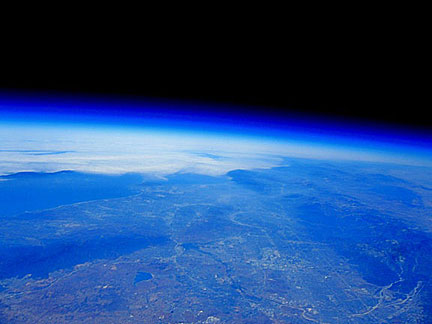
 Robonaut-1 Balloon Mission Live Video and Mission Updates
"If all goes according to plan a balloon with a student-oriented payload will photograph Space Shuttle Discovery as it climbs into space from an altitude of 100,000 feet. There will also be live streaming video from the balloon itself during the mission - sent back by two regular smartphones running Google's Android operating system. Co-sponsored by the Challenger Center for Space Science Education, this mission is one in a series of flights conducted by Quest for Stars, a California-based non-profit educational organization that uses off-the-shelf hardware and a little ingenuity to allow students to place experiments at the edge of space at exceptionally low cost. Quest for Stars and the Challenger Center for Space Science Education have now joined together to promote the use of these low cost delivery systems. This mission will be the first of what is hoped to be many future collaborations." More information
Google Nexus S phone reaches 100,000 feet via weather balloon
"Seven styrofoam beer coolers sit lined up behind the open hatchback of an SUV, parked next to a soccer field in California's rural Central valley. Each box contains a black Google Nexus S phone, mounted with their cameras facing out through a clear plastic cut-out in the side. Some of the boxes/phones have consumer-grade wide-angle sport video cameras mounted on the outside, odd bits of custom-soldered circuitry poke out of others." More at New Scientist
Now You Can See and Record Your Own Exploration - Just Like SciFi Astronauts
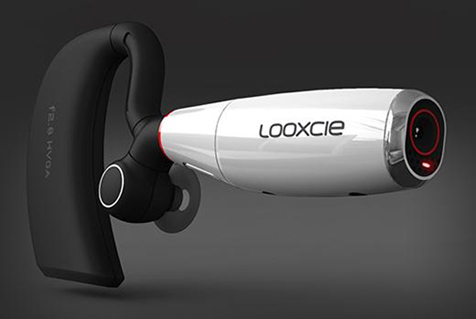
You've seen these things in SciFI films for years - "Aliens", "Avatar", "Star Trek" and so on. Headsets that let you communicate and record everything around you - hands free. Now you can buy one that works with your iPhone/iPad or Android device. Imagine equipping NASA Away Teams in the field or astronauts in space with these devices and allowing all of us back home to literally peer over their shoulders as they work and live in space and exotic research locations on our own planet.
NASA And Gowalla Launch Partnership With Search For Moon Rocks
 NASA and Gowalla, a mobile and web service, have partnered to bring users one small step closer to the universe. The partnership populates Gowalla with NASA-related information and four virtual items -- moon rocks, a NASA patch, a spacesuit and a space shuttle -- that can be found at agency-related venues.
"NASA's partnership with Gowalla is a creative way for us to reach out and share information about what the nation's space agency is doing," said Bob Jacobs, NASA's deputy associate administrator for communications at NASA Headquarters in Washington.
Gowalla users who virtually "check-in" at NASA-related venues and places of discovery via their smart phone have a chance to find the four agency virtual items which can be swapped for other items, dropped in locations or kept in their vault. Anyone with a Gowalla account who collects three of the four items will receive a special pin in their Gowalla Passport. In addition, the first 100 people to collect three items will win the special edition NASA+Gowalla Map: Search for the Moon Rocks by JESS3, a creative agency that specializes in data visualization.
A Medical Tricorder Using an Android Phone
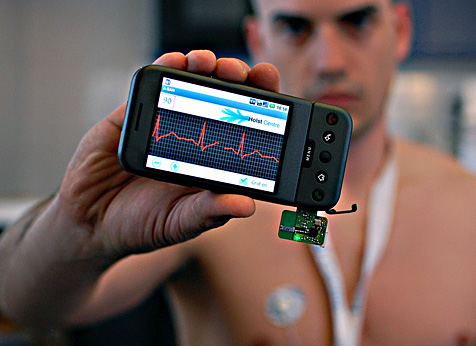
Image: ECG signals wirelessly transmitted to an Android mobile phone via a low-power interface. Click on the picture to download the high-res version.
Imec and Holst Centre, together with TASS software professionals have developed a mobile heart monitoring system that allows to view your electrocardiogram on an Android mobile phone. The innovation is a low-power interface that transmits signals from a wireless ECG (electrocardiogram or heart monitoring)-sensor system to an android mobile phone. With this interface, imec, Holst Centre and TASS are the first to demonstrate a complete Body Area Network (BAN) connected to a mobile phone enabling reliable long-term ambulatory monitoring of various health parameters such as cardiac performance (ECG), brain activity (EEG), muscle activity (EMG), etc. The system will be demonstrated at the Wireless Health Conference in San Diego (US, October 5-7).
More (video) below
NASA Ames Makes Payloads Out of Phones and Toys
 Cheaper, Better Satellites Made From Cellphones and Toys, Wired
"Instead of investing in their own computer research and development, engineers at the NASA Ames Research Center are looking to cellphones and off-the-shelf toys to power the future of low-cost satellite technology. The smartphone in your pocket has about 120 times more computing power than the average satellite, which has the equivalent of a 1984-era computer inside. "You can go to Walmart and buy toys that work better than satellites did 20 years ago," said NASA physicist Chris Boshuizen. "And your cellphone is really a $500 robot in your pocket that can't get around. A lot of the real innovation now happens in entertainment and cellphone technology, and NASA should be going forward with their stuff."
Video: Would a Lava Lamp work on Jupiter?
Would a Lava Lamp work on Jupiter with its higher gravity? To find out, I built a large centrifuge out of Meccano and spun up a lava lamp. For more information go here. Note the smartphone doing data collection.
A Bot With Droid Brains
 Android Phone Grows Up, Becomes Brain for Real Robot, Gadget Lab, Wired
"Playing with apps on an Android phone is fun. Building your own apps, even more so. But what about using the phone to operate a moving, talking bot? Tim Heath and Ryan Hickman have done exactly that. The bot they recently finished building -- Truckbot -- is still relatively simple. It's got an HTC G1 phone for a brain, riding on top of a chassis with some wheels and treads. All it can do is roll around on a tabletop, turn and head off in a specified direction. When I visit the workshop where they're building it, Heath and Hickman show how it can use the phone's compass to make itself point to the south. But the duo have much more ambitious plans in mind. "I knew I could build this thing. I just needed a phone," explains Heath, a Python web engineer. He posted on various e-mail lists looking for one, including that of Hacker Dojo, a Mountain View, California, hackerspace. Hickman, who works for Google's Doubleclick division, but has no connections to the Android people, saw Heath's pleas."
NASA Ames Scientist Develops Chemical Sensor For the iPhone
 Jing Li, a physical scientist at NASA's Ames Research Center, Moffett Field, Calif., along with other researchers working under the Cell-All program in the Department of Homeland Security's Science and Technology Directorate, developed a proof of concept of new technology that would bring compact, low-cost, low-power, high-speed nanosensor-based chemical sensing capabilities to cell phones.
The device Li developed is about the size of a postage stamp and is designed to be plugged in to an iPhone to collect, process and transmit sensor data. The new device is able to detect and identify low concentrations of airborne ammonia, chlorine gas and methane. The device senses chemicals in the air using a "sample jet" and a multiple-channel silicon-based sensing chip, which consists of 16 nanosensors, and sends detection data to another phone or a computer via telephone communication network or Wi-Fi.
More information and high resolution photos here.
Hacking a Cellphone Into a Microscope
Far From a Lab? Turn a Cellphone Into a Microscope, NY Times
"... an engineer, using software that he developed and about $10 worth of off-the-shelf hardware, has adapted cellphones to substitute for microscopes. "We convert cellphones into devices that diagnose diseases," said Aydogan Ozcan, an assistant professor of electrical engineering and member of the California NanoSystems Institute at the University of California, Los Angeles, who created the devices. He has formed a company, Microskia, to commercialize the technology. The adapted phones may be used for screening in places far from hospitals, technicians or diagnostic laboratories, Dr. Ozcan said."
How-To: Make a Star Trek Bluetooth Communicator
 "Usually I write about ham radio. But looking at communication devices of the future from the past, I thought it would be fun to have a Star Trek: The Original Series Bluetooth communicator for a cellphone. I worked with Dave Clausen to hack one together from a toy Star Trek communicator, a Bluetooth module, and a microcontroller. Following are the directions and program to make your own. And of course a video to show how the Star Trek Bluetooth Communicator works."
More at Make:
The Cyborg Astrobiologist
In previous work, two platforms have been developed for testing computer-vision algorithms for robotic planetary exploration (McGuire et al. 2004b,2005; Bartolo et al. 2007). The wearable-computer platform has been tested at geological and astrobiological field sites in Spain (Rivas Vaciamadrid and Riba de Santiuste), and the phone-camera has been tested at a geological field site in Malta.
In this work, we (i) apply a Hopfield neural-network algorithm for novelty detection based upon color, (ii) integrate a field-capable digital microscope on the wearable computer platform, (iii) test this novelty detection with the digital microscope at Rivas Vaciamadrid, (iv) develop a Bluetooth communication mode for the phone-camera platform, in order to allow access to a mobile processing computer at the field sites, and (v) test the novelty detection on the Bluetooth-enabled phone-camera connected to a netbook computer at the Mars Desert Research Station in Utah.
Cell Phone Chemical Sensor (Or Is It A Tricorder?)
News media are invited to see a demonstration of first-generation laboratory prototypes of new technology that would bring chemical sensing capabilities to cell phones on Tuesday, Oct. 27, 2009 at San Diego State University Regional Technology Center, San Diego, Calif.
Jing Li, a physical scientist at NASA's Ames Research Center, Moffett Field, Calif., along with other researchers working under the Cell-All program in the Department of Homeland Security's (DHS) Science and Technology Directorate, will demonstrate their proofs of concept. Li has developed a device, designed to be plugged in to an iPhone, which collects sensor data and sends it to another phone or a computer via telephone communication network or Wi-Fi.