As seen through windows in the Cupola, the station's Canadarm2 robotic arm moves toward the unpiloted Japan Aerospace Exploration Agency (JAXA) H-II Transfer Vehicle (HTV-3) as it approaches the International Space Station. NASA astronaut Joe Acaba and Japan Aerospace Exploration Agency astronaut Aki Hoshide, both Expedition 32 flight engineers, used the station's robotic arm to capture and berth the HTV-3 to the Earth-facing port of the station's Harmony node. The attachment was completed at 10:34 a.m. (EDT) on July 27, 2012. ISS032-E-010609 (27 July 2012) --- high res (1.2 M) low res (96 K)
More photos below
Continue reading Photos: Capturing and Berthing HTV-3 at the Space Station.


"DigitalGlobe (DGI), a leading global provider of high-resolution earth imagery solutions, today announced an agreement with the Enough Project to continue providing unrivaled imagery and analysis services to monitor evidence of bombings, razed villages and possible threats to civilians in Sudan in an effort called the Satellite Sentinel Project (SSP). In addition to the imagery and analysis provided under the terms of this new agreement, DigitalGlobe will also contribute additional in-kind services." 


"The competition judges have awarded Space Ground Amalgam, LLC first place in the 2012 NewSpace Business Plan Competition and the $100,000 prize was presented by competition Project Manager, Tom Olson. Digital Solid State Propulsion, LLC earned second place in the competition, along with a $10,000 prize. In a last minute addition, Honorable Mention is given to Terapio Corporation for providing an unusually commendable technology that will address one of the inherent risks of space settlement. The hosting organization, the Space Frontier Foundation, and judges congratulate the winners and thank all the finalists for their participation. The awards were presented on July 28th at the NewSpace Awards Gala, the culminating event of the NewSpace 2012 Conference." 


"Team Phoenicia announced today they have teamed up with Tyvak Nano-Satellite Systems LLC and Cal Poly, San Luis Obispo (Cal Poly) to work on lunar and interplanetary small satellite and CubeSat launch opportunities. This teaming arrangement covers collaboration on the $30 million Google Lunar X PRIZE; collaboration on future interplanetary and lunar nanosat Launches; and tapping into each other's knowledge bases for both the competition flights and beyond.


"Imagine a fully-instrumented satellite the size of a half-gallon milk carton. Then imagine that milk carton whirling in space, catching never-before-seen glimpses of processes thought to be linked to lightning. The little satellite that could is a CubeSat called Firefly, and it's on a countdown to launch next year. CubeSats, named for the roughly four-inch-cubed dimensions of their basic building elements, are stacked with modern, smartphone-like electronics and tiny scientific instruments. Built mainly by students and hitching rides into orbit on NASA and U.S. Department of Defense launch vehicles, the small, low-cost satellites recently have been making history. Many herald their successes as a space revolution."
"Discovered by Lincoln Near Earth Asteroid Research (LINEAR), NEA (near-Earth asteroid) 2002 AM31, an asteroid the size of a city block, will make its close approach to Earth Sunday evening (July 22) -- just 39 days after newly discovered asteroid 2012 LZ1 paid an unexpected visit to Earth. Slooh Space Camera will cover its near-approach live on 


"NASA's Office of Education has selected more than 200 organizations across the country to receive Summer of Innovation (SoI) mini-grants. Each award has a maximum value of $2,500. This investment is designed to expand NASA's education network and help the agency keep middle school students engaged in science, technology, engineering and mathematics (STEM) activities throughout the summer break and beyond. Last month, NASA announced it was seeking collaborators to infuse NASA-themed STEM content into existing summer and after school programs for middle school students. The agency received more than 500 proposals in response to this solicitation."


The 


"It's a project 500 million years in the making. Only this time, instead of playing on a movie screen in Jurassic Park, it's happening in a lab at the Georgia Institute of Technology. Using a process called paleo-experimental evolution, Georgia Tech researchers have resurrected a 500-million-year-old gene from bacteria and inserted it into modern-day Escherichia coli (E. coli) bacteria. This bacterium has now been growing for more than 1,000 generations, giving the scientists a front row seat to observe evolution in action. "This is as close as we can get to rewinding and replaying the molecular tape of life," said scientist Betuel Kacar, a NASA astrobiology postdoctoral fellow in Georgia Tech's NASA Center for Ribosomal Origins and Evolution. "The ability to observe an ancient gene in a modern organism as it evolves within a modern cell allows us to see whether the evolutionary trajectory once taken will repeat itself or whether a life will adapt following a different path."
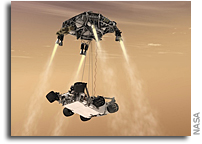
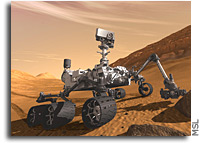
A NASA-created application that brings some of the agency's robotic spacecraft to life in 3-D now is available for free on the iPhone and iPad. Called Spacecraft 3D, the app uses animation to show how spacecraft can maneuver and manipulate their outside components. Presently, the new app features two NASA missions, the Curiosity rover that will touch down on Mars on Aug. 5 at 10:31 p.m. PDT (Aug. 6 at 1:31 a.m. EDT), and the twin GRAIL spacecraft, Ebb and Flow, currently orbiting the moon.


ESA Summer of Code in Space 2012 (SOCIS 2012) is a program run by the European Space Agency. It aims at offering student developers stipends to write code for various space-related open source software projects. Through SOCIS, accepted student applicants are paired with a mentor or mentors from the participating projects, thus gaining exposure to real-world software development scenarios. In turn, the participating projects are able to more easily identify and bring in new developers.

Keith's note: Picture a swarm of these things - sized to function on Mars - powered by the sun.


NASA Space Tech Program Selects Technologies For Development And Demonstration On Suborbital Flights